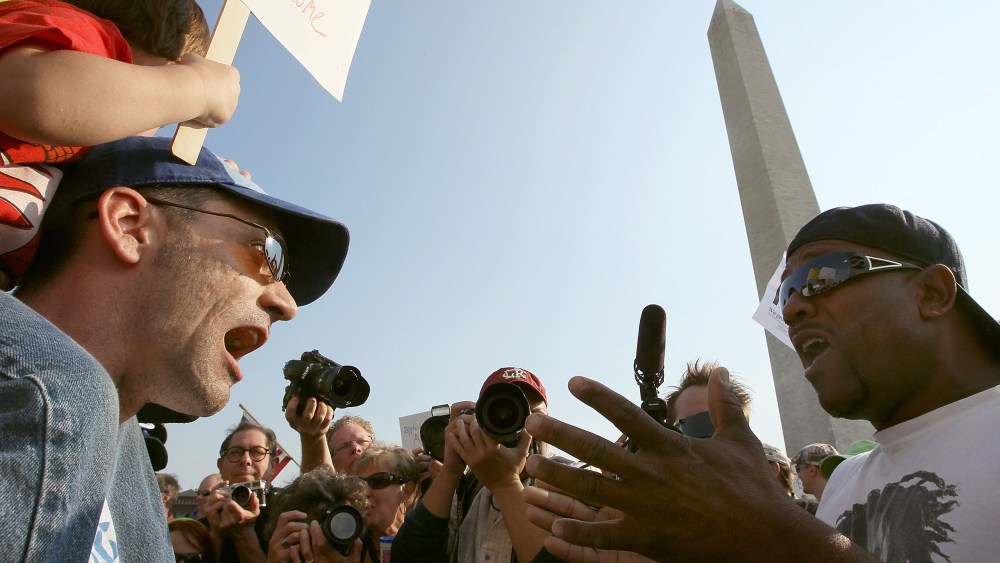
Looking back, it’s clear that American politics started to shift in the early 2000s in ways that are affecting us to this very moment.
From the 2000 presidential election to the 2006 midterm rebuke of the GOP, the seeds of voter discontent were strewn about the political landscape. But then the 2008 financial crisis, which severely damaged public trust in government, banks, and economic elites crystallized in the emergence of two political movements from opposite ends of the spectrum — the Tea Party movement on the right and the Occupy Wall Street movement on the left.
They spoke different languages but shared one core belief: Government was out of control; the system had been captured by powerful elites and the political class had grown too comfortable with its own power. Everyday people no longer mattered.
As chairman of the Republican Party at the time, I realized that their anger would not be easily contained. I recall warning my colleagues, at times unsuccessfully, that the Tea Party was not a passing protest but a force to reckon with.
The Tea Party would transform itself in short order ultimately leading to the rise of Donald Trump and the various characters of the MAGA movement; while Occupy Wall Street failed to take root within the Democratic Party — its influence was more cultural and rhetorical, reshaping debate about inequality — it would, however, become key to the political ascendancy of Sen. Bernie Sanders, Rep. Alexandria Ocasio-Cortez and New York Mayor Zohran Mamdani.
Voters respond less to the fine print of campaign promises than to whether a politician is willing to confront power directly.
In this moment of American politics, voters respond less to the fine print of campaign promises than to whether a politician is willing to confront power directly. Sanders did that by taking on Wall Street. AOC did it by challenging the Democratic establishment itself. Mamdani channeled long-standing frustration with a fatalist approach to city services.
But Trump has taken it the furthest. Devoid of any kind of coherent ideology or political program, he represents nothing but a pure desire to fight, as shown by the first words out of his mouth after narrowly surviving an attempted assassination in Pennsylvania: “Fight! Fight! Fight!”
I wish things were different. I would prefer a political leader who was a serious person, a thinker and a builder whose authority came from quiet competence rather than empty spectacle. But our world does not work that way.
A recent analysis by pollster G. Elliott Morris reveals the core political problem Democrats face. Voters, including swing voters, see Republicans as more extreme. But they also see Democrats as weak and ineffective.
In the age of Trump that perception is politically lethal.

People want to see someone push back. That is why California Gov. Gavin Newsom’s recent shift in tone from conciliatory to aggressively in Trump’s face matter. When Newsom started directly mimicking Trump’s own language on social media, it cut through the noise. Trump reacted because it struck a nerve, but more importantly, voters noticed as well.
Republicans learned this lesson the hard way. When I warned that the Tea Party represented a real force within the party, many in the establishment believed they could contain it and ride the tiger. Later they believed they could similarly restrain Trump.
How do you think that turned out?
Democratic incumbents risk making the same mistake today if they treat the new progressive current as something to manage rather than understand. Pretending otherwise will not make it disappear.
Politics is about power. And in this environment, winning is not just a matter of saying the right things but showing that you’re willing to stand up. The Tea Party understood this. Trump mastered it. Sanders, Mamdani and Ocasio-Cortez grasp it instinctively.
The rest of the Democratic Party now has to decide whether they understand it too, or they will be replaced by people who do.
For more thought-provoking insights from Michael Steele, Alicia Menendez and Symone Sanders Townsend, watch “The Weeknight” every Monday-Friday at 7 p.m. ET on MS NOW.