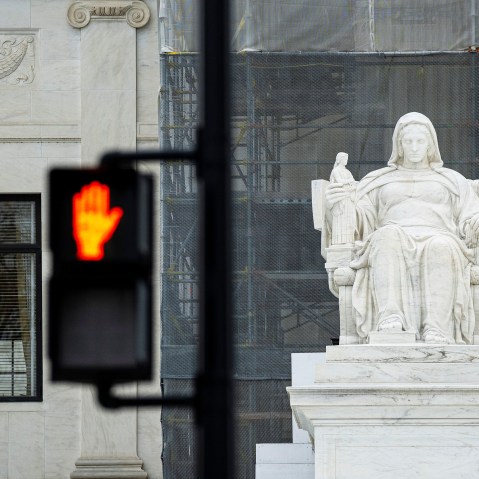
Two illogical things collided at the Supreme Court on Monday: the war on drugs and the court’s Second Amendment jurisprudence.
The latter requires the government to justify modern gun laws by showing that the country had analogous firearm restrictions hundreds of years ago.
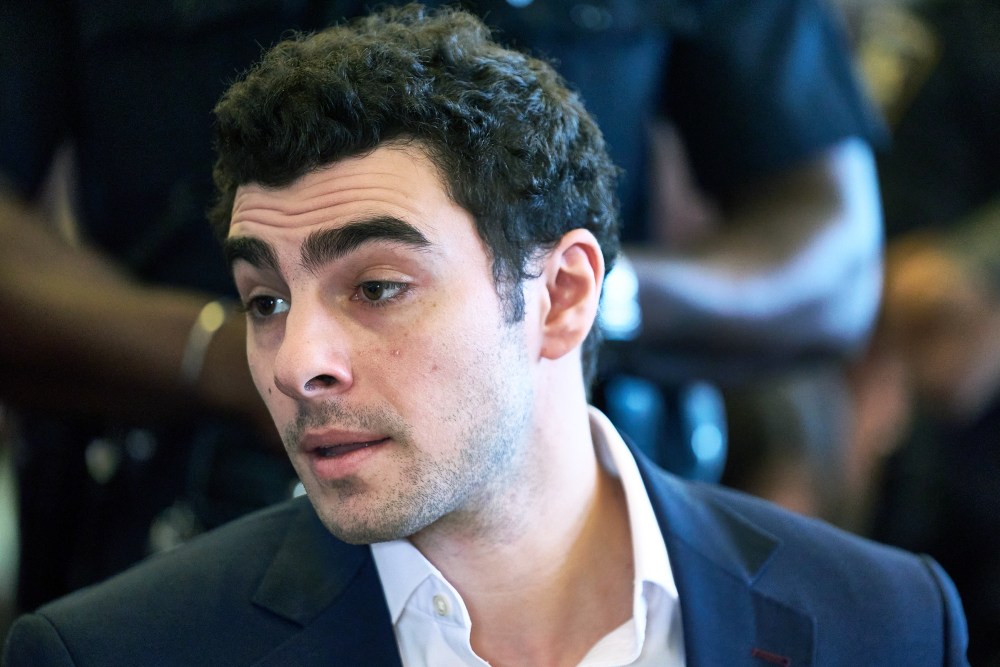
This led to the high court’s latest peculiar tangle with gun rights and historical equivalents, in a case in which the Justice Department wants to disarm a man it called a habitual marijuana user. Attempting to justify the move against Ali Danial Hemani, the DOJ pointed to laws from the time of the country’s founding that restricted the rights of “habitual drunkards.”
Questions from several justices showed the absurdity of both the legal inquiry itself and its application to this case.
One of the more colorful offerings came from Justice Neil Gorsuch. Toward the beginning of Monday’s hearing in United States v. Hemani, the Trump appointee prompted laughter in the courtroom when he said, “The American Temperance Society back in the day said eight shots of whiskey a day only made you an occasional drunkard.” He told Trump DOJ lawyer Sarah Harris, “If you want to invoke the founding era, to be a habitual drunkard, you had to do double that, okay?”
Gorsuch recalled that John Adams “took a tankard of hard cider with his breakfast every day” and that James Madison “reportedly drank a pint of whiskey every day.” He added that Thomas Jefferson “said he wasn’t much a user of alcohol, he only had three or four glasses of wine a night, okay?”
He asked Harris of those founding-era figures, “Are they all habitual drunkards who would be properly disarmed for life under your theory?”
She said no.
But if not, then Gorsuch wanted to know what to do with the modern marijuana user, Hemani. The justice said the record in this case only shows that he used the plant about every other day, and there’s no information about the quantity or potency when he used.
Gorsuch, who came to the high court from Colorado, wondered what the government’s stance would be if the defendant “took one gummy bear with a medical prescription in Colorado” to help him sleep every other day.
“Would that be enough under your theory, one gummy bear every other night with a medical prescription?” he asked.
Harris eventually conceded it would be.
Gorsuch further observed that the Trump administration has supported moving marijuana to a less-restricted drug control schedule, from its current placement on the most-restricted Schedule I to the intermediate Schedule III. He asked Harris, who had suggested that the justices could apply gun restrictions according to how strictly the government classifies drugs, why she wanted the court to consider the issue in Hemani’s case specifically.
“Why is this the test case?” he asked.
Harris said the drug was on Schedule I when the government brought the case and that it’s still on Schedule I, adding, “The government has not made final decisions with respect to what to do with marijuana.” (What she didn’t bring up is something the government stressed in its court papers, where it made several claims about Hemani’s allegedly nefarious connections to Iran, which gun rights advocates called irrelevant character assassination in their own brief to the justices ahead of the hearing.)
Jackson: Falls Apart
Gorsuch joined in the Republican-appointed majority’s recent gun rulings. At Monday’s hearing, he pushed back against the government’s application of the historical test laid out by the court in the 2022 Bruen case — even as he didn’t take issue with the test itself.
Justice Ketanji Brown Jackson, meanwhile, has been a frequent critic of the court’s approach to firearms. The Biden appointee criticized both the Bruen test and how the government sought to satisfy it against Hemani.
She said Harris’ argument “sort of falls apart under the Bruen test,” citing Gorsuch’s examples of historical drinkers.
“So we have to see that the historical legislature, going back to Justice Gorsuch’s point, was making a determination that someone who only drinks or takes an intoxicant once every, you know, other day and is not doing so while he’s using a firearm can be disarmed. And if we don’t see that, then the fact that today’s Congress thinks that that person is dangerous is irrelevant under the Bruen test,” Jackson said.
In response, Harris made what amounted to a telling point about the court’s approach to gun cases. She said Jackson’s logic would require overturning the high court’s 2024 ruling in United States v. Rahimi, a post-Bruen appeal in which the court upheld gun restrictions for people with domestic violence restraining orders. Rahimi was an 8-1 ruling, with only Justice Clarence Thomas (who authored Bruen) dissenting.
“If you thought that only people who were dangerous at the founding could be restricted now, I think you’d have a real problem with the fact that domestic abusers at the founding were only penalized through surety laws,” Harris said.
That is, as with other modern advancements, domestic violence wasn’t recognized as a problem then, so the founding-era laws didn’t reflect that concern. Whether intentionally or not, Harris’ response highlights a problem with the Bruen test, which binds modern society to whatever was deemed sufficient to warrant protection hundreds of years ago. Indeed, Thomas may have been correct in his Rahimi dissent that the majority failed to properly apply Bruen; the consequences of doing so may have been too much for the majority to bear.
Against that backdrop, Monday’s hearing reflected only the latest awkward outing in the court’s Second Amendment adventures — this time with the added mixture of drug-war illogic.
Regardless of what one thinks of the Bruen test, it’s hard to call the government’s application of it straightforward here. If the court is going to apply the test consistently, then Hemani should win this one — and the hearing reflected that he has a decent chance of doing so.
It probably helps him that his case involves marijuana, not a “harder” drug or domestic violence, which makes Gorsuch’s question about why the government pressed this particular case a good one. Of course, the court agreed to take the case, which required at least four justices to vote to do so and the vote tally isn’t public.
However the case got to this point, the justices need to sort out their latest Second Amendment mess. They’re expected to rule by early July, the unofficial deadline by which they typically rule in the cases argued each term.