
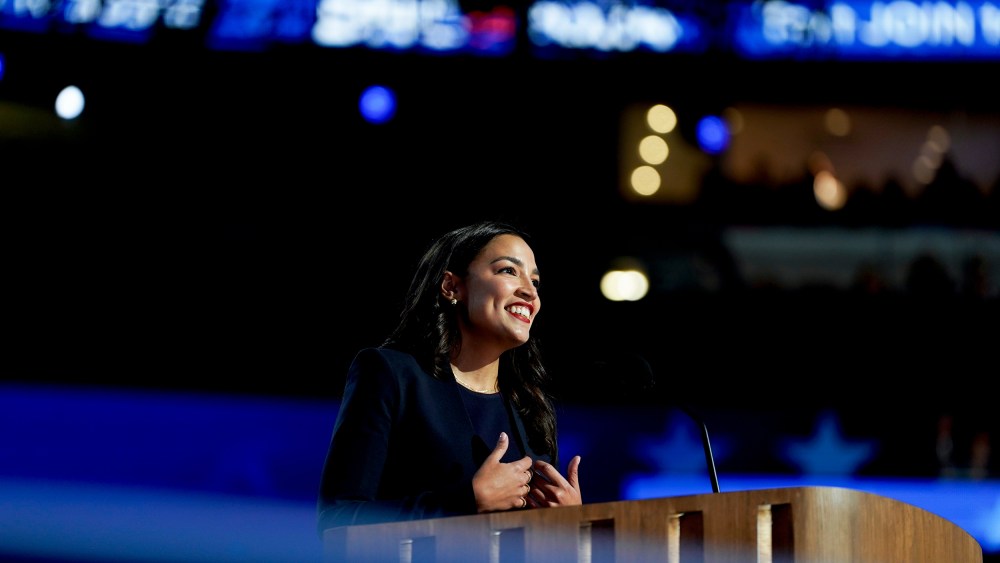
It was a blunt moment — that went straight at the elephant in the room.
Rep. Alexandria Ocasio-Cortez, D-N.Y., was taking part in a panel discussion about populism at the Munich Security Conference when the moderator appeared to give up on pretense and cut to the chase.
“So, when you run for president,” she said, turning to Ocasio-Cortez, “are you going to impose a wealth tax or a billionaire’s tax?”

The Bronx Democrat and progressive star didn’t take the bait. Instead, she said Americans “don’t have to wait for any one president to impose a wealth tax.”
“I think that it needs to be done expeditiously,” she continued.
What went unspoken, of course, was a confirmation or denial that she was or wasn’t weighing a run.
Ocasio-Cortez’s appearance in Munich — where she participated in two panels, and later was part of a forum hosted by Technische Universität Berlin — has set off a fresh round of speculation about her future.
The 36-year-old, who burst onto the national stage in 2018 when she successfully primaried 10-term incumbent Rep. Joe Crowley, is now in her fourth term on Capitol Hill. Some have suggested she may run for Senate in 2028, when longtime Sen. Chuck Schumer, D-N.Y., is next up for reelection.
But her appearance at the annual international gathering in Munich has prompted new questions that she could instead be eying the office at the other end of Pennsylvania Avenue, and using the Munich gathering to help boost her international affairs bonafides.
At the TU Berlin forum, Ocasio-Cortez sought to sidestep the 2028 speculation, saying she came to the conference because she wanted to make sure progressive foreign policy has a voice on the world stage. She repeatedly warned about the rise of authoritarianism, and argued that governments had “strayed too far” from being “responsive to the working class.”
“We cannot yield the rooms where decisions are made,” she said.
As for her own career, she insisted her ambitions were focused on changing the “political environment.”
“When I was first elected, my ambition was to change the Democratic Party and to make it more economically populist and responsive to working class Americans, while also not yielding the civil rights of the most vulnerable people in the country,” she said. “It meant we had to elect scores of elected officials that shared the same values.”

Of course, other potential 2028 Democratic contenders — like California Gov. Gavin Newsom and Sen. Ruben Gallego of Arizona — also made trips to Munich. Michigan Gov. Gretchen Whitmer was also on one of the panels with Ocasio-Cortez.
Former Ocasio-Cortez aide Corbin Trent said he saw her Munich message — and her purpose for being there — as one of reassurance for the world: “Don’t give up on America. We’re not giving up on ourselves.”
He said he’d be “glad” to see his old boss make a White House bid in 2028, telling MS NOW that “Alexandria understands that there might be a need for her to run for president,” though he also warned that his former boss would probably be clear about her intentions if she were actually running.
One of the people who advised Ocasio-Cortez on foreign policy ahead of her Munich trip was Matt Duss, the executive vice president of the Center for International Policy.
When MS NOW asked Duss if he got the sense she was preparing for a larger ambition, he said he was “not gonna touch that.”
Duss said he began briefing Ocasio-Cortez on foreign policy after she accepted the invitation to speak at Munich about two months ago. And he said the message she offered there should not have been unfamiliar to those who have followed her career stateside.
“Here are the values — the principles that you’ve been talking about all along. What does a foreign policy look like that is based on those principles? I think that is what you heard from her,” he said.
Rep. Nydia Velazquez, D-N.Y., who represents a neighboring district to Ocasio-Cortez’s, noted that this is not the first time her colleague has taken steps on the world stage. In 2023, for instance, Ocasio-Cortez and Velazquez traveled with other progressive lawmakers to a handful of Latin American capitals — calling for a “realignment” of U.S. relations.
That’s not to say there’s a shortage of evidence the progressive star could, if she decided to, make waves in 2028.
Early Democratic primary polls show Ocasio-Cortez in the mix. And she continues to be a prolific fundraiser, bringing in more than $20 million throughout 2025.
But she has, thus far, pushed back on the idea that she’s raising her profile with a presidential run in mind.
In an interview with The New York Times this week, Ocasio-Cortez warned that those who are analyzing her every move through a domestic political lens are missing the point.
She went to Munich, Ocasio-Cortez said, “not because I’m running for president, not because I’ve made some kind of decision about a horse race or a candidacy” but instead “to sound the alarm bells that a lot of those folks in nicely pressed suits in that room will not be there much longer if we do not do something about the runaway inequality that is fueling far-right populist movements.”
“To me, my opponents are the network that links [Viktor] Orban, [Donald] Trump, [Javier] Milei, [Jair] Bolsonaro — all of these folks,” she said.

During her remarks at the Munich conference, Ocasio-Cortez positioned “working class-centered politics” as an antidote to “the scourges of authoritarianism.” She also repeatedly took on Trump and, in some instances, her own party’s record on foreign policy.
She warned that “hypocrisy” by western powers that promoted a “rules-based” global order — “whether it is kidnapping a foreign head of state, whether it is threatening our allies to colonize Greenland, whether it is looking the other way in a genocide” — only serves to undermine faith in democracy.
She sought to reassure America’s allies, saying that Democrats intend to be there for them. “We are shocked at the president’s destruction of our relationship with our European allies,” Ocasio-Cortez said.
And, after Secretary of State Marco Rubio — who is also the subject of 2028 presidential speculation — addressed the conference, Ocasio-Cortez likened it to an example of the “ascent of the right” on the global stage, and dismissed his comment as a “pure appeal to Western culture.”
Her remarks, though, also faced intense scrutiny — every little stumble, analyzed. Republicans latched on to two particular moments from her time in Munich, using them to cast her as out of her depth.
Asked during a roundtable discussion whether the U.S. would commit troops if China moved against Taiwan, Ocasio-Cortez filibustered for a moment before saying that’s “a very long-standing policy of the United States.”
“I think what we are hoping for is that we want to make sure that we never get to that point,” she continued. “And we want to make sure that we are moving in all of our economic research and our global positions to avoid any such confrontation and for that question to even arise.”
She also described Venezuela as below the equator — even though it’s entirely located above.
Ocasio-Cortez’s progressive ally on Capitol Hill, Rep. Mark Pocan from Wisconsin, dismissed the geography criticism.
“If we gave a test to most of those folks, they would have f*cked up, as well,” he said.
More importantly, Pocan said, was the fact she was there at all.
“It’s something that progressives never, ever are a part of,” he said of the Munich Security Conference. “If I was a conservative or a neocon or someone from the defense industry, I would have tried everything I can to make sure that I diminished the importance of what she did.”



Become a member to join the discussion