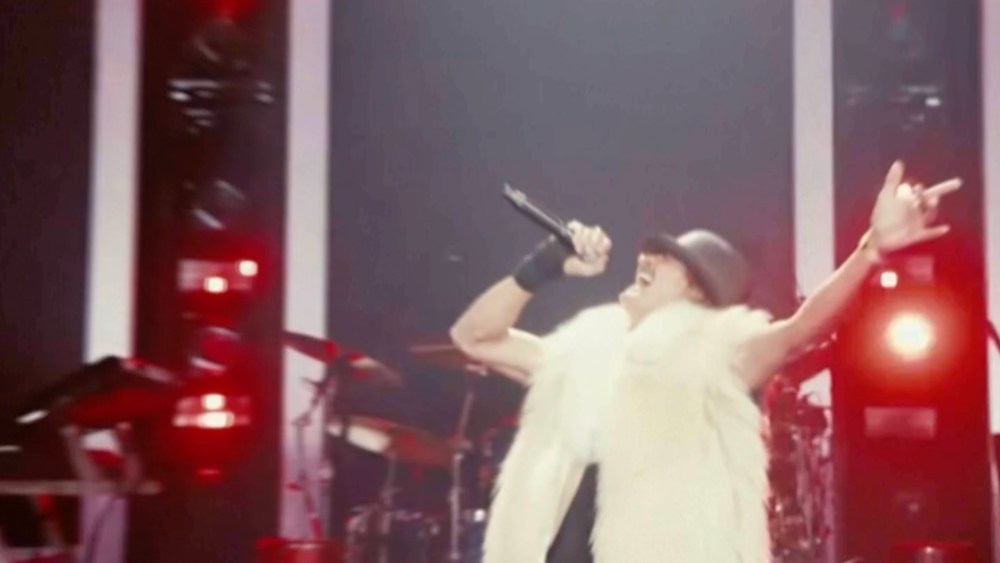
Trinity Broadcasting Network, or TBN, which bills itself as “the world’s largest Christian television network,” was among the select media outlets betting that audiences would leave NBC’s official Super Bowl 60 Halftime Show on Sunday featuring “King of Latin Trap” Bad Bunny and tune in to see rap rocker turned country rocker Kid Rock headline what Turning Point USA is presenting as “America’s Halftime Show.”
TPUSA’s so-called All-American program featured country artists who pledge to celebrate “faith, family, and freedom.” And “America’s Halftime Show” was billed as wholesome counterprogramming to Bad Bunny, whose selection as the Super Bowl’s halftime act has sparked some outrage among right-wing commentators, in part because he’s been an outspoken critic of President Donald Trump, has provocative dance moves, a gender-bending persona and a Spanish-language catalog.
But arguments that TPUSA’s artists are more “American” and more Christian than Bad Bunny disregard that Bad Bunny was born in Puerto Rico and is, thus, an American citizen, and that he was raised Christian and grew up singing in church.
Kid Rock’s 1997 song that appears to celebrate statutory rape and his public comments endorsing the legalization of heroin and cocaine are among the things make him a counterintuitive choice for TPUSA’s aims.
At the same time, Kid Rock’s 1997 song that appears to celebrate statutory rape — “I like ’em underage, see / Some say that’s statutory, but I say it’s mandatory” — and his public comments endorsing the legalization of heroin and cocaine are among the things that make him a counterintuitive choice for TPUSA’s aims and an equally tough choice for a Christian television station that aims to be “a global messenger of God’s love.” But those familiar with TBN and its history shouldn’t see it as a surprise.
Founded in 1973 by Assemblies of God televangelists, the television station serves a global Pentecostal and charismatic audience with a taste for the glitz and glam of celebrity culture — and a high tolerance for scandalous figures. TBN has built its brand on the kind of dramatic testimony that Pentecostals and charismatics have long cherished: conversion stories in which unlikely heroes encounter God and are transformed. Rockers with transgressive histories are ideal candidates for televised Pentecostal storytelling, and Kid Rock will not be the first bad boy of rock to appear on the network’s airwaves.
Shock rocker Alice Cooper, famous for guillotines and gothic spectacle, has spoken on TBN about his own spiritual journey, crediting his Christian faith with helping him overcome addiction and rebuild his life. In that spirit, broadcasting Kid Rock — who describes himself as a Christian convert and credits his “longtime friend” prosperity preacher Paula White-Cain, as a spiritual influence — aligns with the TBN brand.
In the 1970s, charismatic, scandal-prone celebrity preachers on TBN such as Jim and Tammy Faye Bakker were largely seen as fringe figures in American public life, but — thanks in no small part to Kid Rock’s spiritual mentor Paula-White Cain — they are now in prominent positions of influence in the Trump administration.
Paula White-Cain has long served as a personal pastor and spiritual adviser to Donald Trump, and now holds a formal role as leader of the White House Faith Office. Under her influence, the Trump administration strategically courted high-profile figures within Pentecostal and charismatic media, especially high-profile musicians. In 2020, for example, worship leaders Kari Jobe and Cody Carnes, co-writers of the global megahit “The Blessing,” were among a cadre of celebrity worship leaders to visit Washington, D.C., and prayed for the president and expressed awe at what Jobe described as God’s work unfolding in the White House.
TPUSA has also recognized the power of music when it comes to shaping political ideologies, and the funeral of Charlie Kirk drew an array of prominent Christian musicians; among those participating were Jobe and Carnes, as well as superstars Chris Tomlin and Brandon Lake.
Kid Rock’s appearance on TBN represents a fusion of Pentecostal and charismatic spirituality, celebrity culture and political activism.
In a way, Kid Rock’s appearance on TBN represents a fusion of Pentecostal and charismatic spirituality, celebrity culture and political activism. And while it may seem unlikely that TPUSA viewership will top a performance from a global superstar like Bad Bunny, it’s worth noting that distribution through TBN gives TPUSA access to a global charismatic and Pentecostal audience.
Ascendant worldwide, charismatics and Pentecostals represent the future of Christian conservative Christian activism in the United States. In fact, recent research that my colleagues and I conducted, which was funded by the Public Religion Research Institute (PRRI), indicates that charismatic and Pentecostal forms of Christianity are expanding quickly among self-identified “born-again” or evangelical Christians. These charismatic and Pentecostal Christians are younger, more diverse and conservative on key social issues.
In that light, TBN is not an incongruous platform for “America’s Halftime Show,” but an entirely fitting one. For a movement in which musicians, prophets and political actors share media platforms with ease, and in which scandal can be reframed as redemption, Kid Rock is less an odd booking than a recognizable character in a familiar story. If anything, TBN’s involvement underscores how thoroughly charismatic media has become a conduit for contemporary conservative activism.