To protect their properties from an ever-encroaching Atlantic Ocean, about 150 homeowners in Salisbury Beach, Massachusetts, funded a $600,000 sand dune project whose construction was completed last Thursday, March 7. Three days later, though, a storm washed away half of their 15,000 tons of sand.
Ad hoc efforts to mitigate the effects of climate change are poor substitutes for a more global approach.
That instantaneous erosion is a costly illustration that ad hoc efforts to mitigate the effects of climate change are poor substitutes for a more global approach. No matter how wealthy the individuals, no matter how wealthy the neighborhoods, they can’t by themselves effectively hold back a rising sea. Or chip in to create a dry spot for themselves.
“No man is an island,” English poet John Donne famously wrote. That’s especially true during this season of accelerated climate change. “If a clod be washed away by the sea” near your home, then chances diminish that I’ll be able to save all the clods near mine.
If any of that sounds like a criticism of the beachfront property owners, that’s not the intent. Having spent most of my life in Louisiana — which lost more than 2,000 square miles of land from 1932 to 2016 and could lose 75% of its wetlands within the next 50 years — I sympathize with the Massachusetts property owners. How many times have I seen homeowners hastily filling bags of sand to place around their doorways before an expected heavy rain event? Hanging over such preparations is the fear that it will never be enough.
The Salisbury Beach homeowners aren’t wrong for taking matters into their own hands. But their hands — our hands — are never going to be big enough to counteract the problem that confronts us. We can extrapolate even further, though. Slowing the rate of climate change and mitigating against its effects isn’t even something that individual states or countries can effectively tackle alone. At the same time, sitting back and doing nothing isn’t an option.
The National Weather Service didn’t record the conditions at Salisbury Beach on March 10, but a spokesperson for the service told The Boston Globe that those conditions would have been “very similar” to what happened at a nearby beach where strong winds at high tide pushed ashore storm surges of two and a half feet and where water levels reached 12.34 feet.
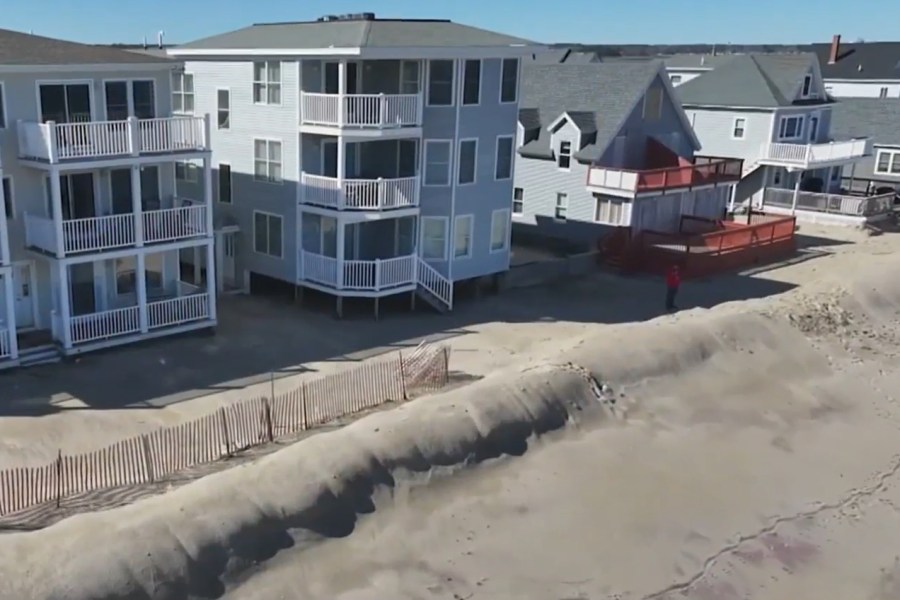
Tom Saab, the president of Salisbury Beach Citizens for Change, the group that oversaw the construction of the dune, told The Boston Globe that “Sunday, March 10 was a nightmare” because “$300,000 of people’s hard-earned personal funds washed into the Atlantic.”
Similar nightmares preceded that one. Sunday’s storm was the fourth significant flooding event since December for the Maine-Massachusetts-New Hampshire tri-state region. Included in that were back-to-back storms on Jan. 7 and Jan. 10, during which Salisbury Beach homeowners, Saab said, lost “decks, patios, and stairways,” prompting homeowners to take action. They quickly built a dune to replicate a previous barrier. And then the ocean quickly washed it away.
It was “the worst I’ve seen in over 50 years of living here at the beach,” Ron Guilmette told Boston’s WCVB-TV. “The right word is catastrophic.”
They quickly built a dune to replicate a previous barrier. And then the ocean quickly washed it away.
That’s the right word for the effect the changing climate is having in so many places. Long ago, Guilmette told the television station, the ocean claimed a tennis court on his beachfront property. On the other hand, the Gulf of Mexico, over a 25-year span, claimed an average of a football-field amount of land from Louisiana every hour.
But more often than not, our efforts to address these changes are as piecemeal and ineffective as that short-lived dune. And, far too often, politicians and government officials lack the urgency to address the problem.
We haven’t heard nearly as much about climate policy so far in this presidential election cycle as we heard in the last one, and the policies that Biden has put forward to address rising temperatures and rising seas have been fought tooth and nail by Republicans doing the bidding of corporations and Big Oil.
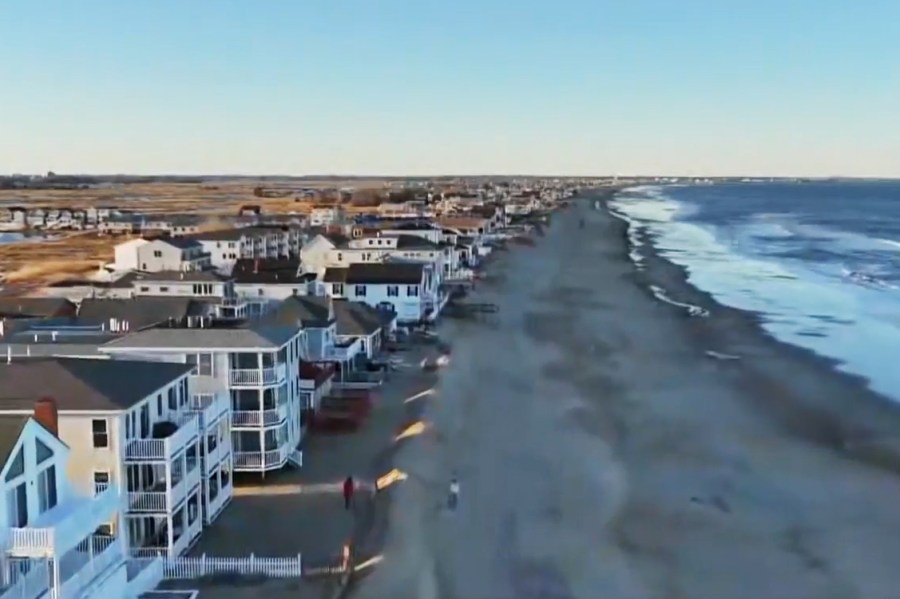
After a 2022 nor’easter, Saab said beach property owners unsuccessfully “begged” their state government for help. “We pulled off a minor miracle,” he said of the dune they built. “It should have been a huge undertaking by the state or federal government, but it was a little not-for-profit organization.”
When speaking to The Boston Globe, Massachusetts State Rep. Bruce E. Tarr, a Republican, gave the property owners credit for their quick work, but then said rather unhelpfully, “If the state had paid for the project, it would have been equally sacrificial.”
Flood mitigation is a government’s task, and it should be a government expenditure.
That’s not true. Spreading $600,000 over 150 homeowners averages out to $4,000 per household. Spreading the same amount over 5.66 million Massachusetts adults comes to 11 cents. That said, flood mitigation is a government’s task, and it should be a government expenditure. It’s not something individual neighborhoods should be funding themselves.
Given the relative wealth of the people at Salisbury Beach and their failure to build a dune that lasted, there may be some folks harboring a feeling of schadenfreude. Please don’t. That climate change bell we hear tolling? It tolls for all of us.