
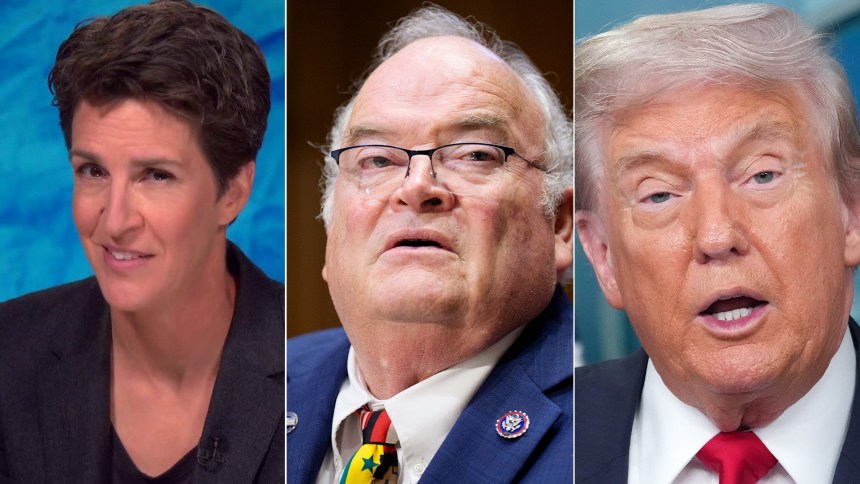
When Booz Allen Hamilton, one of the nation’s leading tax and consulting firms, joined the many corporate giants donating to Donald Trump’s White House ballroom vanity project, it might have hoped the contribution would generate some goodwill in the Oval Office.
The firm quickly learned otherwise. Earlier this week, the Trump administration announced that it was cutting Booz Allen’s Treasury Department contracts, and as the Associated Press reported, the motivation was predictably petty: “In 2024, former IRS contractor Charles Edward Littlejohn of Washington, D.C. — who worked for Booz Allen — was sentenced to five years in prison after pleading guilty to leaking tax information about Trump and others to news outlets.”
The AP’s report added that the move, which scrapped contracts worth $21 million, was “in line with Trump administration efforts to exact retribution on perceived enemies of the president and his allies.”
Three days later, Trump took an additional step down the same retributive path. The Republican isn’t just punishing Booz Allen for the actions of one its former employees, he’s also suing the IRS itself for the same reason. The New York Times reported:
President Trump sued the Internal Revenue Service on Thursday for the unauthorized leak of his tax returns during his first term, demanding that the government agency pay him at least $10 billion.
Mr. Trump, as well as his two eldest sons and his family business, charged in the lawsuit that the I.R.S. and the Treasury Department had failed to prevent a former I.R.S. contractor, Charles Littlejohn, from gaining access to Mr. Trump’s tax documents, which were shared with The New York Times.
Unlike some of the president’s other weird lawsuits, this one at least has some basis in reality. A former IRS contractor really did break the law by leaking tax information that Trump wanted to keep secret from the public. It’s why Littlejohn is in prison.
But that doesn’t mean the new civil suit is sensible. On the contrary, the circumstances are absurd: Trump wants $10 billion from the federal government that he currently leads.
What’s more, he’s filing the case in his personal capacity, which sets the stage for a legal fight in which Trump’s private attorneys will go up against Trump administration attorneys, some of whom also used to work for Trump as his personal attorneys.
But hanging overhead is a related question about whether the president intends to approve a payment to himself — or, more to the point, another potential payment to himself.
In October, Trump demanded that the Justice Department he leads pay him roughly $230 million in compensation for the federal criminal investigations he faced after losing his 2020 re-election bid. He noted that it would ultimately be up to him to approve a payout to himself. “I’m the one who has to settle it,” the president told a group of supporters in North Carolina shortly before Christmas. “In other words, I am suing, and I’m the one that’s supposed to settle it.”
During the same comments, Trump debated with himself about whether he’d keep the money or donate it to charity, before concluding that it’s “a strange position to be in” because he felt the need to “negotiate with” himself.
Now, a month later, the president apparently has decided that $230 million from the Justice Department won’t be enough, and he also wants $10 billion from the IRS. Whether Trump intends to oversee another settlement with himself is not yet clear. Watch this space.






Become a member to join the discussion