
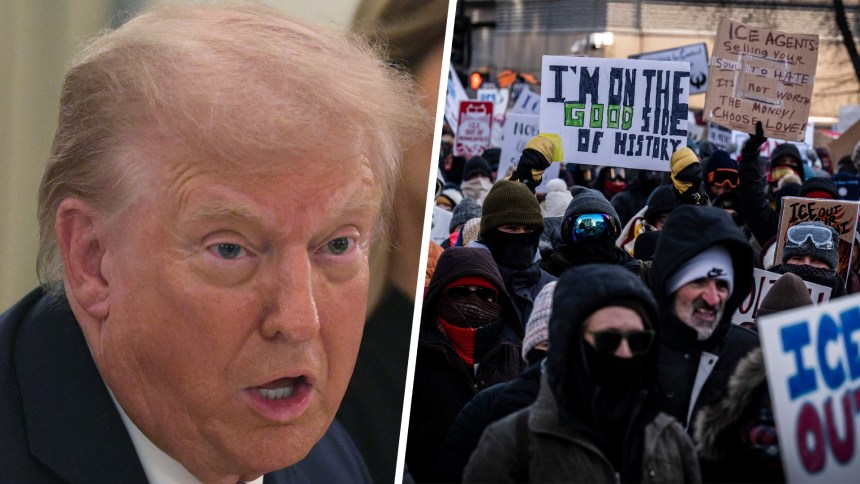
As a rule, the White House is indifferent to Democratic criticism, and when there’s a sliver of dissent from within the Republican Party’s ranks, Donald Trump employs a familiar tactic: He calls them names and threatens their electoral futures.
But after federal agents shot and killed intensive care nurse Alex Pretti on a Minneapolis street in broad daylight — violence that was well documented by several cameras — Team Trump has confronted a dynamic it hasn’t seen since the Capitol riot of Jan. 6, 2021. It’s one in which the sheer volume of GOP critics is so significant that tiresome tweets about “RINOs” aren’t a credible response to an intensifying political problem. My MS NOW colleague Mychael Schnell summarized:
The deadly shooting of 37-year-old intensive care nurse Alex Pretti in Minneapolis — the second immigration officer-involved fatality in the Twin Cities this month — is prompting unusually sharp pushback from many Republicans on Capitol Hill.
It’s not just President Donald Trump’s usual GOP skeptics, either.
The point about the “usual GOP skeptics” is an important one. When news consumers see headlines about the president facing intraparty pushback, they tend to assume (with good reason) that the list will include some combination of four Senate Republicans — Susan Collins of Maine, Lisa Murkowski of Alaska, Rand Paul of Kentucky and maybe Thom Tillis of North Carolina — and Republican Rep. Thomas Massie of Kentucky.
But after the latest shooting death of an American civilian at the hands of federal agents and the subsequent fusillade of absurd lies from administrations officials, the number of Republicans expressing varying degrees of discomfort with the official party line has reached unusually high levels.
Indeed, at last count, at least 10 GOP senators have demanded a real investigation into the Pretti shooting. What’s more, Paul, who chairs the Senate Homeland Security and Governmental Affairs Committee, called on three top immigration enforcement officials — Rodney Scott, the commissioner of Customs and Border Protection; Joseph Edlow, director of U.S. Citizenship and Immigration Services; and Todd Lyons, who is serving as acting director of ICE — to testify before his panel.
Even Republican Sen. Ted Cruz of Texas used his podcast to argue that the administration is undermining what remains of its credibility.
On the other side of Capitol Hill, a variety of GOP members have similarly expressed their own dissatisfaction.
The problem has even extended to Republican governors, including Texas Gov. Greg Abbott, who conceded that White House officials “need to recalibrate” when it comes to immigration enforcement.
To the extent that Trump and his team have found themselves on their heels since Saturday, it’s because too many of their partisan brethren have left them without a choice.
Part of this is the inevitable result of indefensible circumstances, coupled with a burgeoning public backlash. But let’s not forget that this is an election year. Republicans were already likely to struggle, and the president’s deteriorating public standing has given GOP officials added incentive to distance themselves from him, his controversies and his administration’s many failures.
Trump’s partisan grip, in other words, appears to be slipping, which is a position he’s largely unfamiliar with — and one he doesn’t know how to respond to. Watch this space.



Become a member to join the discussion