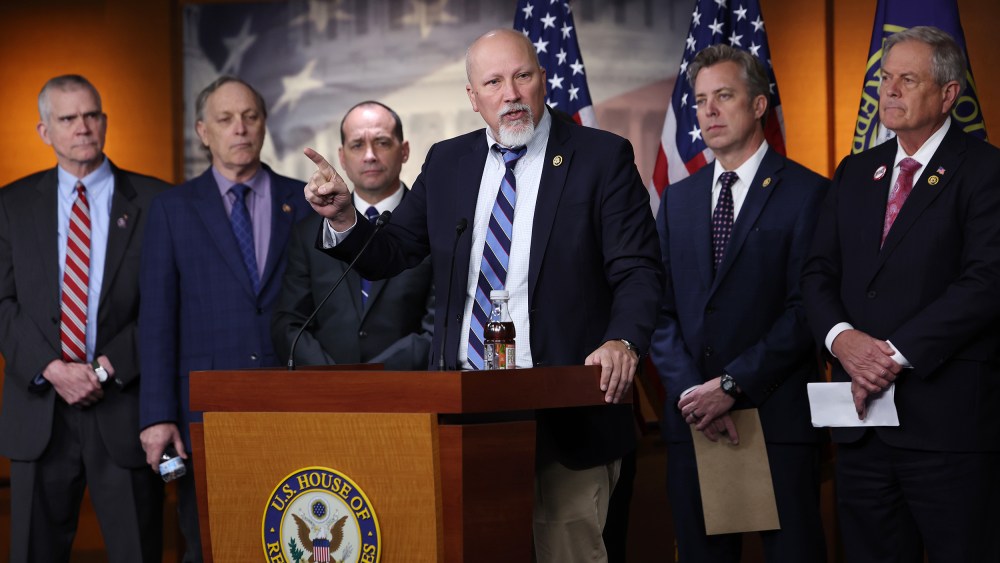
The partial government shutdown that began late last week was expected to be brief, and those expectations proved true: The Republican-led Senate approved a compromise package Friday night, and the Republican-led House followed suit Monday afternoon.
The spending package fully funds several federal departments and agencies through the end of the fiscal year — except for the Department of Homeland Security. At Democrats’ insistence, federal resources for DHS were only approved for a two-week period, during which time the parties are supposed to negotiate some much-needed reforms to immigration enforcement policies.
We’ll see soon enough whether those bipartisan talks prove constructive (I’d recommend keeping expectations low), but in the meantime, I’m reminded of a report published in the conservative Washington Times just one week ago:
House Freedom Caucus leaders said they will take any necessary steps to make sure that funding for ICE stays within the Department of Homeland Security portion of the government funding package.
The conservative caucus sent a letter to President Trump Tuesday urging him to ‘ensure the Department of Homeland Security is fully funded along with all remaining appropriations bills — and not allow Democrats to strip its funding out to pass other appropriations separately.’
At the time, the position from Senate Democratic leaders was straightforward: The party wouldn’t accept a solution that fully funded all of the agencies, including DHS, for the rest of the fiscal year. The only realistic solution, Senate Democratic leaders said, was to separate Homeland Security from the package and allow for a fresh round of debate over possible reforms.
House Freedom Caucus members said this was simply unacceptable. “We cannot support giving Democrats the ability to control the funding of our Department of Homeland Security,” their letter to the White House said.
A week later, the final bill, which enjoyed Donald Trump’s support, reached the House floor. Just seven days after members of the House Freedom Caucus said they couldn’t accept such an outcome, literally none of them opposed the bill.
As striking as it was to see the Freedom Caucus fall in line, just as important was the familiarity of the circumstances.
- In January 2025, House Freedom Caucus members said they were prepared to derail Mike Johnson’s bid for a second term with the gavel, and then they caved.
- In March 2025, House Freedom Caucus members said they were opposed to a stopgap spending measure needed to prevent a shutdown, and then they caved.
- In April 2025, House Freedom Caucus members slammed their party’s budget resolution, and then caved.
- In May 2025, House Freedom Caucus members railed against their party’s reconciliation package, and then they caved.
- In July 2025, House Freedom Caucus members said they were prepared to derail their party’s inaptly named “One Big Beautiful Bill Act,” and then they caved.
In February 2026, it has happened again.
The Washington Post published an analysis last year that remains relevant:
Each threat from leaders of the House Freedom Caucus ended with the same result: capitulation. After caving on each round of threats, these far-right conservatives vowed that the next time would be different — if their demands were not met precisely as they sought. This collection of several dozen Republicans, after a decade of rabble-rousing that helped push aside three other speakers, has yet to fully buck Johnson … on any major initiative this year.
That was published 10 months ago. It’s still accurate.
In recent years, the Freedom Caucus managed to earn a reputation as unrelenting hardliners who rejected compromise, who were indifferent to party leaders and who had no qualms about derailing GOP proposals they deemed insufficiently conservative. They quickly became a painful thorn in the side of several Republican House speakers.
As an NBC News report explained last spring, “They didn’t fear government shutdowns; they welcomed them. Their signature move was to collectively withhold votes unless House GOP leaders met their demands. Before this year, most members of the conservative crew had never supported a stopgap spending bill or debt ceiling increase in their entire House careers.”
But in 2025 and 2026, the uncontrollable pit bulls have become obedient lapdogs.
It’s at least possible that Freedom Caucus members will someday find a bill that causes them to take a principled stand, but for now, we’re dealing with an unmistakable legislative dynamic in which the far-right faction talks a good game, right up until the president tells them what to do — at which point, the lapdogs roll over.
This post updates our related earlier coverage.








Become a member to join the discussion