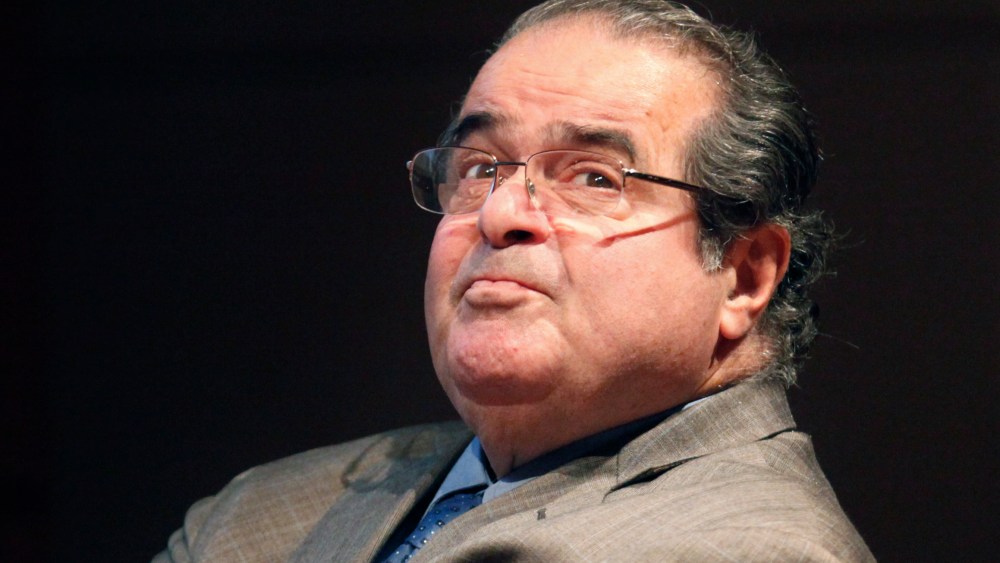
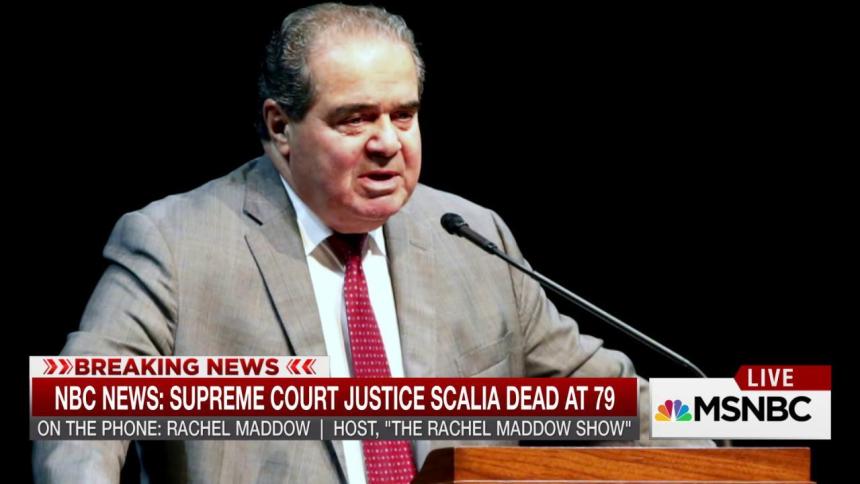
Supreme Court Justice Antonin Scalia, the bench’s ideological conservative known for his fiery comments in and out of the courtroom, has died, Texas’ governor said Saturday. He was 79. […]A cause of death was not immediately confirmed by NBC News. Chief Justice Roberts said that he and his fellow justices were saddened to learn of his death.“He was an extraordinary individual and jurist, admired and treasured by his colleagues. His passing is a great loss to the Court and the country he loyally served,” Roberts said in a statement.
Scalia’s passing creates the first high court vacancy since 2010. He is the first sitting justice to die since then-Chief Justice William Rehnquist’s death in 2005.
Scalia, a larger-than-life personality with a controversial record on the court, leaves behind his wife, Maureen, and their nine children.
His death, of course, creates conditions that are likely to rock the political world for much of 2016. The current Supreme Court has earned a reputation for being friendly to the right, thanks largely to a five-member conservative majority, with justices who were appointed by Republican presidents.
Scalia’s passing obviously changes that equation, offering President Obama an opportunity to not only replace one of the court’s most reliable far-right jurists with a center-left successor, but also to shift the balance of ideological power on the Supreme Court and quite possibly change the direction of American jurisprudence for many years to come.
Obama has already placed two progressive justices on the Court — Sonia Sotomayor and Elena Kagan — but in both of these cases, this president’s nominees were replacing justices who were already considered members of the center-left contingent, leaving the larger balance of the institution unchanged.
Replacing Scalia, however, is a different story entirely.
What’s unclear is what the Republican-led Senate intends to do under these circumstances. Though Scalia’s death comes as a surprise — he was not thought to be ill — it seems likely the White House will nominate a successor sometime fairly soon.
What happens next is poised to quickly become the most important mystery in the country. How will the Senate’s GOP majority respond to such a nomination? Could anyone, regardless of merit, be confirmed by Republicans given the enormity of the stakes? Is the Senate prepared to simply leave an eight-member Supreme Court in place — four conservatives and four progressives — for the next 11 months, in the hopes that a far-right presidential candidate will take office next January?
At this point, we don’t have answers to any of these questions.
What we do know is that the future of the Supreme Court has suddenly gone from the political world’s background to its center stage. Any time there’s a vacancy on the high court, it’s an enormous and significant story, but this one, in particular, creates a political dynamic unlike anything Americans have seen in a very long time — and quite possibly, ever.






Become a member to join the discussion