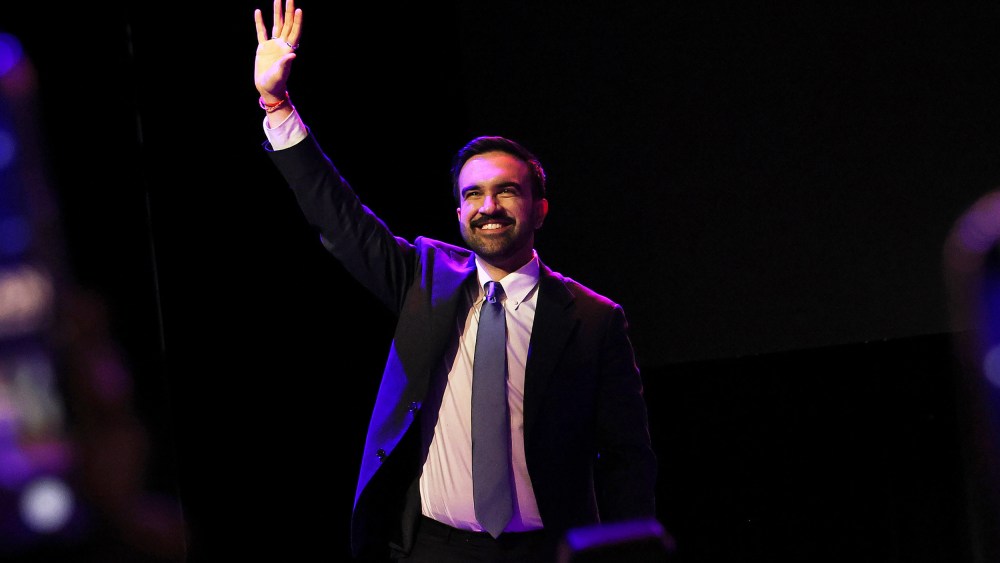
Zohran Mamdani is set to be sworn in as mayor of New York at a traditional midnight ceremony on New Year’s Eve. With just hours until he takes office, there are still no signs that his democratic socialist agenda has sparked the mass exodus of rich New Yorkers his critics warned of throughout his campaign.
As Bloomberg reported earlier in the month, sales of luxury homes in Manhattan increased in November. According to appraiser Miller Samuel Inc. and brokerage Douglas Elliman, buyers signed contracts on 176 homes in the borough priced at $4 million or more in November, which was 25% more than the previous month. Bloomberg also notes that, according to Olshan Realty’s luxury market, more than 20 people bought homes in Manhattan in the immediate days after Mamdani’s election.
For many of the ultrarich, leaving the city would be an act of economic and social self-sabotage.
“There is no Mamdani effect,” Donna Olshan, president and founder of Olshan Realty, told Bloomberg. “The idea that people would flee New York was overblown. The numbers just aren’t bearing that out.”
CNBC reported in November, after Mamdani’s election, that Scott Rechler, CEO of real estate company RXR, said at a conference, “We’re seeing a record level of leasing in office buildings. And it’s not just for next year, it’s for 2028, 2030, 2032.” Bill Rudin, co-executive chairman of Rudin Management, another real estate company, said at that conference, “We haven’t seen any diminishment in meetings with brokerage firms.”
In what was a mixture of prediction and threat, conservative and centrist opponents of Mamdani claimed that his campaign promise to incrementally hike taxes on people making more than $1 million a year to fund new social services would drive them out of the city in droves and blow a hole in the city’s economy. But on the eve of Mamdani’s swearing-in, there is no data that suggests any such trend is emerging.
That’s not to say that some rich people won’t leave the city and cite Mamdani’s higher taxes as a reason. But experts who study migration rates of ultrarich people say that it’s likely to be a very small number at most. “Millionaires have low migration rates,” Cristobal Young, a professor of sociology at Cornell University, wrote in The Conversation in December. “Mobility in America is highest among people who are still searching for their economic place in life.”

“When millionaires do move, it rarely appears to be for tax reasons,” he added. “For example, Florida is the top destination for New York movers in general. But among the richest 1% of New Yorkers, the top destination is Connecticut, followed by New Jersey and California, all three of which levy a millionaire tax.”
In a survey of what the academic data says about migration of the rich, Martin Bernstein, a PhD student in economics at Harvard University, wrote in Jacobin that data from marginal tax increases in different states suggests that a fraction of 1% of millionaires could leave the city due to higher rates. But he additionally surmised that tax hikes in New York City may result in even less millionaire flight than in other places due to its unusual status in the country.
Indeed, it’s hard to imagine that an incremental tax increase — that would have a small effect on the budget of millionaires — would cause them to uproot themselves from a city with unique offerings for their elite lifestyles, from schools to clubs to fine dining to rarefied social circles to business connections. For many of the ultrarich, leaving the city would be an act of economic and social self-sabotage. That so many seem to be sticking around as the socialist enters office suggests they know that.