
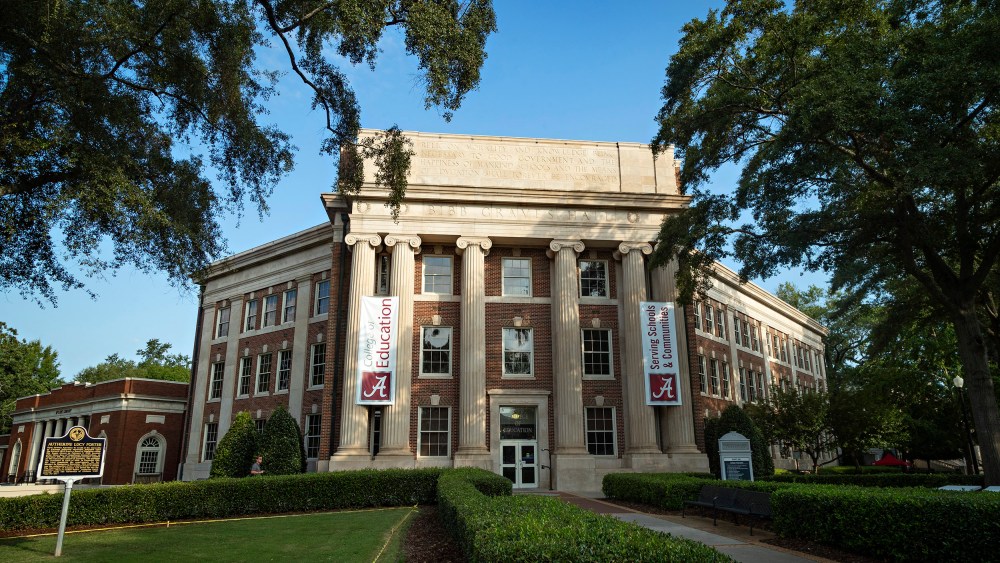
As the web editor of “Alice,” a fashion and lifestyle magazine at The University of Alabama, I can say that our editorial team strives to ensure that our publication is as inclusive as possible. This month, however, the University of Alabama suspended our magazine and claimed that our mission is not inclusive enough.
“Alice” was not the only publication wrongly gutted by the university administration. It also suspended “Nineteen Fifty-Six,” a magazine — named for the year that the first Black student, Autherine Lucy, integrated our campus — that focuses on Black culture and Black student experiences. According to the university, our two publications, intended to uplift the voices of marginalized students, do not comply with the policies set forth by the federal administration.
The University of Alabama suspended our magazine and claimed that our mission is not inclusive enough.
In suspending our magazines, the university cited a July 29 memo from Attorney General Pam Bondi concerning “guidance for recipients of federal funding regarding unlawful discrimination.” In that memo, the attorney general writes: “Facially neutral criteria (e.g., ‘cultural competence,’ ‘lived experience,’ geographic targeting) that function as proxies for protected characteristics violate federal law if designed or applied with the intention of advantaging or disadvantaging individuals based on protected characteristics.”
But the goal of “Alice” and “Nineteen Fifty-Six” is the exact opposite. It has never been the intention of anybody on either of our staffs to advantage or disadvantage certain individuals. In fact, the mission statement of Alice proves that: “Though we do focus on college women, our belief in inclusivity extends far beyond the content we produce. We want everyone and anyone to feel like they can pick up our magazine and enjoy.”
Additionally, neither publication has excluded anybody from joining its team based on their identity. Students who aren’t Black have served on the staff of “Nineteen Fifty-Six.” At “Alice,” we’ve had staff members of a variety of genders. Each of our publications has crafted diverse, welcoming environments for everybody.
As Sarah Mitchell, our magazine’s creative director, said in response to the suspension, “Alice, to me, is freedom. We don’t write just for women. Our magazine just makes sure that women have a seat at the table, and it was created to make sure of that. Discrimination is not what we were founded on, and if that isn’t freedom, I don’t know what is. ‘Alice’ is for everyone that wants to listen to what we have to say. It’s sad to see that all the hard work we have done to make sure women have a place in journalism at the University of Alabama has been disregarded so quickly.”
It’s sad to see that all the hard work we have done to make sure women have a place in journalism at the University of Alabama has been disregarded so quickly.
Sarah Mitchell, creative director of Alice magazine
We strongly object to the rationale provided for suspending our publications. I would also point out that an attorney general’s memorandum is not law; it is merely an interpretation of the law that can serve as guidance. While our university claims “students’ First Amendment rights remain fully intact,” suspending our two publications simply for existing says otherwise. The university’s suspension of our magazines is not merely a case of censorship, it is also the censorship of marginalized voices.
“The students who have cultivated this magazine over its five-year lifespan have poured their hearts and souls into their work. Regardless of our suspension, there will continue to be a need on campus for the stories of the university’s Black community to be told,” wrote Kendal Wright, editor-in-chief of “Nineteen-Fifty-Six,” in a statement posted to Instagram after her magazine was suspended. “The mission of the magazine was to educate students from all backgrounds on culturally important issues and topics in an effort to produce socially conscious, ethical and well-rounded citizens.”
The suspension of “Alice” and “Nineteen Fifty-Six” is part of a larger agenda from the university. Resources for marginalized students have been closed, renamed and repurposed, often with little notice. The university forced the Women and Gender Resource Center to rename itself this year to comply, it said, with anti-discrimination laws. During the Thanksgiving break, the university removed the Frances S. Summersell Library from the Camellia Center. That library was home to literature detailing Southern experiences, specifically those of Black and queer southerners.
Prior to that, the university gutted the LGBTQ+ Safe Zone, a program that provided a space for queer students, and, in response to Alabama Senate Bill 129, repurposed the office space that had belonged to the Black Student Union.
The staffs of both publications and the UA community denounce this suspension, as evident by the 80 student media alumni who signed a letter to the editor in the Crimson White, our school’s student-led news source, condemning the university’s actions. That anger is also evident in the nearly 3000 names on an online petition demanding the reinstatement of both publications that was delivered to President Peter J. Mohler and the university’s president of student life.
We are witnessing a backward slide in the rights of marginalized people here at Alabama. These erasures hurt all UA students and set a precedent that our voices are not the priority.
Although we were not expecting this decision by the university, the suspension of these magazines was not surprising, given the current political climate. This country’s current administration thrives on stripping resources that marginalized people use to amplify their voices, and censoring our magazines is one of the latest examples of a strategy found in the toolbox of fascists.




Become a member to join the discussion