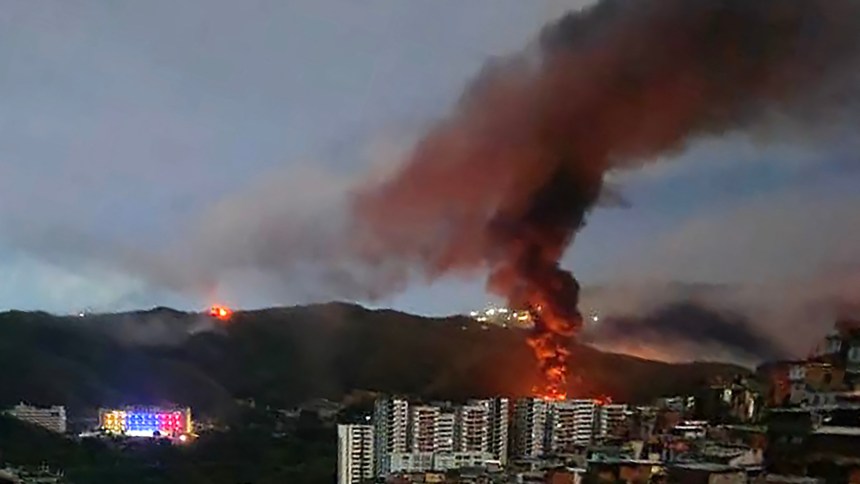
The United States has pulled off a shocking tactical success in Venezuela: capturing President Nicolás Maduro and first lady Cilia Flores with a “large scale strike” in Caracas in the dark hours of Saturday morning. Maduro, who is to be arraigned in New York, is a narcotics trafficker who has overseen the economic and political destruction of Venezuela, invited in foreign terrorist organizations and cozied up to strategic competitors of the United States. His brutal regime led to the migration of millions of Venezuelans; an estimated 25% of the population has fled Maduro’s dictatorship since 2017 and massive protests led to the opposition boycotting the 2018 presidential election. Clearly, Venezuela and the region will be better off without Maduro in power.
But a tactical victory by U.S. special forces does not necessarily portend strategic success.

One immediate concern is who holds power in Caracas and the stabilization of the country. Critically, some nefarious figures remain in office, including Diosdado Cabello Rondón, the minister of interior, justice and peace; and Vladimir Padrino Lopez, the minister of defense. Their continued presence in Venezuela means that rather than cutting off the head of the snake, the Trump administration has merely taken out one head of a hydra.
Diosdado Cabello is responsible for the internal security services as well as running the semi-official motorcycle gangs known as the colectivos. While there were reports early Saturday of Maduro supporters rallying in Caracas, Washington should not expect Venezuelans to pour into the streets, cheering Maduro’s capture. Given Cabello’s propensity for violence — including the detention and kidnapping of American citizens — ordinary Venezuelans are likely to be concerned that Cabello may unleash his armed thugs against those who dare celebrate Maduro’s removal.
Vladimir Padrino Lopez, for his part, has run Venezuela’s military longer than anyone else in modern history. While the country’s forces are no longer truly a professional military, Venezuelan forces are more than capable of suppressing the civilian population. Unless their offensive weapons were taken out in the initial U.S. strike, the Venezuelan military also should be able to hit regional targets such as Trinidad and Tobago and Guyana, countries that are supportive of U.S. policy in the area and, in the case of Trinidad and Tobago, allowed the use of its airfields for U.S. counter-narcotics operations. While Venezuelan forces are unlikely to launch an external attack, at least in the immediate term, its stockpiles include some 5,000 portable anti-aircraft missiles. Should those weapons fall into the wrong hands, it could create an extraordinary threat to commercial aviation.
The other critical question is how all this is supposed to end: What does Maduro’s removal mean for restoring democracy and upholding the will of the Venezuelan people?
The other critical question is how all this is supposed to end: What does Maduro’s removal mean for restoring democracy and upholding the will of the Venezuelan people, as demonstrated in the historic electoral victory by Edmundo Gonzalez in July 2024? If this U.S. action is the end of the story, then the answer is: very little. From the time the Trump administration’s anti-narcotics operations began in the Caribbean in September, it was clear that this was about much more than drugs. The U.S. naval and aviation assets that surged into the region provided firepower ill-suited to the task of counternarcotics, a role traditionally handled by the U.S. Coast Guard in coordination with regional allies. They were, however, suited for regime change. But has the regime changed with merely the removal of Maduro?
Here are a few key questions for Washington and the world: Is the United States entering into a phase of negotiating with those left behind in Caracas? Delcy Rodriguez, Venezuela’s executive vice president, technically is the constitutional head of Venezuela. She is reportedly in Moscow; will the Russians fly her back into Caracas and dare the United States to react? Will the Venezuelan military react if the people of Venezuela take to the streets to celebrate Maduro’s removal?
So far, there are more questions than answers to what’s next for Venezuela.
The removal of Maduro was a necessary but insufficient action for restoring democracy in Venezuela. If the U.S. strike is merely a legal action to remove a dictator, then the euphoria felt by millions of Venezuelans may be short-lived. The crucial question policymakers and others have to consider when weighing actions such as this is always: And then what? It remains unclear what the Trump administration’s desired end state is, but for those seeking liberty in Venezuela, the job isn’t done.