
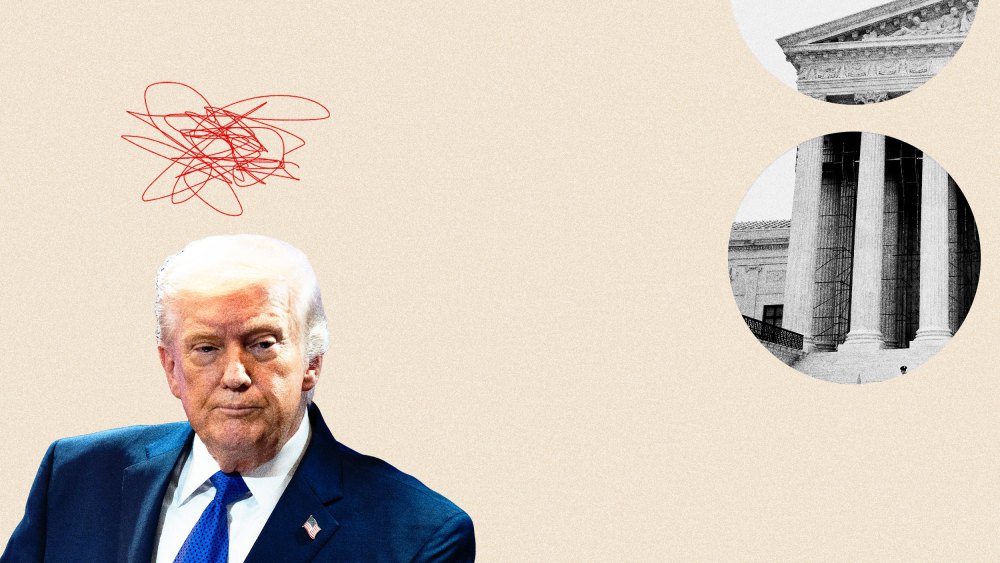
President Donald Trump had a bad day Friday — and the rest of us had a good one.
The Supreme Court’s 6-3 ruling striking down the Trump administration’s so-called “reciprocal tariffs,” a sweeping set of taxes on imports that took U.S. tariff rates up to levels not seen for a century, couldn’t have been clearer that the administration’s legal logic was fatally flawed.
Had the high court not struck down such egregious presidential overreach, it would have been a terrible day for democracy.
As an economist, I have closely tracked Trump’s disruptions to international trade since his first term. But my immediate reaction to the court’s ruling was not about the economics of trade. It was about the rule of law. Had the high court not struck down such egregious presidential overreach, it would have been a terrible day for democracy. Instead, in contrast to Trump’s announcement last April, Friday was the real-deal “Liberation Day.”
OK, onto the economics:
Early analysis from the Yale Budget Lab found that the tariff rate should fall by about half, from around 17% to around 9%, if the Trump tariffs are removed as the high court ordered. That’s still a historically high rate, but it would be important relief for businesses and consumers — if it materializes.

Such relief, of course, might not be forthcoming if Trump is able to quickly replace the tariffs that were struck down. In his announcement Friday, Trump leaned into Section 122 of the 1974 Trade Act, which gives the president the authority to quickly and broadly impose tariffs up to 15%. What the president didn’t say was that under Section 122, tariffs can last for only 150 days, after which Congress must approve their renewal.
However this effort bounces in the coming days, I expect some degree of the following outcomes:
- Some prices should fall or at least rise more slowly. Although Trump and his team have always been in deep denial about this, careful research consistently shows that at least 90% of the tariffs are being paid by U.S. businesses and consumers. Inflation, by my estimation, is a bit less than a percentage point higher than it would be were it not for the full suite of tariffs. So, taking down most of the tariffs — the ones struck down Friday represent about 70% of the total — should lower inflation, taking it down from uncomfortably close to 3% to closer to the mid-2% range
- Lower inflation will, however, take some time. It’s possible some retailers of imports will move quickly, such as by holding Liberation Day sales, but firms don’t like lowering prices (the lower tariffs are not going to reduce their labor costs). The more likely scenario is that they don’t raise them as quickly, ergo the slower inflation scenario I outlined.
- The budget deficit may just have grown by about $175 billion. That’s an estimate of the loss of expected revenue from pulling down the litigated tariffs. Again, if the administration can replace them, that number would be smaller, but I’m confident that tariff revenues will soon significantly decline.

One big reason for that goes back to another aspect of the Supreme Court’s decision Friday. Sometimes, what courts don’t say speaks louder than what they do say, and the court notably did not say the administration could forget about paying back all companies it illegally taxed. That means that all that revenue — all of those customs’ duties — should, at least in theory, get repaid to the American companies that paid the taxes. Whether the companies choose to pass any of those refunds forward to consumers is a question I’ll speak to below.
As Tobin Marcus, an analyst at Wolfe Research, wrote in a (paywalled) note to clients Friday: “The refund process will be a total mess, and will need to be hammered out in lower court proceedings … the refund process will need to be litigated in the Court of International Trade. Without clear direction from [the Supreme Court], we don’t expect CIT to order a nationwide refund process. That would mean that every importer will need to individually file protests or lawsuits seeking their money back, which sounds like a lot of fun for everyone … ”
Another interesting dimension of this mess is that for companies that passed the tax forward to consumers, this is a windfall.
Another interesting dimension of this mess is that for companies that passed the tax forward to consumers, this is a windfall. Suppose an imported item sold for $10 pre-tariffs but that tariffs added $2 to the cost, which the company was able to fully pass on to consumers, such that the post-tariff cost for the item was $12. Assume that even at the higher price, the company sold 100 of these items. That’s $200 of tariff relief the companies are owed, but because they fully passed the expense through to consumers, businesses would be getting back a windfall.
Like I said, what a mess.
Remember, too, that half of U.S. imports are inputs into our domestic manufacturing production. The court’s decision will thus help producers who’ve been struggling under this weight benefit from lower input costs.
Finally, the Federal Reserve has been saying for a while that the inflationary impacts of tariffs were making it harder to lower the interest rate it controls. Like the rest of us, the Fed will want to see where the dust settles, and this decision could pave the way for lower rates.
So, bottom line, a good day for the rule of law and democracy. And depending on how aggressively the Trump administration tries to find other paths to replace its lost tariffs, Friday could go down in history as a good day for businesses, consumers and domestic manufacturers. As for what’s next, the courts will be busy trying to sort out the refunds — Reminder, folks: Keep your receipts! — and Trumpian chaos in this and other areas will surely persist.









Become a member to join the discussion