A listener casually tuning into President Donald Trump’s State of the Union address last Tuesday would be forgiven for being surprised at finding the United States at war on Saturday. Trump’s speech ran for an exhaustive hour and 47 minutes, but only about 350 of the 10,650-odd words he spoke were centered on the putative threat posed by Iran. Listeners might well have assumed from the speech that the greatest threat to the U.S. was instead Democratic legislators.
That lack of consensus-building around the (unbeknownst to the public) imminent strikes was not unique to Trump’s speech. He and his administration did very little to convince the public that military action was necessary, with a YouGov poll conducted for CBS News finding that only 28% of Americans — and only 57% of Republicans! — thought the administration made the case for strikes.
Follow MS NOW’s live blog for the latest updates and analysis on the war in Iran and its impact beyond the Middle East.
Last week, fewer than half of Americans supported strikes for the purposes of curtailing any Iranian nuclear ambitions. Two-thirds thought Trump should seek authorization from Congress for any action.
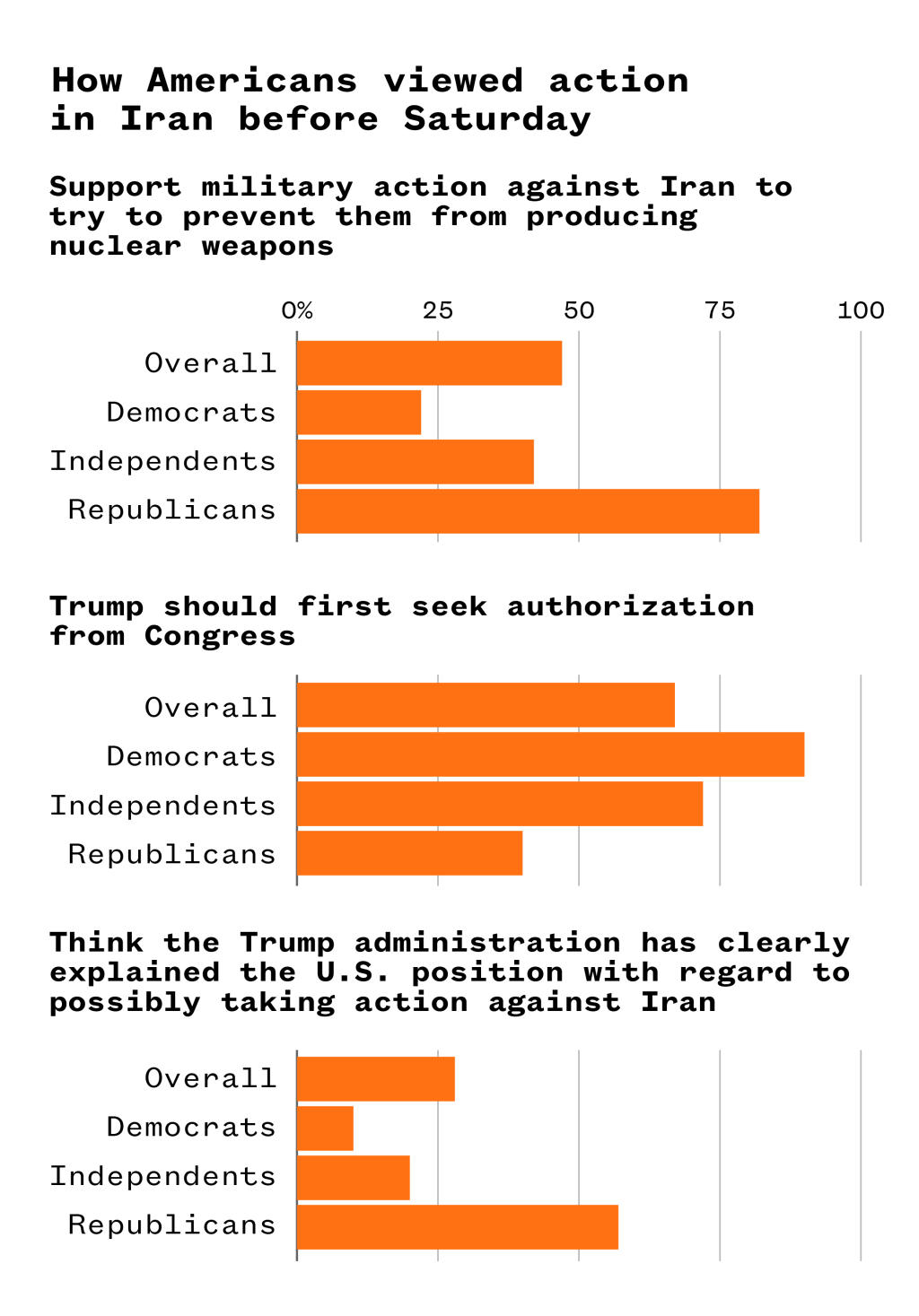
Oh well! Members of Congress were mostly cut out of the discussion, much less asked for authorization. A president who has the approval of only about 4 in 10 Americans moved forward with strikes anyway. And YouGov polling conducted in the immediate wake of the attacks showed that they were only about as popular as Trump himself.
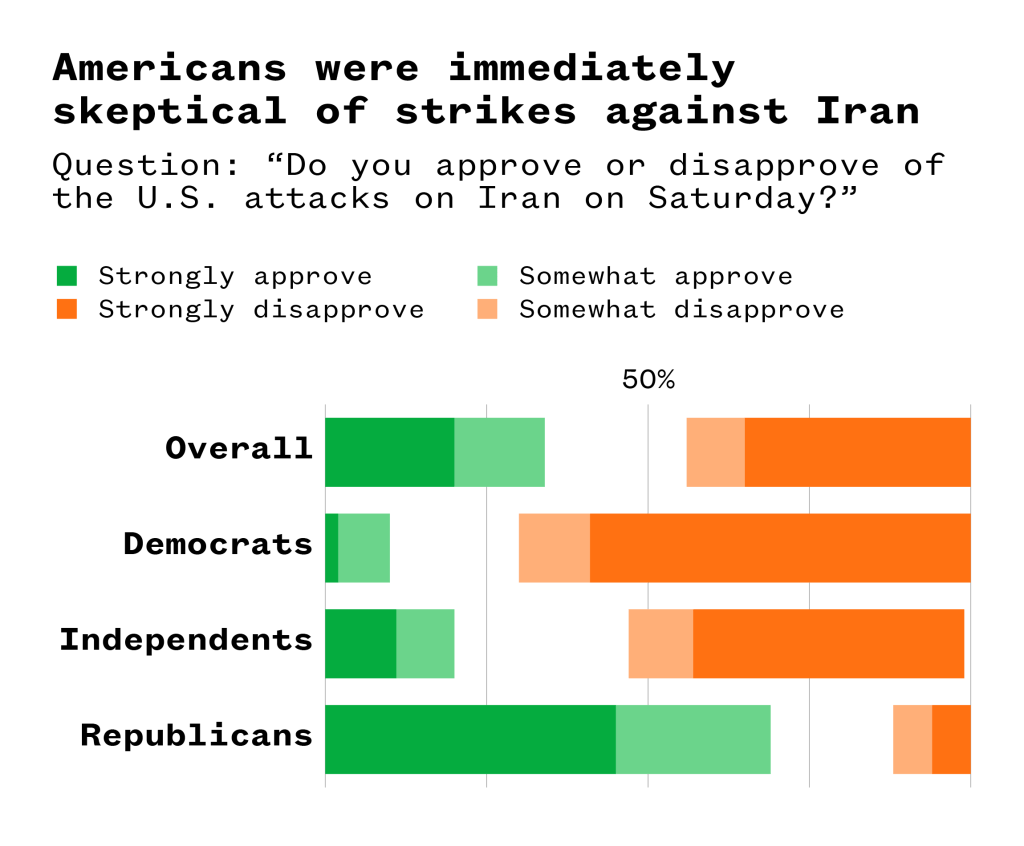
Polling conducted for Reuters by Ipsos found something similar. Only about a quarter of Americans approved of the strikes, including barely over half of Republicans. About a third of Republicans said they didn’t have an opinion of the strikes, which is a common way for supporters of a president to indicate dissatisfaction without having to admit they are dissatisfied.
For people of a certain age, all of this may seem pretty familiar. A Republican president rushing into an unpopular war against a Middle Eastern country whose name begins with I-R-A? Sure, we’ve seen this before.
In an important sense, though, we haven’t. When former President George W. Bush began advocating for strikes against Iraq, he was far more popular than Trump is now, in large part because of lingering support following the Sept. 11 terrorist attacks. He and his administration worked hard to make a public case for invading Iraq — a case that depended heavily on flawed evidence and wishful thinking, but a public, energetic case nonetheless. In the State of the Union Bush gave shortly before the invasion, he spent about a third of the speech focused on the purported threat Iraq posed.
Gallup polling conducted in the immediate wake of the March 2003 invasion, conducted as U.S. forces were sweeping into Iraq with little opposition, found that 72% of the country viewed the action positively, including 6 in 10 who strongly approved. Bush’s approval rating jumped from 58% (a level Trump’s never even approached) to 71%.
Despite how it is remembered, the Iraq War was popular when it began. Because the conflict is now understood as having been something between a mistake and a debacle, there’s been a lot of effort to bury that sentiment, including from Trump, who publicly expressed his support for the war at its outset. But in early 2003, Bush was a popular president initiating a popular war.
It’s easy to use this history to assume that we know what comes next. CNN polling conducted after this weekend’s strikes found that they were broadly unpopular, with most also anticipating that a long-term conflict was looming. This is where that sense of familiarity emerges — unpopular Republican, unpopular war. All that’s missing from the mix is the inevitable, intervening quagmire.
But what if there isn’t one?
It is underappreciated during the (still-young) conversation about Iran the extent to which Trump is somewhat insulated by already being unpopular. He’s already sloughed off nearly anyone who wasn’t a hardcore supporter and already proven to be immune to the tugs and pulls of changing public opinion. Bush found himself scrambling to adjust to shifting opinion as the Iraq War dragged on into 2005 and 2006. Opinions on Trump are already set in concrete.
Sure, you might respond, but this is the “no new wars” president! Won’t his base turn on him now that he’s unleashed attacks on Iran? We know the answer here: no.
This is where that sense of familiarity emerges — unpopular Republican, unpopular war. All that’s missing from the mix is the inevitable, intervening quagmire.
As I wrote in November, the “no new wars” shtick was mostly projected onto Trump and never a central part of his base’s support, except that it was useful (as Trump used it) to disparage his opponents and the establishment. Trump-as-tough-guy was always a more potent element of his personality and his support than Trump-as-dove, and blowing things up has been a central part of his second term for that reason.
There’s another risk with Iran that might differentiate it from Iraq.
Bush and his team were publicly invested in replacing Iraqi dictator Saddam Hussein with a democratic government. Perhaps this was heavily insincere, but U.S. troops remained in the country for years in part to aid the transition to what Bush wanted to see.
There’s little indication that Trump is committed to any similar experiment. He and his team have not articulated what comes next in the country, save for some vague idea that “the people” will take over. There’s little indication that, if Iran collapses into turmoil and instability, the U.S. will invest significant soldiers or energy in making things better. Opinions of Iraq collapsed as American casualties mounted without any obvious improvement in the country’s status. How might Americans have reacted if the troops had simply left, whatever the result?
Bush publicly articulated an outcome that required American soldiers. You can be excused for assuming that Trump’s desired outcome has already been achieved: a lot of explosions and a corpse with an identifiable name.
Put simply, the unpopularity of Trump and this conflict make it less likely that he’ll be swayed by public opinion. At the same time, his seeming indifference to what happens next in Iran makes it more likely that he’ll avoid the sort of quagmire that plagued Bush.
For those, like myself, who opposed the Iraq War before it began, we’ve arrived at a bizarre moment. Bush at least believed that he should and could bring the public along with him; he was, at least to some extent, responsive to the public as the situation in Iraq collapsed.
Say what you will about the tenets of neoconservativism, to paraphrase Walter Sobchak, but at least it’s an ethos. Trumpian nihilism, on the other hand, may prove to be more dangerous for the world but, somehow, less dangerous politically.