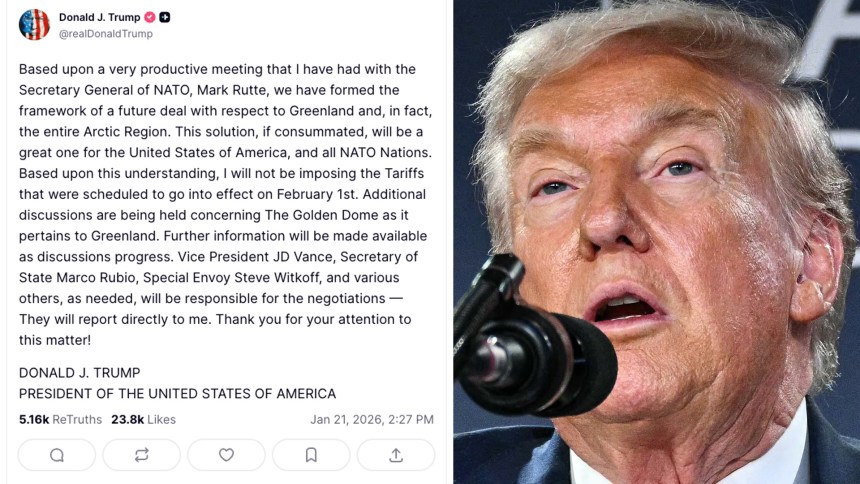
President Donald Trump appears to have pulled back from the brink of possible economic and military warfare with Europe in his quest to annex Greenland. He announced on Wednesday a “framework of a future deal” over the Arctic island after a meeting with NATO Secretary General Mark Rutte, and he called off tariffs against eight European countries that had opposed his Greenland agenda. Trump then claimed on Thursday that the U.S. is “going to have total access to Greenland” and “all the military access that we want,” but the scope and details of the negotiations remain unclear.
There’s a lot we still don’t know — but at the very least it’s a relief that Trump seems to have found an off-ramp from the most severe kind of clashes with allies over one of the dumbest and most dangerous foreign policy ideas he’s ever had.
That Europe was forced to send troops to Greenland for military exercises and was gearing up for a potential trade war was madness.
Trump wrote on Truth Social, “This solution, if consummated, will be a great one for the United States of America, and all NATO Nations.” He added in his announcement that “additional discussions are being held concerning The Golden Dome as it pertains to Greenland.” The Golden Dome is Trump’s idea of a missile defense system that would protect North America from foreign attacks, although the administration hasn’t released details on it.
Trump’s announcement of a NATO deal on social media came hours after he suggested he was cooling on the idea of using force to seize Greenland. In ambiguous, threat-laced language, he indicated he “won’t use force” to try to annex the semiautonomous Danish territory — for now at least.
The apparent diplomatic breakthrough is good news insofar as the threat of a full-on confrontation has abated for the moment. That Europe was forced to send troops to Greenland for military exercises and was gearing up for a potential trade war was madness. NATO’s implosion seemed like a real possibility — although it still is likely permanently damaged.
“The day ended better than it started,” Danish Foreign Minister Lars Løkke Rasmussen said on Wednesday. “Now, let’s sit down and find out how we can address the American security concerns in the Arctic while respecting the red lines of the Kingdom of Denmark,” he said. He later said, “sovereignty is a red line.”
We don’t have any details of the purported “framework of a future deal” yet, but based on the limited bits of reporting indicating some possibilities for its scope, there are both positive and negative ways to look at what Trump may be angling to secure.
The New York Times, citing three senior officials familiar with the talks, reported on Wednesday that NATO officials had discussed among one another the possibility of the United States “obtaining sovereignty over land for military bases” in Greenland. Two of those officials likened a potential arrangement to the United Kingdom’s military bases in Cyprus. According to the Times, “the officials said that Mr. Rutte had been pursuing a compromise this week, but they did not know if the concept of the United States having some sovereignty over small pockets of Greenland for military bases was part of the framework announced by Mr. Trump.” In an interview with Fox News, Rutte said the question of whether Greenland will remain a territory of Denmark “did not come up anymore” in his conversation with the president Thursday.
So we don’t know if Rutte discussed the idea of potential land for U.S. bases in Greenland, and Rutte does not have the right to simply sell off parts of Danish territory. But insofar as some version of this idea may be in play, there are two takeaways.
One way to look at it is as a reward to Trump for bad behavior. It may be that his threats have made Europe scramble to give him something to chew on and sell to his political base as a successful imperialistic maneuver. Some Greenlandic politicians have objected to the idea of NATO officials going over the heads of Greenlanders and discussing excising small parts of the island’s territory to give to the U.S. as a peace offering.
On the other hand, there is a version of this that is somewhat more benign. The U.S. already has a small military installation in Greenland, and under a 1951 agreement it has the right to set up more. It would depend on the details, but if the U.S. built a few new bases there under an already existing agreement, then that wouldn’t be the cardinal violation of sovereignty that many feared. In fact, it could even be a reprisal of an established Trump strategy of withdrawing threats in exchange for a weak or largely illusory deal. He backed off a set of tariffs against Canada and Mexico in 2025 based on agreements on border policies that were largely about optics or that were already planned to go into effect.
That being said, there are other worrisome possibilities under the 1951 agreement path as well, such as an extremely expansive renegotiation of that agreement, or a bad faith interpretation of what that agreement allows the U.S. to do.
It’s far too early to render judgment on Trump’s potential deal. Greenland’s sovereignty remains up in the air. But the worst outcome seems to have been averted for now.