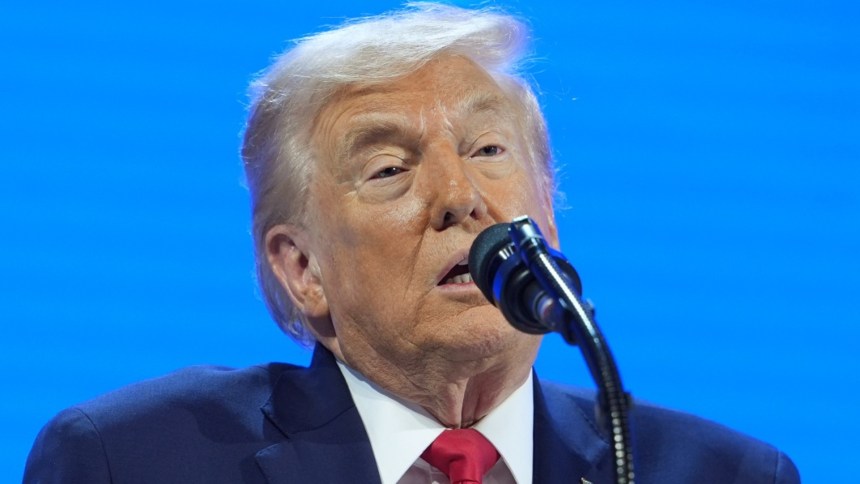
In his speech at the World Economic Forum in Davos, Switzerland, on Wednesday, President Donald Trump again focused on his desire for the United States to take control of Greenland. But, he insisted, that desire wouldn’t include the use of military force.
“We probably won’t get anything unless I decide to use excessive strength and force, where we would be, frankly, unstoppable. But I won’t do that,” Trump said. He riffed for a bit about how relieved everyone in the room must be to hear him say that.
Then he added: “All the United States is asking for is a place called Greenland.” He noted that the U.S. had been central to Europe’s defense during World War II, denigrating Denmark’s efforts in particular. (Greenland is a Danish territory.)
“We were a powerful force then,” Trump said, “but we are a much more powerful force now.”

Anyone who has seen a mafia movie understands that this is not actually a promise not to use force. It is, instead, using force as an implied threat. No one should breathe a sigh of relief, just as you might not take much consolation from a thug promising not to break your knees as he demanded $20 while holding a hammer.
We should recall what Trump wrote in a text message to Norwegian Prime Minister Jonas Gahr Støre last week, when he pivoted from the acquisition he’d relentlessly demanded a few months ago (the Nobel Peace Prize) to the one he wants now (Greenland).
“Considering your Country decided not to give me the Nobel Peace Prize for having stopped 8 Wars PLUS,” Trump said, “I no longer feel an obligation to think purely of Peace.”
Trump was replying to a note from Støre questioning the American president’s recent fixation on Greenland. Trump ended his response with a declaration that “The World is not secure unless we” — meaning the United States — “have Complete and Total Control of Greenland.” And then he offered his thanks.
Anyone who has seen a mafia movie understands that this is not actually a promise not to use force.
Spanning the 125-year history of the Nobel Peace Prize, it’s hard to imagine any other person has demanded the award as loudly and insistently as has President Trump over the past 12 months. Perhaps it’s not surprising, then, that Trump’s failure to secure the prize (save for getting it secondhand from this year’s winner, Venezuelan opposition leader María Corina Machado), has led him to abandon the conceit of peacemaking entirely.
Why is Trump so bitter about not winning the Nobel Peace Prize?
Some part of it is Trump’s obsession with Barack Obama, who won the prize in 2009. Trump likely sees the Peace Prize as “a thing good presidents get, so he wanted one, too. He is not a terribly secure person.
He has also bizarrely enjoyed right-wing ovations for him being the no-new-wars president, despite only rarely suggesting that he was committed to the cause of avoiding military conflict, and demonstrating in both his first and second term that he has no compunction about expanding America’s military entanglements abroad. But there’s little doubt Trump enjoyed hearing right-wing media praise him for this theoretical trait — or seeing allies and sycophants offer up nominations for the award — just as he likes hearing people praise him for anything else.
For months, he’s been hyping how many global conflicts he’d resolved which, as MS NOW contributor Daniel R. DePetris recently wrote for MS NOW, sits at some distance from reality.

Even here, Trump couldn’t help engaging a little of his trademark numbers inflation. On Aug. 15, for example, he said he’d resolved five wars. Four days later, he said it was six … but also that “a lot of people say seven because there’s one that nobody knows about.” Which doesn’t make any sense, but no worries, since by early October, the number hit eight, including, somehow, the war in Ukraine.
This purported peacemaking has always sat uncomfortably alongside Trump’s eagerness to deploy military force. Even as he was hyping those five six seven eight resolved wars, Trump was blowing up boats near Central America and unleashing airstrikes on a range of countries in Africa and the Middle East. A president dedicated to peace probably wouldn’t prioritize a birthday-slash-military parade months into his term.
While Trump’s bid for the Nobel unsurprisingly failed, his desire was still there, so those looking for benefits from Trump or his administration handed over both real and invented prizes. But, in Trump’s thinking, since Norway didn’t give him the Nobel Peace Prize, so much for peace. Norway would explain — and has explained — to Trump that the prize isn’t their nation’s to give, but Trump inexplicably rejects that.
In a sense, it’s unsurprising that a president who believes himself to have power over which football games television networks broadcast thinks that a foreign prime minister controls who receives a prestigious award given by an independent organization.
The main question regarding Trump’s increasing fixation on seizing Greenland is the timing: Why now?
The U.S. has military access to Greenland and could negotiate with its ally (or, perhaps, former ally) Denmark for access to Greenland’s natural resources.
The current fervor that’s gripped the West Wing may have originated with a random post from White House deputy chief of staff Stephen Miller’s wife, Katie. She responded to the seizure of Venezuelan President Nicolás Maduro with a social media post showing a U.S.-flag covered Greenland and one word: “SOON.”
This triggered a familiar escalatory cycle, one that probably heightened Trump’s fixation on the Nobel Peace Prize itself. Asked how they felt about Trump’s designs on the island, European leaders rejected the idea flatly. This (completely understandable) dismissiveness contributed to the White House leaning in to the idea, continuing a spiral of rejection and insistence that has now resulted in NATO member countries dispatching soldiers to the island. Not in an effort to protect it from Russia or China, threats Trump has identified. They are there, instead, to demonstrate Europe’s resolve to stand up to American threats.
It’s a reminder that the stakes of Trump’s Greenland flirtation are far, far higher than his jockeying for the Nobel. As the World Economic Forum’s annual conference kicked off this week, various foreign leaders excoriated Trump’s geopolitics, stating flatly that cross-Atlantic and cross-border comity had been shattered.
Belgian Prime Minister Bart De Wever invoked a philosopher who’d lived at the outset of European fascism a century ago. “The old world is dying, and the new world struggles to be born: now is the time of monsters,” Antonio Gramsci said. De Wever added that “it’s up to [Trump] to decide if he wants to be a monster.”
Canadian Prime Minister Mark Carney — who owes his job in no small part to Trump’s declaration that he’d also like to annex our northern neighbors, turning a substantial lead for that nation’s Conservatives into a resounding victory for the Liberals — offered a slightly less poetic rejection of America’s role in the world and of its president.

“We are in the midst of a rupture, not a transition,” Carney said. “Over the past two decades, a series of crises in finance, health, energy and geopolitics have laid bare the risks of extreme global integration. But more recently, great powers have begun using economic integration as weapons, tariffs as leverage, financial infrastructure as coercion, supply chains as vulnerabilities to be exploited.”
“You cannot live within the lie of mutual benefit through integration,” Carney added, “when integration becomes the source of your subordination.”
Things were shaky before Trump, he argued, but the difference between word and deed was still to Canada’s benefit. Under Trump, though, that’s no longer the case. It was reported on Tuesday that the Canadian military has begun developing plans to counteract a U.S. invasion. Trump took notice of Carney’s speech, stating on Wednesday that “Canada lives because of the United States.”
“Remember that, Mark,” he added, “the next time you make your statements.”
All of this hostility to our longstanding allies presents one essential question: Why? Why is Trump forcing these particular issues? The U.S. has military access to Greenland and could negotiate with its ally (or, perhaps, former ally) Denmark for access to Greenland’s natural resources.
Given what we know about Trump, the reason is the same one that undergirded his demand for the Nobel Peace Prize: He wanted it. It was an achievement. It was something that would mark him in the history books. It was something that people he didn’t particularly like didn’t particularly want him to have, so obtaining it would be both a public and a private triumph.

Trump said it himself: If he couldn’t have the Nobel, he would have Greenland by any means necessary. If those means include the obliteration of a global order he didn’t care for or entirely understand, fine. He is as indifferent to international law as he is to constitutional checks on his domestic power. He wants what he wants and he’s not going to let boundaries of law or propriety stand in his way. Acquiring Greenland is unpopular and doing so by force is especially so — but his own popularity has not proven to be a check on his actions, either.
For the first five years of President Trump, we’ve gotten lucky: His desire for attention and approval and dominance hasn’t triggered a massive military conflict. With luck, we’ll somehow emerge from this current cycle similarly unscathed.
Our erstwhile allies, though, aren’t taking any chances.