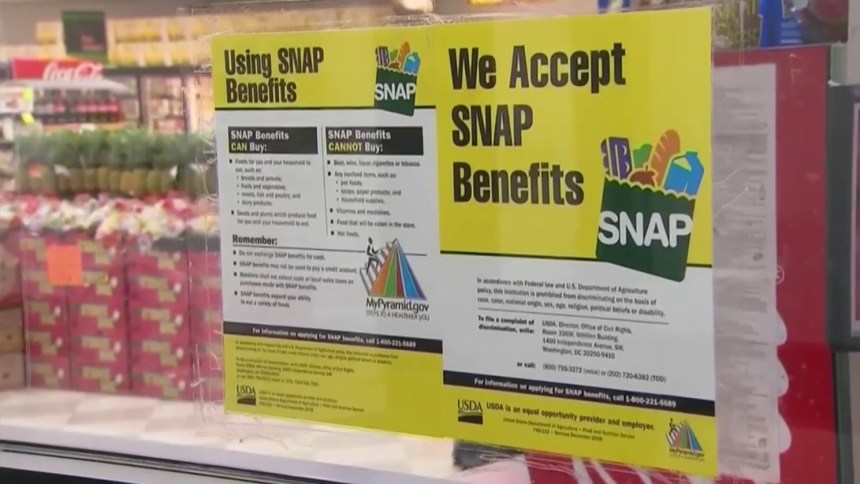
President Donald Trump tried to withhold Supplemental Nutrition Assistance Program benefits, still often called food stamps, from tens of millions of Americans to force Democrats to cave during this fall’s government shutdown. Now he’s once more threatening to leave low-income Americans hungry — this time in an attempt to hoover up sensitive personal information from SNAP recipients that could easily be misused.
Trump’s Agriculture Department said in May it wanted to amass a giant database from states to root out waste and fraud in SNAP. The data it requested from states included names, addresses, dates of birth, social security numbers, immigration status and other personal information from people who have received, are receiving or have applied to receive SNAP benefits the past three years.
Because the administration’s demand seemed invasive and prone to misuse, 13 Democratic senators, led by Sen. Adam Schiff of California, wrote in a letter in July that the database represented a “a clear violation of the privacy of millions of Americans” and “would violate federal law and undoubtedly lead to a loss of trust in the federal Supplemental Nutrition Assistance Program.”
The Trump administration is threatening to let people starve in its purported bid to make a program meant to feed people more “efficient.”
That same month, a coalition of 21 states and Washington, D.C. sued the Trump administration to block the demand, arguing that the Agriculture Department’s effort appeared to be part of an agenda to collect information that could be used to “advance the president’s agenda on fronts that are wholly unrelated to SNAP program administration” — including immigration enforcement. According to the Associated Press, a San Francisco-based federal judge has “barred the administration, at least for now, from collecting the information from those states.”
More than 40 million food-insecure Americans receive SNAP benefits each month. While the federal government funds the program, the states administer it — which is why Trump is leaning on states to hand over the information.
The Trump administration says many Republican-led states have handed over the data, but more than 20 Democratic-led states have refused to. And now, even as it faces legal obstacles, the administration is trying to twist the arms of officials in blue states by threatening to cut off their SNAP funding.
Agriculture Secretary Brooke Rollins said during a Cabinet meeting Tuesday, “As of next week, we have begun and will begin to stop moving federal funds into those states until they comply and they tell us and allow us to partner with them to root out this fraud and to protect the American taxpayer.”
It’s unclear what the legality of this maneuver is, but there are some obviously troubling things going on here. First, the idea that SNAP is a hotbed of “extremely corrupt” activity, as Rollins has argued, is not supported by evidence. The Center on Budget and Policy Priorities, which does a lot of careful work on how SNAP works, noted in 2024 that SNAP has an “extensive quality control program,” and that while the overpayment rate was substantial according to 2022 data — over 9% — it was not primarily due to fraud:
Relatively few SNAP errors represent dishonesty or fraud on the part of recipients, such as lying to eligibility workers to get benefits. Given its nature, the exact extent of fraud is difficult to pinpoint, but it is clear that the overwhelming majority of SNAP errors result from honest mistakes by recipients, eligibility workers, data entry clerks, or computer programmers. USDA reports that about half of overpayments and 80 percent of underpayments in fiscal year 2019 were states’ fault; most others resulted from simple errors by households, not intentional fraud. Individual households must pay back overpayments — even when due to the state agency’s error — and the state issues corrections for underpayments.
The CBPP also pointed out that SNAP’s error rates “compare favorably to many other government activities.” For example, the tax gap, the difference between taxes owed and paid, in the tax year 2021, was around 15 percent, the think tank noted.
The Associated Press reported that SNAP experts say that, to the extent fraud does exist, the bigger problem is organized crime efforts stealing benefit cards, not wrongdoing by individual beneficiaries. An individualized database would do nothing to address that bigger problem.
So even if one takes Trump’s rationale at face value, there’s not a strong case for creating an unprecedented database with the sensitive personal information of SNAP recipients.
But it is just as important to note that the Trump administration is threatening to let people starve in its purported bid to make a program meant to feed people more “efficient.” These are strongman tactics, the kind that would only be deployed by the morally bankrupt. Trump is perhaps banking on Democrats caving as they did during the shutdown, but we should all be aghast at his indifference to — or maybe his pleasure in — the pain hungry people may feel as he pursues more power.