I didn’t anticipate what the abandoned baby monkey Punch would do to me when I was scrolling social media on Monday. But I know why I couldn’t look away. I was abandoned by my mother too.
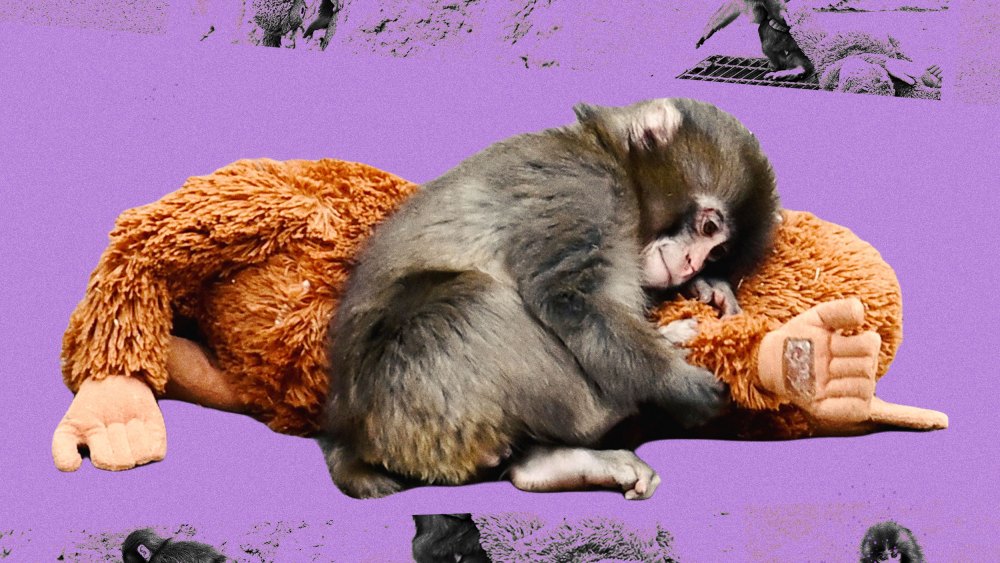
On Feb. 5, Ichikawa City Zoo, located about 12 miles from central Tokyo, posted a routine update about a baby macaque in its care. Within hours, it was anything but routine. Clips of Punch, a 7-month-old Japanese macaque, spread across social media, drawing millions of views. The hashtag #HangInTherePunch went worldwide. Lines formed outside the zoo. People contacted the zoo from around the globe, demanding intervention, convinced he was being bullied. The Ikea stuffed orangutan he carried everywhere sold out across multiple regions within days.
The question worth asking isn’t why a baby monkey is adorable. It’s why so many of us fell apart watching him.
What undid me was watching him arrange the toy’s arms around his own small body. He was constructing an embrace where none existed.
Punch’s mother rejected him shortly after birth, so zookeepers raised him. When they later introduced him to the troop, he was pushed away, swatted and corrected for a social grammar no one taught him. Again and again, he ran back to an orangutan plushie fans nicknamed “Ora-mama.”
What undid me was watching him arrange the toy’s arms around his own small body. He was constructing an embrace where none existed. Punch did not just cling to comfort. He built it.
My birth mother abandoned me on a stairwell in Hong Kong in 1959. I spent 17 months in an orphanage before a Chinese American immigrant couple adopted me. Parental presence doesn’t guarantee a child’s needs for connection are met. My adoptive mother struggled with severe, untreated mental illness that made warmth difficult and physical affection nearly impossible. I grew up with a deep fear of rejection and a desperate need to belong. I knew other children had something I didn’t. I didn’t have the words for it yet.
That hunger shaped how I moved through the world. Like Punch, I often didn’t know the rules. I joined organizations and workplaces with an intensity that clashed with others — too much, too fast — and then met a social recoil I couldn’t explain. The more I feared being left out, the more I acted out of step, helping to manufacture exactly the exclusion I dreaded. It was the cruelest loop: My desperate need drove away the things I craved, closeness and connection.
This is not a niche experience. A 2023 survey found that only 38% of Americans describe themselves as securely attached. Those with an anxious attachment style are more than three times as likely to report chronic loneliness. When you understand those numbers, the size of Punch’s audience starts to make sense.
A memory surfaced as I watched the clips. I was 10, staying with my parents’ old friends on a family trip. “Auntie,” as I called her, braided my hair — her hands slow and unhurried, smoothing each strand. I remember beaming under her touch, surprised by how much it moved me. It was a language I hadn’t known I was missing.
Among primates, grooming is precisely that language — trust, safety, inclusion made physical. What my auntie’s hands did for me, an older female macaque at the Ichikawa Zoo named Ansing did for Punch. In widely shared clips, she grooms him slowly and deliberately. The meaning needs no translation: I will touch you with care because I care for you. You belong. Punch’s arms — which had spent months clutching a stuffed toy — held on to something living. A new hashtag appeared: #PunchHasAMom.
Punch’s story reaches far beyond those whose mothers rejected them. Many people grow up with a parent who is emotionally absent, withholding or unpredictable.
The collective exhale was palpable. I felt it too.
Punch’s story reaches far beyond those whose mothers rejected them. Many people grow up with a parent who is emotionally absent, withholding or unpredictable. They become adults who look fine from the outside while privately doubting whether they’re truly loved or belong anywhere. I have carried that doubt most of my life. I’ve struggled with depression for decades because of it.
The zoo reports Punch is deepening bonds within the troop. In a recent video, he appears alongside another young macaque, a friend, and the two groom Ora-mama together. Punch may one day no longer even need his plush toy. That possibility is not about erasing what happened. It’s about what remains possible. Through years of therapy, I learned to comfortably occupy the appropriate amount of space, avoiding timidity’s constraint or desperation’s excess.
Whether Punch was accepted because he learned the troop’s language, or because some older monkey decided he was worth the effort — or both — we can’t know for certain.
The story was never about just a monkey and his toy. It’s about what happens after rejection: You keep trying, you learn, and sometimes the world surprises you. And sometimes you surprise yourself.