One of the most influential progressives in Congress is gearing up to pitch her fellow Democrats on embracing “Medicare for All” as a health care goal. It’s a badly needed policy that never should have vanished from Democrats’ radar.
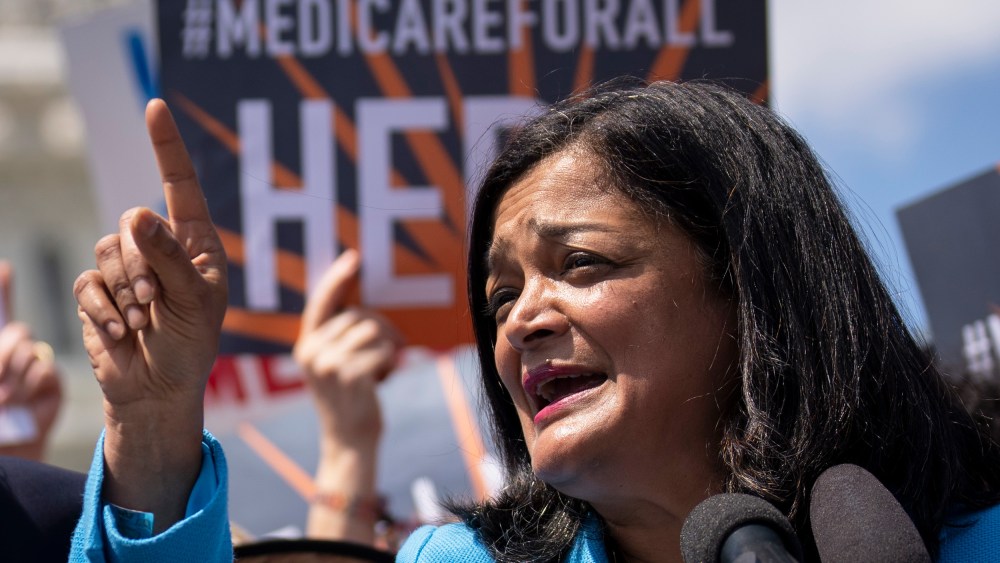
Politico reported on Thursday that Rep. Pramila Jayapal, D-Wash., a former chair of the Congressional Progressive Caucus, “plans to present polling to her House Democratic colleagues next month as she argues for the electoral merits of Medicare for All — even in battleground districts the party must win to flip the House next fall.”
Medicare for All is single-payer health insurance — a system under which the administration of health care remains private but insurance is run and paid for by the federal government, replacing all private coverage or most private coverage, depending on the plan. In the 2020 Democratic presidential primaries, many major progressive candidates either supported Medicare for All as their chief proposal for health insurance or referred to it as a North Star —a goal to move toward with incremental plans like a government-run “public option.” But after Joe Biden won the nomination, the policy lost momentum — and he never tried to make good on his advocacy for a public option.
Jayapal’s survey is not the only one finding majority support for Medicare for All more recently.
Jayapal’s poll, which was paid for by her leadership political action committee and conducted by GQR Research, surveyed 1,000 likely 2026 voters from Nov. 5 to 13 and oversampled voters in battleground House seats. The survey found that 54% of voters nationally and 56% in battleground districts support Medicare for All, Politico reported. The poll found that 90% of Democrats back the policy. The survey also showed that 1 in 5 Republicans and a majority of independents support a “government-provided system” of health care.
The poll results should be taken with a grain of salt, as the survey was commissioned by a Democratic PAC and not a news outlet or other nonpartisan institution. But data suggesting broad support for Medicare for All across the political spectrum is not surprising. Back in 2020, Medicare for All consistently received support from a majority of Americans, including significant numbers of Republicans.
Jayapal’s survey is not the only one finding majority support for Medicare for All more recently, either. In November, Data for Progress asked more than 1,200 likely voters if they would back a “national health insurance program, sometimes called Medicare for All, that would cover all Americans and replace most private health insurance plans.” Its survey found that 65% of voters supported it, including 78% of Democrats, 71% of independents and 49% of Republicans. Now, that Republican share is likely to go down if debate over Medicare for All heats up again and GOP leaders start taking aim at it. But the takeaways remain what they have been for years: There is appetite for sweeping health care reform and broad dissatisfaction with our current system, which still leaves tens of millions uninsured and in medical debt.
Many Democratic lawmakers argue that Republicans are in a weak position ahead of the 2026 midterms because the GOP’s refusal to extend Affordable Care Act subsidies means that health insurance premiums will rise, and in some cases skyrocket, for 22 million Americans. But beyond the short term, Democrats need to lay out a vision for health insurance that’s bigger than “we will try to protect your insufficient health care system from getting worse every time Republicans get elected.”
If Democrats should have learned anything from the Trump era, it’s that defending a broken status quo isn’t enough to excite voters. They need a positive vision. Medicare for All provides one that’s not only morally imperative but could also serve naturally as a flagship policy proposal in 2028.