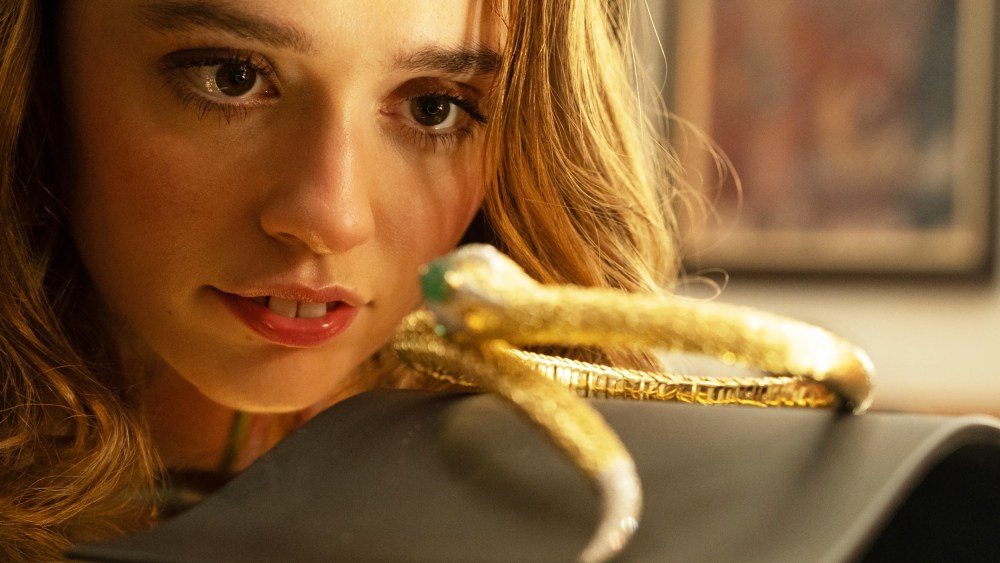
Actress Aimee Lou Wood, one of the surprise standouts of the third season of “The White Lotus,” is having what she describes as a “full circle” moment as the season draws to a dramatic close. Amid a cast stacked with the likes of Parker Posey, Walton Goggins and Carrie Coon, an unlikely new star has emerged: Wood’s buckteeth.
Wood’s character, a young woman named Chelsea, meets Chloe (Charlotte Le Bon), another resort guest, early in the HBO drama. In one of the most memorable lines of the season, Chloe breaks the ice with disarming candor. “I love your teeth,” she tells a smiling Chelsea. “You’re from England, right?”
Wood later told the online magazine The Face that the line was actually improvised, beautiful in its simplicity.
Called ‘radical’ and ‘inspiring,’ Wood’s decision not to ‘fix’ her teeth has earned her fans — a lot of them.
Called “radical” and “inspiring,” Wood’s decision not to “fix” her teeth has earned her fans — a lot of them. Some are so fascinated with Wood’s overbite — a flare complete with a large space between her two front teeth — that the actress has felt compelled to warn against overeager DIY copycats. Dentists and orthodontists meanwhile have taken to TikTok to diagnose Wood’s dental condition, sight unseen.
Fans can be extraordinarily ridiculous; this is not a new phenomenon. In Victoria-era Britain, Alexandra, the Princess of Wales, developed a limp after a case of rheumatic fever. Before long, her female fans and followers decided to imitate the so-called “Alexandra Limp,” with some going so far as to purchase shoes with mismatched heels in order to achieve it.
But for those of us with a wild set of chompers, Wood’s claim to fame is both welcome and bittersweet. My own malocclusion (the medical term for teeth that dare to exist one way or another in misalignment) combined with a set of cruel and vicious peers made my childhood a living hell.
Like Wood, I suffered years of intermittent bullying, with some of the worst abuse delivered by adults. Anyone with a craniofacial anomaly (another fancy term for anyone born with facial structure that dares to deviate from the socially accepted norm) knows that living with defiant teeth can be brutal. In my case, the bullying and unsolicited criticism was life-altering.
My own experiences inspired a bestselling children’s book on the same topic, so I also know what it’s like to face your pain and come out the other side triumphant. But unlike Wood, I’ve never met an orthodontist or dentist who said they “wouldn’t change a thing” about my teeth or smile — even after extensive treatment.
I remember when, at 23 years old, I moved from New York City to suburban New Jersey and found a new local dentist. After the standard pleasantries, he tapped my front teeth with his pointer finger and said, “This isn’t very nice.”
Such moments, beginning around the time I turned 8 years old, shaped what became a lifetime of severe body dysmorphia. I endured three separate rounds of braces across three decades to correct an overbite. My stubborn front teeth, however, resisted even the most modern orthodontic technology. Mine is a deeply structural problem. I was born with misaligned jaws that could only be corrected with orthognathic surgery.
My dysmorphia has proven just as entrenched. Despite various (and expensive) treatments, I am still unable to imagine my teeth as anything other than socially unacceptable. And I envy Wood’s seeming self-acceptance.
But while cultural attitudes do seem to be changing in Hollywood and on fashion runways, it’s a slow process.
But while cultural attitudes do seem to be changing in Hollywood and on fashion runways, it’s a slow process.
According to 2022 data published by the the American Association of Orthodontists, there are over 3 million children between the ages of 8 and 17 receiving orthodontic treatment. A good chunk of orthodontic patients, around a 25% or more, are adults. Indeed, according to the British Orthodontic Society, demand for orthodontic treatment is increasing in Britain.
But this quest for the perfect smile is often wildly expensive, even for “easier” cases.
It’s also impermanent. Teeth shift as we grow older. When I finished my third round of braces 13 years ago, my teeth were perfect. But I knew I would have to wear retainers and a bite guard for the rest of my life in order to maintain all of that grueling work. And even despite these efforts, my teeth have shifted.
Wood, of course, is also a beautiful, thin white young woman and an excellent actress. In this context, her “perfectly imperfect” teeth arguably add to her appeal in a way that might not be true for someone less conventionally attractive. I also don’t think that words like novel or inspiring are the compliments people seem to think they are — instead, they suggest just how brainwashed we’ve become when it comes to conventional beauty. The reactions also highlight an enduring sense of entitlement; an intense need to judge others, and especially to judge their bodies. This entitlement, as both Wood and I have experienced, can be life-altering for those on the receiving end.
While I could have really used Wood’s newfound notoriety when I was growing up, it shouldn’t take a celebrity’s “radical” natural features for the rest of us to feel a little more socially acceptable.