
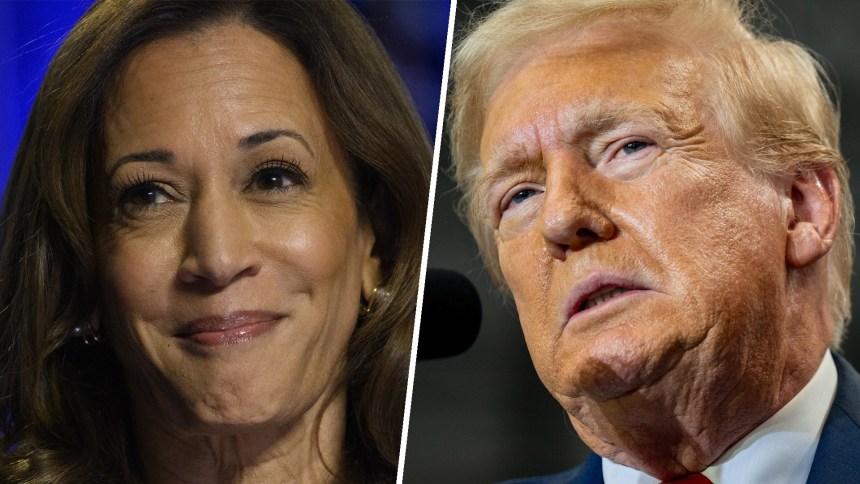
If there’s one thing everyone can agree on about American politics, it’s that we are extremely polarized. Red and blue are so diametrically opposed and hostile to one another that they might as well be different countries. Fewer voters are changing the party they vote for than ever before, especially in the last eight years.
But wait! If you are following the horse race coverage of the election, the one thing that everyone can agree on is that about 1 in 6 Americans are undecided or have weak vote preferences, driving the constant swings in each day’s new batch of polls, especially in the battleground states. (And even more so in “the demographic that will determine the winner!”— like noncollege voters, or whatever the conventional wisdom is fixated on at the moment.)
Both of these ideas cannot be true, and they aren’t. In reality, there are far fewer genuinely persuadable voters in America than there are survey respondents who say they are “undecided.” But we’re fooled by two things.
When taken literally, poll questions exaggerate how many voters are actually movable.
The first problem is statistical noise. Here’s an illustrative thought experiment. Let’s say we’ve been asking the same 2,000 people every week for the last year which presidential candidate they think they’ll vote for. You would expect to see almost no change week to week, and not much more change over a year or more. Indeed, that’s the result we get in the real world from panel studies that do exactly this. Yet if we ask a different set of 2,000 people every week, we will invariably see swings — not because individuals are changing their minds, but because we are asking different people.
The second problem is that when taken literally, poll questions exaggerate how many voters are actually movable. To survey respondents, choosing “undecided” doesn’t always mean what reporters writing about polls want it to mean — open to voting for Harris or Trump. Rather, many people say they’re “undecided” to express their ambivalence about the choice they will probably make in the end.
That’s because question writing is more difficult than it appears. What the words mean to the pollster are not always what the words mean to the survey taker. That’s why when I was political director at the AFL-CIO, we took cues from the social sciences and always experimented with different ways of asking the same question. That way, we could be sure that we were getting the responses to the question we intended. Unfortunately, most media polling analysts proceed with complete confidence that the responses are to the question the pollsters intended, or readers of survey results presume.

Consider Sara, a 24-year-old “undecided” survey respondent. Like most young people, she thinks the country is on the wrong track and resists identifying with either party. She doesn’t always go out of her way to vote. She had no enthusiasm whatsoever about President Joe Biden, and she isn’t sure yet how she feels about Vice President Kamala Harris. But since 2018, people like Sara have turned out in historic numbers that have made the difference between Democrats’ losses in 2016 and subsequent victories. The patterns of these turnout surges indicate that these voters are anti-MAGA, but not necessarily pro-Democrat. They are motivated by loss aversion — fearing (correctly) that they could lose their freedoms if MAGA wins. So, when Sara is asked which candidate she favors, she really doesn’t “favor” either of them. But if she votes, it won’t be for Trump.
We can get deeper confirmation of this dynamic by looking at an adjacent question — party identification. In most surveys, voters are asked which party they support, and if independent, which way they lean. At the AFL-CIO, we experimented with adding another question about party ID at the end of the survey: “Do you always vote for Democrats, usually vote for Democrats, usually vote for Republicans, or always vote for Republicans?” Given this choice, about 90% of respondents said they usually or always vote for one or the other party, and less than 10% volunteered some other answer, like “both parties equally.” When we reinterviewed the same people after the election, we learned that the extra question overwhelmingly predicted the vote choice of people who declared no party affiliation earlier in the survey, or had said they were undecided. What’s more, the people who weren’t frequent or always single-party voters usually just didn’t vote.
We risk that too many of the infrequent anti-MAGA voters who helped Democrats win before will stay home in November.
In short, we should be skeptical of swings in the polls greater than the swings from any election to another in the 21st century (except for the Great Crash landslide in 2008). Nor should we breathlessly accept numerous demographic realignments that are certain in the surveys but never arrive on Election Day. In truth, the epic realignment is the one that followed the 2008 election. Since then, both parties have become largely regional parties again, now along the Dobbs line that is barely displaced from the original Mason-Dixon line.
The key to Harris’ chances lies not with voters who are truly undecided between two candidates, but those undecided between casting a Democratic ballot and staying home. Our discourse refuses to recognize that every American has three choices in a presidential election: voting for the Democrat, voting for the Republican, or not voting at all. (In our winner-take-all system, voting third party has the same practical effect as not voting.) We obsess over the people who might be torn between options 1 and 2, yet we ignore the people who might choose option 3.
We ignore these voters at our peril. While Harris has done a terrific job reconsolidating and inspiring Democrats, perceptions of how dangerous a second Trump administration seem to have stalled. If that doesn’t change, we risk that too many of the infrequent anti-MAGA voters who helped Democrats win before will stay home in November. And if that happens, it will be an unforgivable failure of the media and civil society to alert Americans to the very avoidable consequences of Trump regaining power.




Become a member to join the discussion