
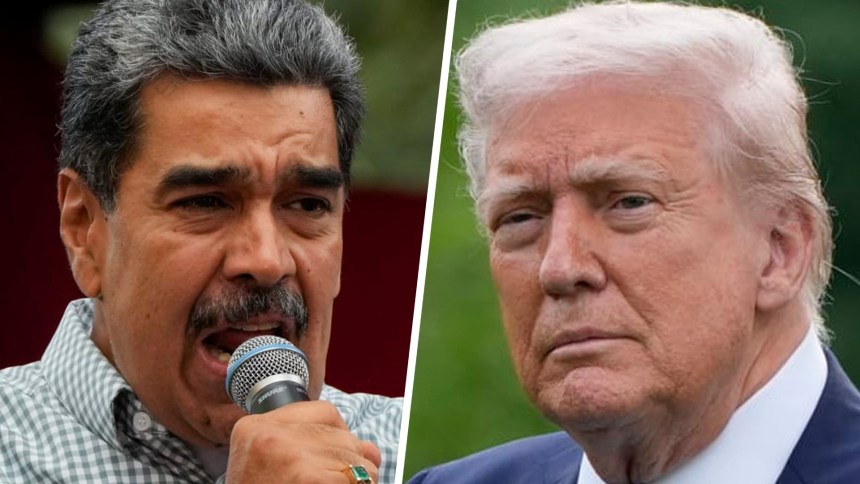
The United States on Friday said it sank a third boat in the Caribbean it said was carrying drugs that President Donald Trump said were intended “to poison Americans.” The latest drone strike, announced by Trump in social media, reportedly killed three people and followed two others against Venezuelan vessels said to be trafficking drugs; a combined 17 people have been killed in this way in recent weeks. Trump has hailed the operations a success. The second attack, he said, had left “big bags of cocaine and fentanyl all over the place.”
Venezuelan President Nicolás Maduro has accused the Pentagon of doctoring the drone footage.
Trump could be starting a narco-war unlike any we’ve seen.
Venezuelan President Nicolás Maduro has accused the Pentagon of doctoring the drone footage and has denied that crew members onboard were affiliated with the Tren de Aragua cartel. Regardless, it’s seemingly clear that the U.S. has no plans to stop these acts of aggression.
Trump insists that blowing up boats that the United States unilaterally declares to be trafficking drugs helps address America’s drug crisis. Since 2000, overdoses (mostly of fentanyl) have killed more than 1 million people in the United States (between 2015 and 2023 alone, overdose deaths in the United States doubled.) The opioid epidemic costs the U.S. economy $1 trillion a year and drives nearly three million emergency room visits annually.
But Washington’s recent actions in the Caribbean appear to be more about regime change and less about intercepting narcotics.
The U.S. recently doubled the bounty on Maduro’s head to $50 million, threatened to shoot down Venezuelan jets and deployed 10 F-35s to Puerto Rico, backed by warships and a nuclear submarine positioned off Venezuela’s coast. And as if to tighten the vise further, the Trump administration has stripped immigration protections from more than 600,000 Venezuelans — deporting 238 to an El Salvador prison earlier this year. Military muscle closes in from the Caribbean, while humanitarian pressure bears down through deportations and legal exclusions. Together, the jaws of Washington’s strategy snap shut on Caracas.
In my hometown of Los Angeles, we are already straining to house immigrants and fight fentanyl. The same is true elsewhere. We’re facing a domestic emergency that is increasingly turning international. But militarizing this fight — even overthrowing Maduro — will do nothing to eliminate cartels or stem the flow of drugs across the U.S. border.
Strikes that kill cartel members without dismantling their networks create power vacuums.
Strikes that kill cartel members without dismantling their networks create power vacuums, spawning new factions and violence. We saw this in Mexico after the capture of Joaquín “El Chapo” Guzmán. His removal didn’t end the Sinaloa cartel but fractured it, unleashing brutal turf wars and accelerating the spread of fentanyl and other opioids into U.S. cities.
President Ronald Reagan’s “War on Drugs” promised to crush cartels, but instead it left Latin America scarred by violence, corruption and weakened democracies while cheap narcotics flooded U.S. streets. And Washington’s latest political theater risks repeating that cycle.
Instead of dismantling the drug trade, a narco-war would destabilize Venezuela, drive more families to flee north and accelerate U.S. overdose deaths as fractured cartels compete by pushing even deadlier substances, like carfentanil, over the border.
We can’t afford to make this crisis worse. Trump’s focus should be on strengthening regional institutions, tackling the corruption that fuels trafficking, and investing seriously in prevention and treatment.
Research in 2023 underscored that curbing recruitment is the single most effective way to weaken cartels. That means putting resources in schools, elevating credible local leadership and enlisting faith leaders, educators and NGOs to give young people alternative pathways away from crime.
If the Trump administration is going to designate Tren de Aragua as a terrorist organization, then it should take lessons from the fight against extremist movements, including ISIS.
Curbing recruitment is the single most effective way to weaken cartels.
Where military campaigns historically fell short in fighting extremism, NGOs such as the Muslim World League (MWL) and movements such as Comunidad de Sant’Egidio have shown other ways of handling the problem — they have successfully worked within vulnerable communities to reclaim young people from the grip of violence and addiction by cutting off recruitment at the root, fighting extremist ideology and promoting civic engagement.
Migrant and minority communities with ties to Latin America are on the front lines of disrupting drug networks here in the U.S., and they must be partners — not collateral — in this fight. If the Trump administration continues to cast this as a war, those communities will be further alienated and unlikely to cooperate.
In the same way that extremists do, cartels thrive on despair, poverty and broken social bonds. Meet those conditions head-on, and the grip of criminal networks weakens. For example, MWL’s secretary-general, Dr. Mohammed Al-Issa, has repeatedly warned that immigrant and multifaith communities falter when faced with suspicion and that addiction cannot be fought with stigma or force, but with care, community awareness and open dialogue. This has been underscored by studies from the Pan American Health Organization (PAHO) and the Center for American Progress (CAP).
Turning the opioid epidemic around requires partnerships that empower families, civil society and local leaders on both sides of the border — not drones in the skies or fascistic deportation orders.
Otherwise, military aggression in the Caribbean could slide into a forever war that doesn’t end migration, addiction and instability, but feeds them.





Become a member to join the discussion