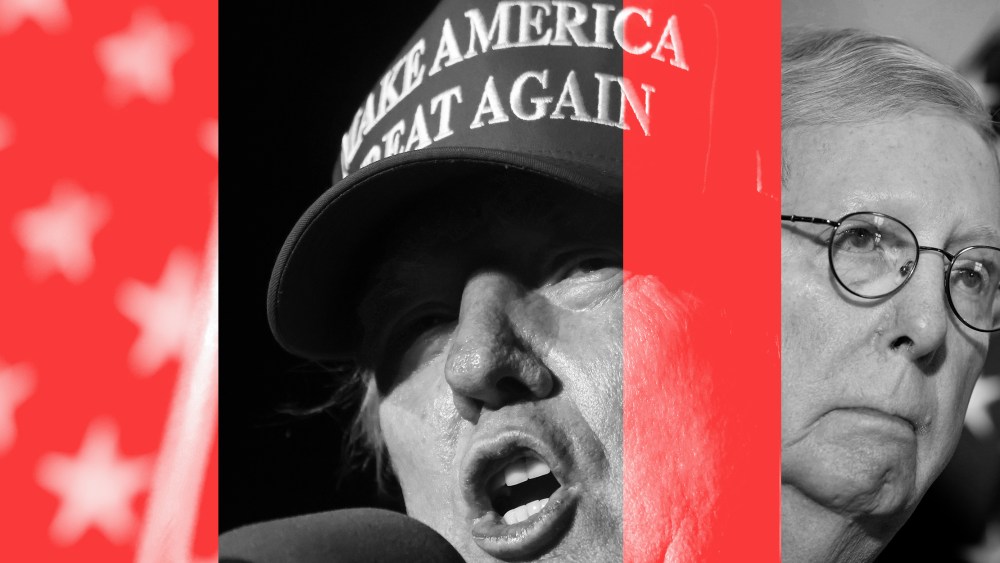
Senate Minority Leader Mitch McConnell is reportedly spearheading a behind-the-scenes push to counter former President Donald Trump’s influence over the midterm elections. But while McConnell might win some battles, it’s clear that he’s losing the war.
According to a new report from The New York Times, the Kentucky Republican and some of his allies are “quietly” moving to “thwart Trump” with influence campaigns by party bigwigs and offers of millions of dollars in support for a Senate run, emboldened in part by signs that Trump is losing some traction in the polls. According to the Times, “It’s all aimed at recapturing the Senate majority, but the election also represents what could be Republicans’ last chance to reverse the spread of Trumpism before it fully consumes their party.”
The fact that McConnell is seeking to wage this campaign covertly already puts him at a disadvantage.
If we are to grant that last point — that McConnell sincerely finds some tenets of Trumpism objectionable on an ideological level — then he has little reason for optimism about his plan.
As the Times reports, a number of McConnell’s preferred candidates to represent the establishment GOP wing are “declining to subject themselves to Mr. Trump’s wrath all for the chance to head to a bitterly divided Washington.” But even if McConnell is able to recruit some anti-Trump (or at least non-Trumpian) candidates to run for Senate, it’s unclear how he could possibly be sanguine about the future beyond 2022.

The fact that McConnell is seeking to wage this campaign covertly already puts him at a disadvantage. If McConnell lacks the fortitude to rebut Trump’s ideological project publicly and forcefully, then how can he steer the direction of the party? Operating quietly is a posture of fear — and gives the advantage to the voices in the party who are loudest. Simply put, if the establishment GOP is actively aligning itself with Trumpism or is remaining silent on Trumpism — which it mostly is — then potential candidates are going to make calculations about the viability and desirability of a run based on that political climate. McConnell’s preference for not starting open flame wars with Trump makes some sense on a short-term tactical level, but it also ensures that the party is winnowing down the potential candidate pool for those who don’t align with the anti-establishment wing of the party.
Perhaps just as importantly, McConnell’s scrambling to capitalize on Trump apparently losing some of his grip on the party requires a kind of willful delusion about the way Trump has already restructured it. It’s true that Trump has made some strategic errors in backing candidates that his base dislikes and that there is some appetite for other 2024 presidential contenders among Republicans. But he’s still the most popular figure in the party and, according to a recent CNN poll, half of Republicans still want their party to nominate Trump for president again. Among Republicans who don’t want to see him on the ballot, most aren’t specifically opposed to seeing him become president again. Rather, they express, among other things, concerns about his electability. Notably, that poll showed only one serious potential challenger to Trump: Florida Gov. Ron DeSantis, whose political lane amounts to out-Trumping Trump. DeSantis mimics the former president’s political style and has even nudged Trump to become quieter about vaccines. In other words, Trump’s biggest 2024 threat is a politician who’s famous for turbo-charging his own political approach.
Other signs that Trump has changed the party also abound, including Sen. Ted Cruz of Texas begging for Tucker Carlson’s forgiveness for deeming the Jan. 6 rioters terrorists. Cruz is the embodiment of political ambition — and has openly signaled interest in a 2024 run — and his bending the knee before Trump’s most powerful media ally is a neat summary of how Trump’s influence over the party is trending.
McConnell might win some of the Senate recruitment battles against Trump, whose power always lies in political culture rather than institutional competence or strategy. But the idea that that alone can act as a defense against the spread of Trumpism is fantasy.





Become a member to join the discussion