

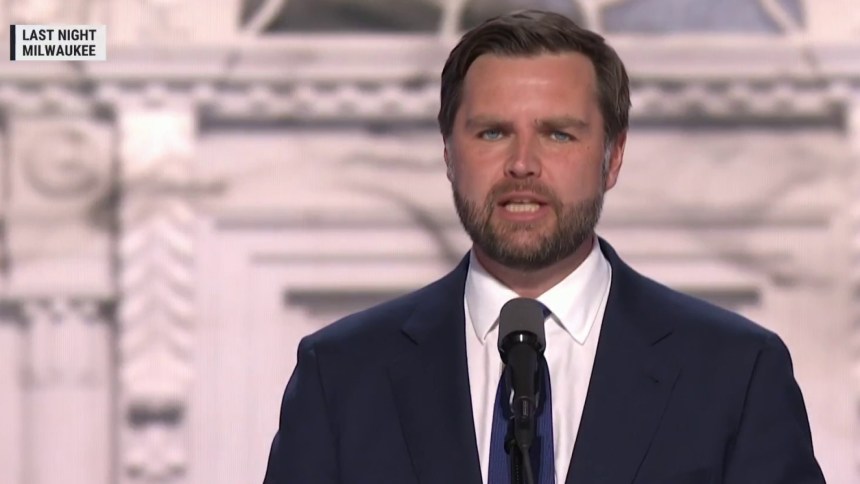
If you listened to Republican vice presidential nominee JD Vance, the junior senator from Ohio, on the third night of the Republican National Convention in Milwaukee, you’d think it was Democrats — and President Joe Biden, in particular — who were to blame for thousands upon thousands of combat deaths and postwar suicides of American military personnel who served in the wars in Afghanistan and Iraq.
“When I was a senior in high school, that same Joe Biden supported the disastrous invasion of Iraq,” said Vance, who enlisted in the Marines and served in Iraq, before attending Ohio State and Yale Law. He later added: “From Iraq to Afghanistan, from the financial crisis to the great recession, from open borders to stagnating wages, the people who govern this country have failed and failed again.”
It was Republican lawmakers who were almost universally in lockstep with the president on his Bush Doctrine, which legitimized the concept of preventive war with its ‘you’re with us or against us’ view of the world.
Yes, Biden did vote for the Iraq War. So did a significant number of Democrats on Capitol Hill — including then-New York Sen. Hillary Clinton, a fateful choice that a younger colleague, the junior senator from Illinois, Barack Obama, used to assail her during the 2008 Democratic presidential primary.
But it was then-President George W. Bush who ignored warnings during the summer of 2001 that Osama Bin Laden and his Al Qaeda group was, as the title of a famous memo goes, “Determined To Strike in U.S.” It was Bush, in the thrall of hawkish Vice President Dick Cheney, who spun a fictitious narrative about Saddam Hussein’s weapons of mass destruction.
And it was Republican lawmakers who were almost universally in lockstep with the president on his Bush Doctrine, which legitimized the concept of preventive war with its “you’re with us or against us” view of the world.
And Republican voters — most of whom have since become MAGA supporters and “America First” foreign policy isolationists, judging by surveys and polls — overwhelmingly supported both.

It was Bush who launched the wars in Afghanistan and Iraq, which led to 7,000 deaths in foreign operations, as well as 30,000 suicides, according to a database kept by Brown University. He condoned torture. And much of it was made possible by the lies his administration told about the supposed need to topple Hussein.
The unfocused campaign against Al Qaeda also demanded extending the “Global War on Terror” — with U.S. military action in 22 countries authorized by Congress’ near-unanimous Authorization for Use of Military Force (AUMF), which became law just seven days after the 9/11 attacks. (The lone vote against the 2001 AUMF was by a Democrat, Rep. Barbara Lee of California.)
Since then, both Republicans and Democrats have tried to clean up the mess he made. Their failure to do so is a testament to the disaster caused by Bush administration hawks who saw 9/11 as the perfect pretext to realize their vision of American power.
Until they acknowledge their own responsibility for the damage those wars caused our reputations — not to mention the lives they took — they don’t deserve to be taken seriously.
Obama tried to extricate U.S. troops, only to order “surges” in both Iraq and Afghanistan, while also creating a regime of legally questionable drone warfare. To his credit, Trump moved to end the wars in Iraq and Afghanistan, only to leave the job unfinished. Biden’s withdrawal from Afghanistan was legitimately disastrous, and national security adviser Jake Sullivan, as well as his top deputy Jon Finer, should have resigned. They didn’t, with a subsequent Biden administration review of the debacle essentially blaming Trump for the timeline he’d set.
Yet it was neither Biden nor Trump who ordered the invasion of Afghanistan to begin with, or mismanaged it to the point that it was sometimes called “the forgotten war,” even as American troops fought and died in it. It was Bush, who was so popular in the wake of 9/11 that the American media made a “rock star” out of Defense Secretary Donald Rumsfeld for his feisty press conferences, even as he was failing to take the steps that would have brought Al Qaeda’s leadership to swift justice.
And despite presiding over the worst attack on American soil since Pearl Harbor, voters rewarded Bush in the 2002 with a rare sweeping victory for the incumbent president’s party in Congress. The idea that Republican politicians and voters opposed America’s Republican-led war footing in the early 2000s is fanciful, to put it kindly.
For all that has happened since then, 9/11 remains the hinge moment for the American project. In one of the most trenchant analyses I’ve read of the terror attacks, columnist Michelle Goldberg of The New York Times wrote in 2021, “The attacks, and our response to them, catalyzed a period of decline that helped turn the United States into the debased, half-crazed fading power we are today. America launched a bad-faith global crusade to instill democracy in the Muslim world and ended up with our own democracy in tatters.”
In his powerful book “Reign of Terror,” the journalist Spencer Ackerman draws a direct line between the militarism that began on 9/11 and the assault on American democracy that took place on Jan. 6, 2021. So many other of the nation’s ills — xenophobia, paranoia, polarization, addiction — began with or were accelerated by Bush’s misbegotten war on “evildoers.”
But if you listened to Vance’s speech, and watched the reactions of the GOP delegates in the crowd in Milwaukee, you’d never know that it was Republican politicians and voters who pushed America into two long, disastrous wars.
Until they acknowledge their own responsibility for the damage those wars caused our reputations — not to mention the lives they took — they don’t deserve to be taken seriously. Then again, maybe being taken seriously is no longer something they crave.





Become a member to join the discussion