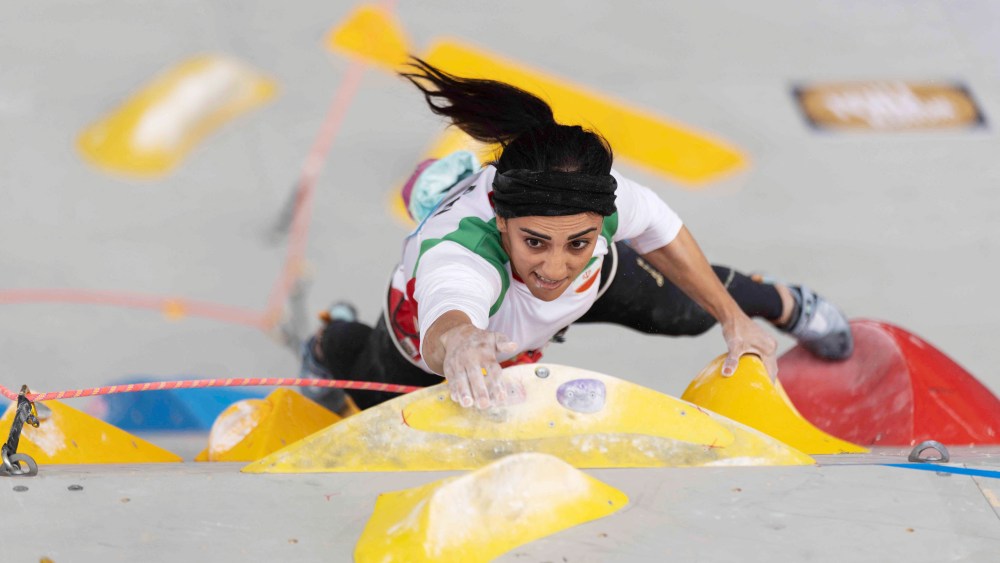
Iranian rock climber Elnaz Rekabi garnered international attention after competing without a hijab on Sunday during the International Federation of Sport Climbing’s Asian Championships in Seoul, South Korea. Iranian women are required by law to wear hijab outside the country when officially representing Iran.
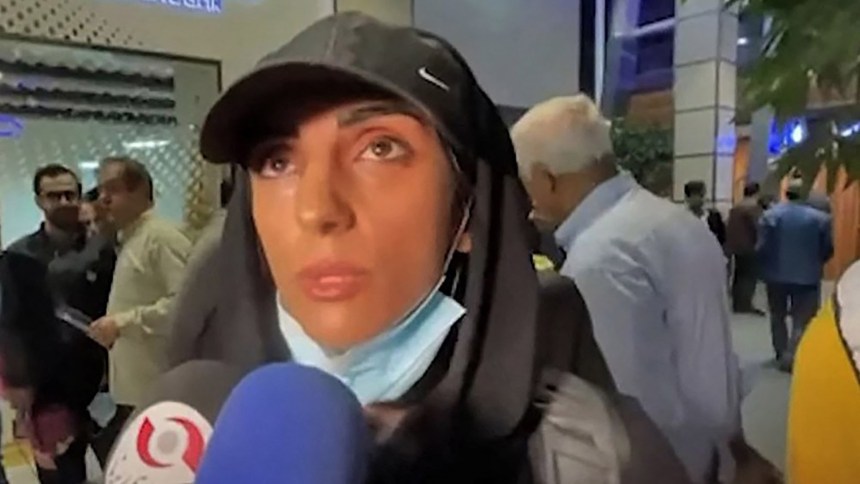
Rekabi returned to Tehran early Wednesday greeted by crowds chanting, “Elnaz is a hero.”
Rekabi returned to Tehran early Wednesday and was greeted by crowds chanting, “Elnaz is a hero,” interpreting the move as a sign of solidarity with the ongoing anti-government protests that have raged across Iran for over a month now, since the death of Mahsa Amini on Sept. 16. The 22-year-old Amini was arrested by the country’s “morality police” for not complying with the state dress code and died in their custody.
But human rights groups remain deeply concerned about Rekabi’s safety. After competing in Seoul, Rekabi could not be located for nearly 48 hours — with reports that her phone and passport had been confiscated — prompting concerns for her safety and speculation that the Iranian government had intervened. A day before she was spotted back in Iran, a post appeared on her Instagram page apologizing for the incident, saying the hijab “inadvertently came off” while hurriedly getting her gear together after supposedly being called to compete earlier than anticipated.
Many human rights groups and activists, including within Iran, suspect these statements were made under duress, especially as as they contradict a statement she made to journalists upon arrival in Tehran: “I was busy putting on my shoes and gear when I was called to compete and I forgot to put on the hijab I had with me.”
Iran has a long and well-documented history of forced confessions from dissenters and activists, including from women who have defied the compulsory hijab law in the past.
Now human rights groups fear the Iranian government will make an example out of Rekabi to discourage similar acts of defiance.
The sustained nationwide unrest is one of the biggest uprisings in the country’s recent history. Hundreds of people have died and almost 8,000 people have been arrested, according to estimates. It is also Iran’s first mainstream women-led protest.
On Oct. 14, a 16-year-old girl, Asra Panahi, died after protesters say she was beaten to death by state security forces for not singing an anthem devoted to Iran’s supreme leader in school. Many of her contemporaries were reportedly beaten in the same incident. Young women and girls have been key targets for Iranian security forces. Sixteen-year-old Sarina Esmaeilzadeh was beaten to death by said forces during a protest on Sept. 23. Nika Shakarami, 16, and Mahsa Mogouyi, 18, were also reportedly killed earlier in September for protesting — just a few in a growing list of murdered women and girls (and men, too) that has only spurred on protesters’ outrage.
Human rights’ groups fear the Iranian government will make an example out of Rekabi to discourage similar acts of defiance.
Masih Alinejad, an exiled Iranian women’s rights activist, wrote on Tuesday in Foreign Affairs that “these demonstrations are different” precisely because they are women-led. She echoed this sentiment in a recent interview with The New Yorker: “The Iranian regime will be brought down by women. I believe this.”
Women’s rights are a significant cornerstone of democracy and, conversely, their suppression is a precondition for authoritarianism. “The oppression of women is a central feature of all authoritarian forms of control around the world, yet far too little attention is paid to the unique promise of women’s uprisings against autocratic governments,” Leta Hong Fincher, author of “Big Brother: The Feminist Awakening in China,” told the Aspen Institute in 2019.
“[T]he 21st [century] is demonstrating that misogyny and authoritarianism are not just common comorbidities but mutually reinforcing ills,” Erica Chenoweth and Zoe Marks explained in Foreign Affairs. “Aspiring autocrats and patriarchal authoritarians have good reason to fear women’s political participation: when women participate in mass movements, those movements are both more likely to succeed and more likely to lead to more egalitarian democracy. In other words, fully free, politically active women are a threat to authoritarian and authoritarian-leaning leaders — and so those leaders have a strategic reason to be sexist.”
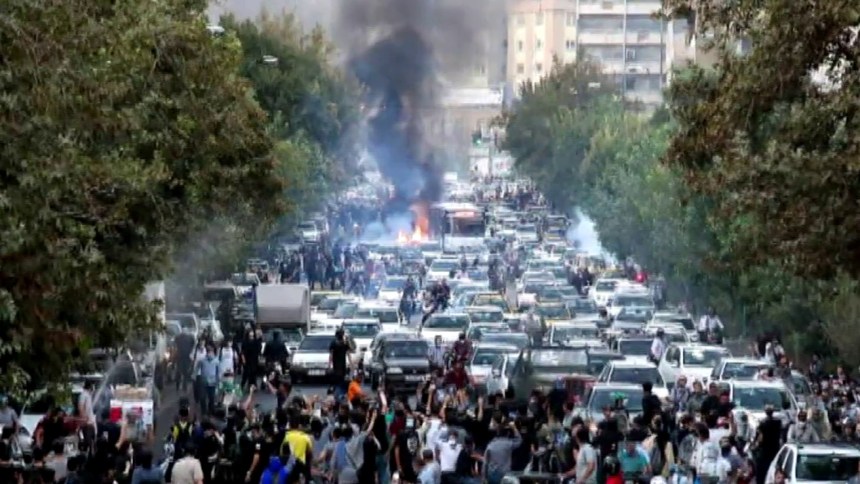
Given the profound threat a women-led uprising presents to the tenuous, regressive and deeply misogynistic social and political order of Iran, there is a logical motivation for the violent suppression of these protests. The survival of Iranian leadership depends on it. The extent of the state-sponsored violence is proof of this alone — our reactions are commensurate with how big we perceive a threat to be. And because it is a battle for survival, civilians are unlikely to win in the long run against a well-resourced state without some kind of meaningful outside support.
Rekabi’s fate remains unclear though the day after the competition, Hillel Neuer, human rights activist and executive director of human rights watchdog group UN Watch, tweeted that Rekabi was going to be taken to Evin prison upon her return, which Iran Wire also reported. One of Iran’s most notorious prisons, Evin contains many of the country’s political prisoners. It, too, made international headlines this weekend after a fire broke out Saturday and at least eight inmates died. (State media has attempted to frame the incident as unrelated to the uprisings, but in video footage from outside the prison, one can hear gunshots, screams and explosions, indicative of protests.)
If Western countries like America were serious about buttressing democratic values, they would see supporting a women-led revolution for the advancement of women’s rights in an authoritarian country as absolutely imperative. But, then again, America has itself cultivated its own special brand of assaulting women’s rights — with Roe being just the tip of the iceberg — so its apathy in supporting Iran is perhaps more aligned with its values than the official rhetoric would have you believe.




Become a member to join the discussion