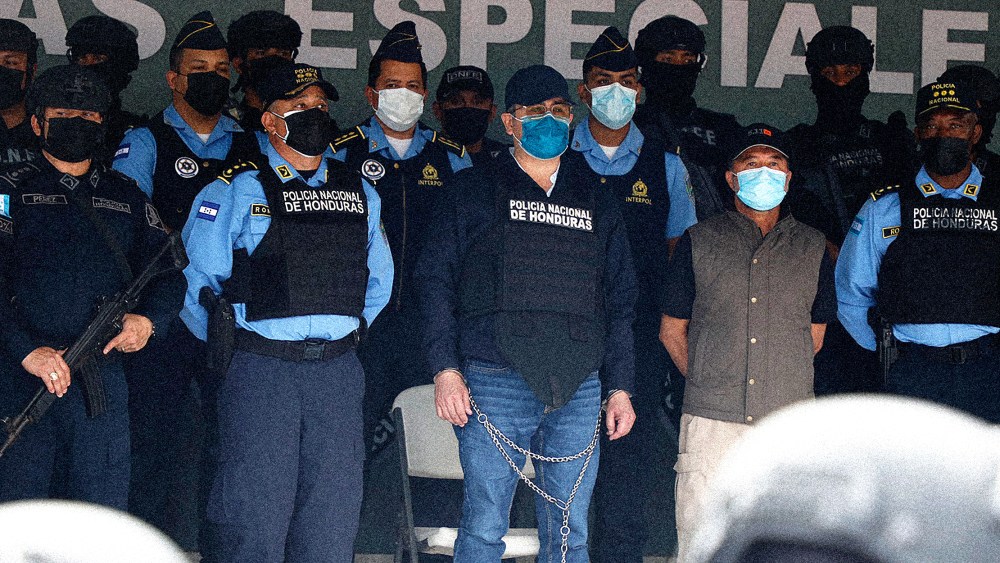
Despite charges of voter fraud, Juan Orlando Hernández was elected president of Honduras in late 2013 with the full support the United States. On Feb. 15, nine years after his election and one month after he left office, Hernández was arrested on charges of drug trafficking at the request of the United States, which has also requested his extradition.
We must place Hernández’s arrest in the context of an ongoing political tragedy that started in 2009.
The story of the politician and alleged drug dealer JOH, as Hernández is often called, is another example of American foreign policy going bad in Central America. Once his power was gone, Hernández, the U.S. ally, instantly became the United States’ enemy, complicating the already uninformed view many Americans have of Honduras.
To understand the key role the U.S. played in creating this problem and destabilizing Honduras for the past 13 years, we must place Hernández’s arrest in the context of an ongoing political tragedy that started in 2009. That June, a military coup led to the ouster of leftist Manuel Zelaya. Many believe Zelaya’s ouster was encouraged by President Barack Obama’s administration, specifically then-Secretary of State Hillary Clinton. The United States denied any role in the 2009 ouster of Zalaya but given the history of intervention in Latin America, skepticism about any claims is natural.
Months after that 2009 coup, right-wing politician Porifiro Lobo was elected president in an election Zelaya called illegitimate. He soon left Honduras, a growing protest movement against the right began to form and in 2013, Xiomara Castro, Zelaya’s wife, ran against Hernández for president and alleged fraud when she lost.

The two Hernández terms that followed will be remembered for a lack of economic opportunities, gangs taking over daily life, constant charges of corruption and allegations linking Hernández to drug dealing. In fact, the U.S. alleges that Hernández has been linked to drug trafficking since 2004.
As one Honduran told The Associated Press when learning of Hernández’s arrest, “He … caused a lot of people to migrate, there was a lot of corruption, there was a lot of unemployment.”
The so-called migrant crisis that has dominated American political media the last two election cycles had some roots in the Hernández era. When unaccompanied minors began arriving at the U.S.-Mexican border, Honduran children were the second-largest group. It was clear that conditions caused by Hernández’s corrupt leadership were a factor.
Not surprisingly, opposition to Hernández grew to levels that were almost historic in the country. The “Fuera JOH” (JOH, get out) chant became a common rallying cry, especially after Hernández won his second term during an election that was even more suspicious than the one before. Despite U.S. support for Hernández and little media attention given to the protest movement, the anti-JOH factions finally claimed victory late in 2021, when Xiomara Castro defeated him this time and became Honduras’ first woman president.
The so-called “migrant crisis” that has dominated American political media the last two election cycles had some roots in the Hernández era.
The hope generated by Castro’s win was magnified after Hernández’s arrest. He had become a symbol of what U.S. policy represents: a culture of corruption that has prevented Honduras from progressing. Despite not being a military leader, Hernández, his opponents say, ran Honduras like a dictator, using his power to personally enrich himself and his family, especially his brother Tony, who was convicted in 2019 of drug conspiracy.
When he served the interests of the United States, Hernández was apparently untouchable. His relationship with the U.S. is likely what made him so unpopular in his country. American troops invaded Panama when its dictator, Manuel Noriega, once an American ally, crossed a line in 1990 by boasting of his drug dealing. Hernández, however, may have been naïve enough to believe his alliance with the U.S. would last forever.
The real power in Central America is and always will be Washington. Once you no longer serve a purpose, Washington may exhibit that power. Hernández being arrested for drug trafficking by a country that consumes the most drugs in the world is riddled with hypocrisy, but it reminds Central America that the U.S. will always be in charge.
The arrest should worry those who successfully fought to end Hernández’s corruption and criminality. While they believe Honduras can move past its history, it will be hard to shake off American power. The United States effectively painted Honduras as a backward country, when it is, in fact, a victim of American intervention and condescension. Even now, as the Biden-Harris administration works to end corruption in Central America as a means to end migration, the framing is always the same. Honduras is corrupt. The U.S. is exceptional.
Where was that exceptionalism during the Hernández’ administration? The U.S. knew who he was but expressed no problem with him until his arrest.
This American tradition of supporting alleged criminals will never go away until the U.S. takes a moral stance and allows for real democracy to prosper in places like Honduras. This latest meddling has led to an untold tragedy that will take years to unpack. One arrest of one corrupt former president doesn’t address the deeper issues that the United States caused but doesn’t want to confront.