President Donald Trump’s suggestion that Republicans should “nationalize the voting” follows his strong push last year for partisan redistricting. The White House’s bullying of local lawmakers to rig this year’s midterm elections reaches into my home state, Missouri, and targets my congressional district.
I have represented Missouri’s 5th Congressional District since 2005. Before that, I served for 12 years on the city council of Kansas City and was the first African American elected mayor, an office I held for two terms. I know and love this community. And what’s being proposed for the 5th District is bad for not only Kansas City, but also voters across the Show-Me State.
What’s being proposed for the 5th District is bad for not only Kansas City, but also voters across the Show-Me State.
Late last summer, after weeks of pressure from the president to redraw congressional boundaries in multiple states, Missouri Gov. Mike Kehoe called our General Assembly into a special session. After two days of fierce debate, the Missouri House passed a gerrymandered map and a bill that would make it difficult to change the state constitution through the ballot initiative process. Although there was bipartisan pushback, the state legislature — which is itself heavily gerrymandered — approved the map under threat from power brokers in Washington. Those who refused to succumb to the pressure were punished.
The pairing of the two pieces of legislation is important. Previous redistricting proposals were considered after a monthslong, statewide process to garner input from local residents and elected officials. That process allowed for a fair representation of views.
Missouri voters responded immediately to the gerrymander effort. In less than 90 days, more than 305,000 Missourians signed a citizen-led petition calling for a statewide referendum to repeal the proposed congressional map. Since 1908, statewide referendums in Missouri have been successful 25 out of 27 times. Knowing this 93% success rate, Missouri Secretary of State Denny Hoskins and Attorney General Catherine Hanaway have attempted to thwart the will of voters. They claimed in December that the new map is already in effect even though the Missouri Constitution gives citizens an explicit right to a statewide vote before new maps can be enacted. Political action committees and others from outside the state have poured money into legal battles over the gerrymandered map and the referendum effort.
Political action committees and others from outside the state have poured money into legal battles over the gerrymandered map and the referendum effort.
If this was not enough disrespect of Missouri voters, the proposed map divides Kansas City into three different congressional districts. One district would place Kansas City’s central business district into a congressional district that stretches to the Missouri-Iowa border and runs across the northern half of the state to Illinois. Another district would lump the Plaza — a distinct area of Kansas City — into a large swath of rural southwest Missouri. And the third proposed district would merge the east side of Kansas City, and its historically African American population, in with the Lake of the Ozarks and more than a dozen rural counties.
Under this map, a single family might live in one congressional district while their children attend a neighborhood school a few blocks away in a separate congressional district and the parents work less than a mile away in yet another congressional district.
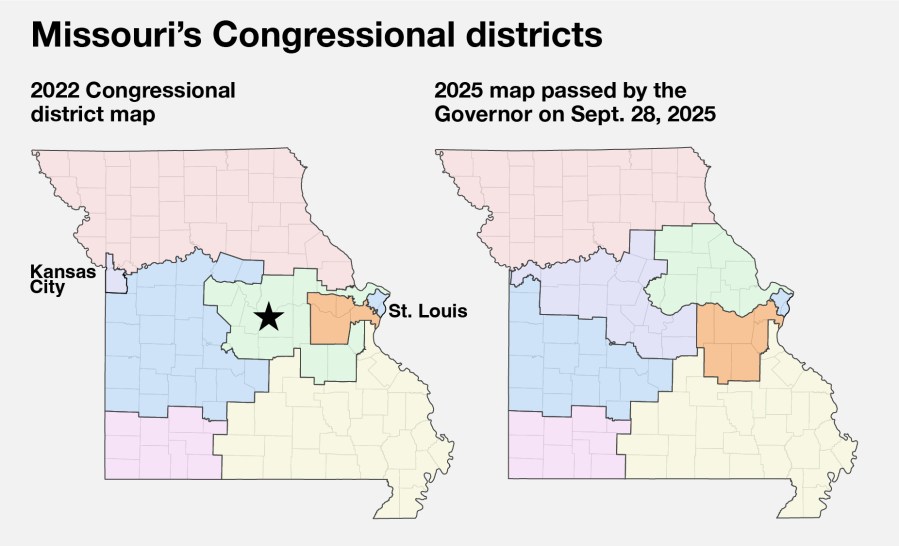
Congressional districts are more than lines on a map; they have the potential to resegregate communities. The historic racial dividing line in Kansas City has been Troost Avenue. West of Troost were white families. East of Troost were Black families. In recent decades, thoughtful and concentrated efforts have been made to erase the divide of what some called the Mason-Dixon Line of Kansas City.
Those efforts at integration created economic opportunity and prosperity for the entire region. Shamefully, the proposed map uses Troost Avenue as the dividing line for the 5th and 4th Congressional Districts. This intentional reviving of a historic symbol of segregation in Kansas City has reignited racial tensions and eroded progress made over many years to bridge the community’s racial divide.
The outrage over all this is not limited to my district. Rural communities around Missouri do not want to be lumped into the same congressional district as urban Kansas City. Their residents’ interests and issues are just not the same. Forcing a combination of wildly different communities is unfair to voters.
Ten lawsuits have been filed over this illegal redistricting plan. The Missouri Constitution states that redistricting shall occur after a census is conducted. This is done every 10 years to ensure equal representation in each congressional district. Imposing a redistricting plan absent a current census ensures unequal representation.
And to make the mess worse, the proposed map duplicates the same ward and precinct in two congressional districts. That means voters in this ward and precinct would be able to vote for two members of Congress — clearly violating the doctrine of one person, one vote.

My constituents — independents, Republicans and Democrats alike — have expressed confusion, anger and frustration. Throughout my career in public service, I have strived to represent all of my constituents, whether they voted for me or not. All elected officials have this charge. We work for the people and swear an oath to the Constitution, not some bully in the White House.
Ignoring the plainly written law and the will of the people to act out of political motivation and fear of retribution is not democracy. At the end of the day, we can disagree on issues and hope to agree on items of common ground. But Missouri’s Constitution is clear. More than 300,000 people in my state signed a petition for a ballot referendum. The foundation of our constitutional republic is providing representation of the people, by the people and for the people. The political process should play out according to the law, not some scheme to implement an illegal gerrymander.