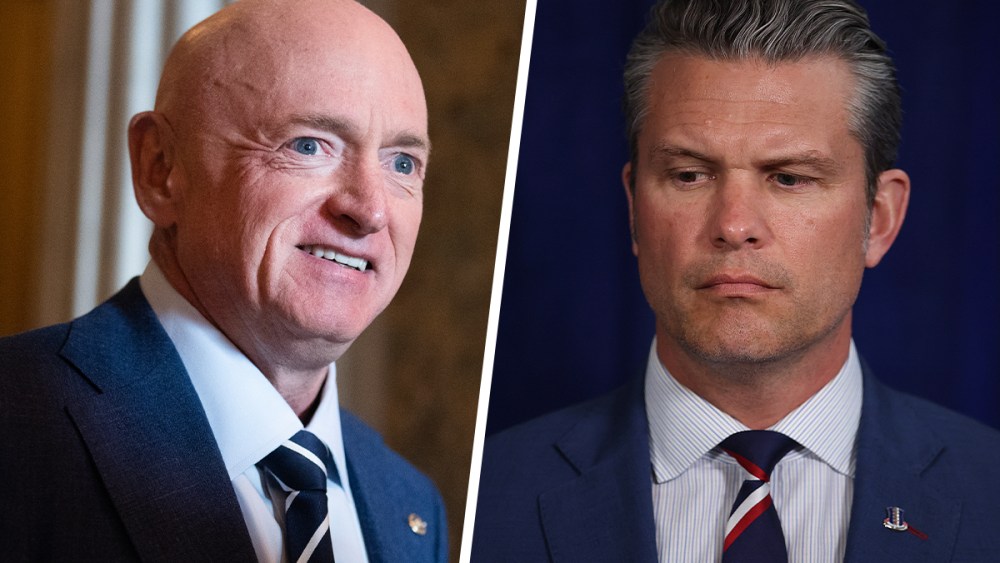
I’m a military retiree who has used my platform as a tenured professor and military law expert to push the Pentagon to improve — often through public criticism of its policies. I was greatly relieved, then, that a federal judge expressed Thursday just how dangerous the Trump administration’s witch hunt against Sen. Mark Kelly is. It is a threat to all military retirees’ freedom of speech and our unique ability to contribute to U.S. national security through that exercise.
In a fiery opinion that quoted Bob Dylan, Judge Richard Leon of the U.S. District Court for the District of Columbia thwarted Defense Secretary Pete Hegseth’s attempt to retaliate against Kelly — and abuse military law — over the senator’s speech. Leon temporarily enjoined the Pentagon from trying to reduce Sen. Kelly’s military rank because he had publicly criticized the Trump administration.
Hegseth’s speech-suppressive campaign against Kelly is extraordinary, and Judge Leon met the moment by clearly outlining its breathtaking consequences for those of us who served our nation for decades in uniform.
Hegseth’s speech-suppressive campaign against Kelly is extraordinary, and Judge Leon met the moment by clearly outlining its breathtaking consequences for those of us who served our nation in uniform. He noted that it “threatened the constitutional liberties of millions of military retirees.”
In early January, Hegseth issued a formal “letter of censure” against Kelly, a Navy combat veteran and astronaut who honorably retired in 2011 after decades of active-duty service. Hegseth claimed that Kelly’s various public critiques of the Pentagon last year — including his appearance in a video with five other military veteran lawmakers urging service members to disobey unlawful orders — constituted conduct both prejudicial to good order and discipline plus conduct unbecoming an officer. Both crimes are unique to the military.
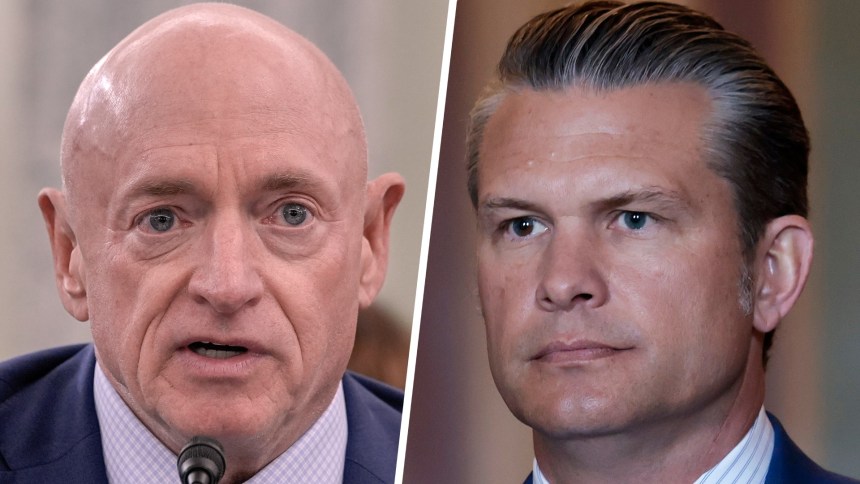
Hegseth’s letter, in addition to characterizing Kelly’s speech as violative of military law, directed Pentagon proceedings to revisit Kelly’s retired rank, even though federal law does not allow administrative rank reduction based on postretirement conduct. Hegseth also threatened criminal prosecution if the senator continued making public comments, a dangerous turn given that the military criminal code extends to retirees (thanks to Civil War-era federal law that needs to be excised) and contains speech crimes with no analog in the civilian world.
Notably, Hegseth pursued this military administrative action solely against Kelly, and not the five other military veterans in the so-called seditious six video, because of Kelly’s status as a retiree. Like all military retirees with at least 20 years of honorable active-duty service, Kelly earns a pension based on his last rank while on active duty and remains subject to military criminal jurisdiction.

But the Trump administration seeks to punish all six. It sought to indict Kelly and his colleagues in federal civilian court over their November video, arguing that the video violated a constitutionally suspect federal statute that prohibits counseling military insubordination. On Wednesday, a grand jury rightly rejected this chilling effort — though Sen. Elissa Slotkin, D-Mich., has said she expects the government to try again to indict them.
In response to Hegseth’s censorious letter (pun intended), Kelly filed a lawsuit against the Pentagon and accused the Defense Department of violating his First Amendment right to criticize the Trump administration and its military policies. Kelly also said Hegseth’s attempt to punish him runs afoul of the Constitution’s Speech or Debate Clause that protects federal lawmakers from executive branch retaliation for doing their job.

Judge Leon’s stinging preliminary opinion released Thursday forcefully called Kelly’s speech fully protected by the First Amendment — specifically because he is a military retiree with greater First Amendment protections than active-duty service members, making Hegseth’s actions against Kelly’s speech unconstitutionally retaliatory. Leon’s opinion justifies the court’s concomitant ruling that orders the Pentagon to stop proceedings to reduce Kelly’s retirement rank, while enjoining Hegseth from pursuing any further action regarding Kelly’s protected speech while Kelly’s underlying lawsuit continues.
The Supreme Court and military courts have long recognized that the military’s need for obedience to command plus maintenance of good order and discipline requires it to restrict service members’ speech to a greater degree than the First Amendment typically allows. This is the rationale that the court has used to uphold the constitutionality of military speech crimes such as “contemptuous words” against federal officials and speech that is “conduct unbecoming an officer.”

But no court has ever extended this shrunken First Amendment protection to military retirees. Retirees for all intents and purposes are merely federal pensioners and no different than all men who have signed up for the draft as required by federal law — as all must comply with a potential federal order to report for active duty. Military retirees do differ, however, in the respect that federal law continues to extend military criminal law to them. But Judge Leon rightly notes that this jurisdictional reach has never been interpreted to also extend identical First Amendment restrictions. And as he vehemently declared Thursday, “This Court will not be the first to do so!”
Unfortunately, Hegseth responded characteristically: by underscoring how committed he is to threatening free speech rights of military retirees. He took to X to mockingly claim, “This will be immediately appealed. Sedition is sedition, ‘Captain.’”
I trust that the D.C. Circuit, and eventually the Supreme Court, will continue to protect the free speech rights of millions of us military retirees. While the attempt to silence a sitting senator has enormous implications for our constitutional democracy and the separation of powers because of his elected role, Kelly winning his lawsuit is important for all of us retirees whose voices are vital to our nation.
As Judge Leon remarked in closing his opinion, “[r]ather than trying to shrink the First Amendment liberties of retired servicemembers, Secretary Hegseth and his fellow Defendants might reflect and be grateful for the wisdom and expertise that retired servicemembers have brought to public discussions and debate on military matters in our Nation over the past 250 years.”