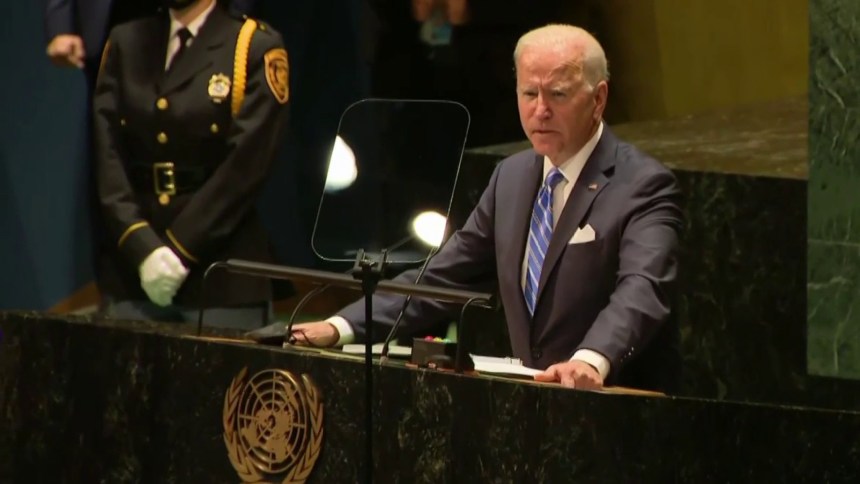
President Joe Biden had a simple message in his speech to the United Nations General Assembly on Tuesday: The U.S. is back to being the global hegemon you all know and love.
There was nothing particularly new or novel in the framing of Biden’s 34-minute address. It was staid and steady, with little of the oratorical flourish of the Obama era and none of the self-congratulatory jingoism of the Trump age. At times, it sounded like a speech that could have been delivered by (almost) any other U.S. president since the early 1990s. And that’s likely how his advisers wanted it to sound.
Biden’s performance was akin to an aging rock star playing a medley from their greatest hits album.
Biden encouraged global cooperation on issues including climate change and prevention of the next pandemic. He vowed to not let Iran develop a nuclear weapon and offered his support for the two-state solution to end the Israeli-Palestinian conflict. He denounced corruption as a “threat to national security” and vowed to support human rights around the world.
Biden’s performance was akin to an aging rock star playing a medley from their greatest hits album. The lyrics to a few tunes might have been tweaked, but the underlying chords remained the same. The question now, though, is whether the audiences in the hall and in the world’s capitals are nostalgic for that familiar playlist.
The Biden administration is betting the world audience does long for that familiarity, and for the same reasons Biden determined that trotting out the crowd favorites was necessary. At times it felt like Biden was attempting to erase the four years of former President Donald Trump from the timeline entirely, retconning it like a particularly hated season of a TV show. As such, there was no overt mention of the “America First” policy that Biden was systematically rebuking with his promise that “as we look ahead, we will lead.”

“We will lead on all the greatest challenges of our time — from Covid to climate, peace and security, human dignity and human rights — but we will not go it alone,” Biden said. “We will lead together with our allies and partners and in cooperation with all of those who believe, as we do, that this is within our power to meet these challenges, to build a future that lifts all of our people and preserves this planet.”
While it may seem that Biden’s laying it on a little thick, this is no time for subtleness. There were no minced words from him when he called out Chinese human rights abuses in Xinjiang alongside reports of war crimes in Ethiopia and the need to protect LGBTQ rights in Chechnya. The contrast to Trump’s glad-handing with dictators and tyrants was clear.
Where Biden really hit his stride was in a section toward the end focused on the clash between democracies and authoritarian governments, a struggle that he insisted democracies will win.
“The future belongs to those who give their people the ability to breathe free, not those who seek to suffocate their people with an iron-hand authoritarianism,” he said. “The authoritarians of the world, they seek to proclaim the end of the age of democracy, but they’re wrong.”
It’s a theme Biden has hit often in the last nine months, at times unprompted. In March, when selling his multitrillion-dollar infrastructure plan, he framed the matter as vital to deciding the fate of that ideological struggle.
“I imagine your children and grandchildren will be doing their thesis on who succeeded: autocracy or democracy,” Biden said. “Because that’s what’s at stake.”
In June, when he was still shepherding his infrastructure plan through Congress, he brought it up again.
“One of the underlying questions is: Can democracies compete with autocratic enterprises in the 21st century?” he said. “And this is a big move toward that, being able to compete. We have to move, and we have to move fast.”
At the U.N. on Tuesday, though, Biden made clear he wasn’t out to start any new beefs in the process:
All of the major powers of the world have a duty, in my view, to carefully manage their relationships, so they do not tip from responsible competition to conflict. The United States will compete, and will compete vigorously, and lead with our values and our strength. We’ll stand up for our allies and our friends and oppose attempts by stronger countries to dominate weaker ones, whether through changes to territory by force, economic coercion, technical exploitation or disinformation. But we’re not seeking — say it again, we are not seeking a new Cold War or a world divided into rigid blocks. The United States is ready to work with any nation that steps up and pursues peaceful resolution to shared challenges, even if we have intense disagreements in other areas.
That’s quite the high wire act to maintain for the Biden administration. Presidents have tried before to blend the realist need to cooperate to achieve goals, even with adversaries who abuse human rights, with the liberal internationalist belief that democratic institutions such as the U.N. can constrain dictators. History shows that it’s not gone particularly well for any of them, as President Barack Obama’s foreign policy, in particular, at times buckled under pressures from Russia and the Middle East. It’s not yet clear whether the delegates in the room, who to their credit did not once laugh at Biden’s declarations, fully bought that this is a feat the United States can pull off.
Biden gave the speech he needed to give at the U.N.
In the run-up to Tuesday’s speech, there’d been a lot of question marks surrounding the idea that “America is back,” as Biden put it in a meeting with U.N. Secretary-General António Guterres. Observers have wondered if the United States is a less trustworthy ally, especially after the chaotic withdrawal from Afghanistan and a recent diplomatic kerfuffle with France over a submarine sale to Australia. And the domestic situation in the U.S. remains tense: There’s no way to avoid the fact that even as Biden is promoting democracy overseas, Republicans at home are attempting to subvert it.
But in the end, Biden gave the speech he needed to give at the U.N. He framed America’s competition with China as manageable and not a threat to international stability. He was forthright about the crises the world faces and the struggle it will be to overcome them. And he promised the U.S. will be there to help guide, not bully, the U.N. and its members through the process.
Biden’s got three more of these speeches to deliver before his term ends. It’ll be fascinating to compare 2021’s with 2024’s version to see if he’s still playing the same old song he thinks the crowd wants to hear.