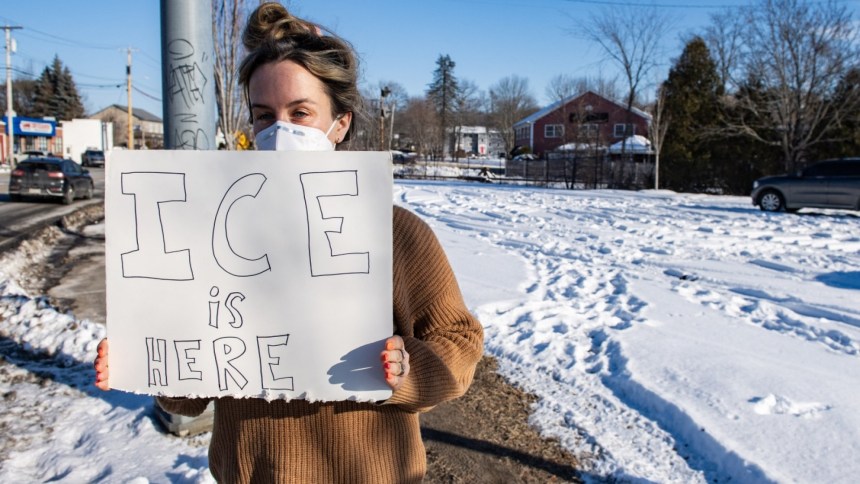
According to a leaked memorandum issued in May by Immigration and Customs Enforcement, the Trump administration has authorized ICE agents to conduct what are effectively home invasions, trespassing on private property without judicial warrants.
For years, right-wing Republicans have denounced Democrats for aiding an “invasion” by immigrant “trespassers.” These were always specious arguments. Immigrants working for us are hardly “invaders” — legal or otherwise — and even if some are here illegally, they aren’t “trespassing.” They live in their own homes on private property. This was overheated rhetoric at best. At worst, the arguments were dangerous threats to deploy violence. Either way, the leaked ICE memo, first reported by the Associated Press, exposes the emptiness of the GOP’s supposed commitment to opposing “invasions” and “trespassing.”
For years, right-wing Republicans have denounced Democrats for aiding an “invasion” by immigrant “trespassers.”
It is difficult to overstate how central to GOP rhetoric on immigration the “invasion” and “trespassing” lines have become. The GOP’s official platform denounces the “Migrant Invasion,” which featured heavily in campaign ads in 2024. White House deputy chief of staff Stephen Miller has referred to immigrants as “trespassers” dozens of times on X alone.
Yet when it comes to invasions of our homes by masked government agents, he’s silent.
Nothing is more sacred in the American legal tradition than the sanctity of the home. As the Supreme Court said in 1972, “physical entry of the home is the chief evil against which the wording of the Fourth Amendment is directed.” In 1980, the court was clear that even in the case of people accused of violent felonies, the Constitution “prohibits the police from making a warrantless and nonconsensual entry into a suspect’s home.”
Even the official training materials for the Department of Homeland Security still plainly state that “entering a home to arrest a person without a warrant or an exception to the warrant requirement is typically a violation of the Fourth Amendment, regardless of whether the officer has probable cause to arrest the suspect.” It notes that the relevant warrant must be issued by a judge.
The blatant illegality is almost certainly the main reason that ICE carefully hid the policy for the better part of a year from the public.

These home invasions without judicial warrants aren’t merely hypothetical, either. This month, ICE arrested ChongLy Scott Thao, a U.S. citizen, inside his home in St. Paul, Minnesota. “I was shaking,” Thao told the Associated Press. “They didn’t show any warrant; they just broke down the door.” His 4-year-old grandson reportedly cried as Thao was led out in nothing but sandals and underwear.
DHS says its agents were actually searching for someone else. If they had been forced to test their evidence with a judge, it may have prevented Thao’s ordeal.
Another Minnesota family with children in the home had their door smashed down by DHS agents using a battering ram with guns drawn, but without a warrant. Family members demanded to see one, and agents just showed them a piece of paper signed by a DHS official. They arrested a Liberian immigrant father inside.
Thao was eventually let go without an apology. A federal judge has ordered the release of the Liberian father illegally detained. These are just some of the most extreme recent examples. For months, I have been tracking dozens of instances of ICE and DHS agents entering private property without warrants.

Security cameras captured the moment when trespassing DHS agents jumped the fence outside the home of a U.S. citizen in Chicago in October. Even after being told to leave and that they didn’t have a warrant to be on the property, agents refused to leave and arrested workers there.
The imagery couldn’t be more on point. For DHS, immigrants are “invaders” and “trespassers” who require a military-style response when they go over or around barriers in the public lands in California and Arizona to request asylum. But when the department’s own agents violate the Constitution by hopping fences to invade private homes, they are not.
Illegal entry into the United States by immigrants is unpopular, but illegal entry into our homes by government agents will be even more unpopular. In a free country, the executive branch must be required to seek permission from a neutral party to enter our private spaces — showing probable cause of a violation of the law.
The other difference between ICE and immigrants (whether asylum seekers or people who cross the border illegally) is that the latter effectively have no path to enter the United States legally. There is no “line” that they can wait in patiently for their turn to come in. By contrast, ICE does have a legal way to enter private property: get a warrant from a judge based on probable cause.
Whether they believed it was an “invasion” or not, many Americans rightly wanted chaotic illegal immigration at the Southern border to stop. This boosted Trump and his extremist rhetoric in 2024. But ICE’s new warrantless policy has made Trump the leader of the pro-invasion party now.