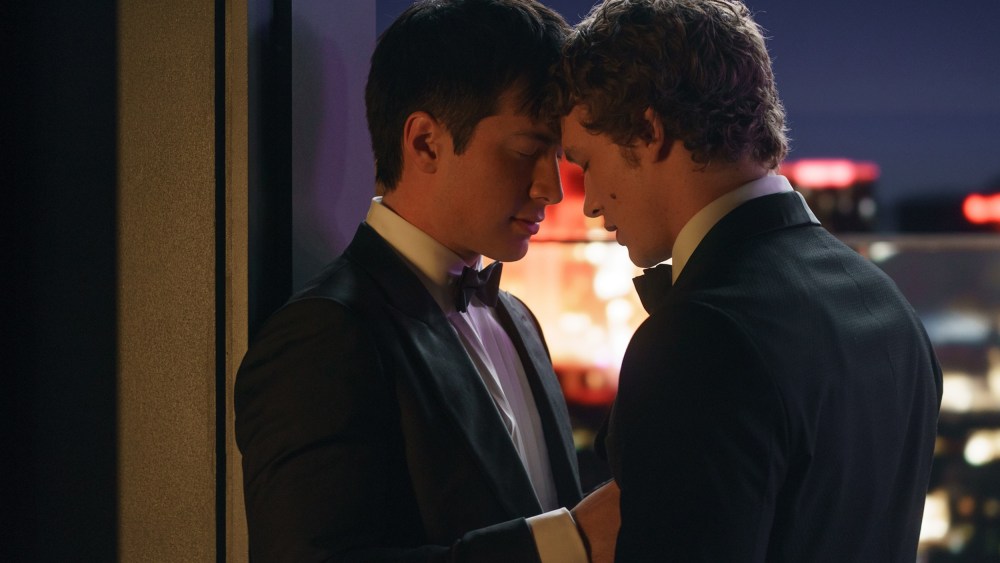
Something unexpected is steaming up windows across middle America just in time for the holidays. Based on the romance novel series “Game Changers” by Rachel Reid, “Heated Rivalry,” the “gay hockey show,” as it’s being affectionately called, has become a full-blown cultural phenomenon, with sports bars streaming the episodes to screaming crowds and the trailer being played on the jumbotron during “Pride Night” in Montreal’s Centre Bell. And the hype around Friday’s finale was no different.
In this wild and unpredictable year, the success of this sexually explicit series produced by the Canadian channel Crave has likely taken some critics by surprise. But that’s part of the joy of watching the rise of “Heated Rivalry.”
In this wild and unpredictable year, the success of this sexually explicit series produced by the Canadian channel Crave has likely taken some critics by surprise.
For the uninitiated, the concept of LGBTQ+ hockey romance may seem niche. But this subgenre has risen in popularity — both in readership and as a “writing prompt” (a suggested starting point for a story) for fan-fiction writers — since the beginning of the 2020s.
Part of the appeal is baked into the premise itself. Hockey skews young, white and tends to be very insular. As a result of geography, culture and barriers to entry, professional leagues also remain surprisingly homogenous. The NHL’s first diversity and inclusion report in 2022 found that 84% of players and employees were white. The NHL is also perceived as surprisingly exclusionary for such a mainstream league, due in part to Commissioner Gary Bettman’s past bans on LGBTQ+ symbols and merchandise, and his comments defending players who refuse to participate in “Pride Nights.”
As a result, hockey romance literature can be viewed as its own small form of rebellion. In 2024, Archive of our Own (AO3), a website on which up-and-coming writers post fan fiction, “Alternative Universe (AU)” stories set in the world of hockey shot to the top of the writing prompts list. The prompt replaced long-time favorite “Coffee Shop AU,” where writers pair their favorite fictional duos within the story of a barista and customer who fall in love at first sight. (Ironically, Reid’s original first draft of what would later become her debut novel, “Game Changer,” was published on AO3 as a Marvel variant of Coffee Shop AU fan fiction.)
“Heated Rivalry” isn’t the first romance to be made into mainstream (or mainstream-adjacent) television, of course. But so far, the genre’s adaptations have trended much more tame, from the family-oriented “Heartstopper” to Amazon’s “Red White & Royal Blue.” Unlike those series, which feature semichaste teens, “Heated Rivalry” is unapologetic erotica for most of the book’s first half, as lovers Shane and Ilya’s entire relationship for the first few years consists solely of secret post-match hotel room rendezvous.
Much like the first season of “Bridgerton,” “Heated Rivalry” doesn’t shy away from the sex, tastefully filmed in softly lit expensive bedrooms, the better to emphasize the stars’ “hockey butts.” But “Bridgerton” never managed to accomplish the same feat: invading male-dominated spaces such as sports bars and arenas with unusual enthusiasm.
To be fair, “Bridgerton” has been hobbled by Netflix’s nonsensical “binge drop” method, denying fans a weekly roll out that could easily become “Bridgerton Night” at local watering holes. (Pity the final season of “Stranger Things,” which may have initially dominated the Nielsen streaming stats but basically disappeared from the cultural conversation by the end of Thanksgiving. Maybe Part 2 will fare better.) In that sense, “Heated Rivalry” has also been extremely lucky in that it was picked up by the network it was most suited for: HBO.
But I’d argue there’s something else going on here. In chatrooms and on social media, you hear a common refrain.
Since its inception at the end of the 1970s, HBO has always pushed television’s Overton window, from the soft-core films of the 1980s, to shows such as “Oz” and “Real Sex” in the 1990s. HBO was where LGBTQ+ touchstones such as “And the Band Played On” and “Angels in America” first aired, and more recently has been home to queer shows including “It’s A Sin,” “Looking” and “Our Flag Means Death.” In that sense, “Heated Rivalry” is merely the next step forward in TV’s queer cultural evolution.
But I’d argue there’s something else going on here. In chatrooms and on social media, you hear a common refrain: “Heated Rivalry” is the thing that made this terrible year better. The 2020s may be America’s decas horribilis, but all hope is not lost. Not when the acknowledgement of this trope is being given mainstream recognition on a widely watched American network known for its tasteful transgressive progressivism.
That may be a small holiday bright spot, but it’s not nothing. There are plenty of days when it can feel like the people trying to turn back the clock to 1850 are winning. “Heated Rivalry” is a glorious reminder that, it is, in fact, still 2025.