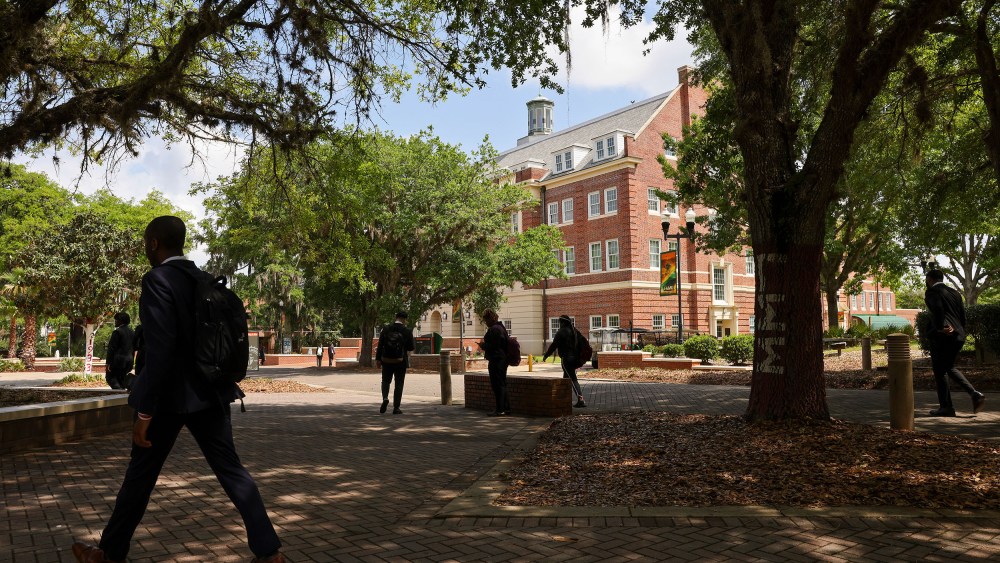
Last week at Florida A&M University, my alma mater, a law school student was initially told by the university that she couldn’t use the word “Black” on a Black History Month flyer because it violated Florida’s law prohibiting DEI programming at public universities. The university has since said a staffer gave the law student that information in error, but such confusion is an inevitable consequence of the backward law my colleagues in the Florida Legislature passed in 2023.
Such confusion is an inevitable consequence of the law my colleagues in the Florida Legislature passed.
Florida A&M is one of our country’s many historically Black colleges and universities, or HBCUs. It’s absurd when a student at an institution founded to promote Black excellence is put in the bizarre situation where she’s told that she can’t use a word that’s used to describe the university she attends. To be clear, though, it would be just as wrong for officials at a majority-white institution to bar students there from putting up the type of flyers the FAMU student was attempting to distribute.
Even though FAMU has admitted that its staffer was in error, this must not be the end of the conversation.
Because this is not just about a single flyer or a staff error. It is an example of what happens when there’s a broad effort to sanitize history and minimize the contributions of Black Americans. Florida has attempted to create an environment where discussing race, struggle and achievement becomes so legally fraught that people simply choose to be silent.

I and some of my colleagues in the Florida Legislature warned about such consequences when this bill was being debated. When laws are vague, people overcorrect out of fear, and confusion replaces common sense. When institutions and students are left guessing about what’s allowed, they err on the side of silence. Such a chilling effect threatens the very fabric of historical truth and education in not only Florida, but nationally, and it’s all the evidence we need that the law needs to be repealed.
Black History Month, which was launched as Negro History Week by historian Carter G. Woodson in 1926, is more than just a designated place on a calendar. Black History Month serves as a vital reminder that the Black experience is integral to the American story. It is a time to celebrate figures such as Dr. Martin Luther King Jr., but also to teach the uncomfortable truths about the systemic oppression he fought against. It is a time to honor the resilience that built this nation, often without acknowledgment or compensation.
We must reject the notion that this history is “divisive” or somehow dangerous to teach. What is dangerous is ignorance. What is dangerous is creating a generation of students who do not understand the roots of systemic inequality, who are shielded from the stories of courage and perseverance that define the Black community.
I warned about such consequences when this bill was being debated.
As a proud FAMU alum, I know that our history cannot be erased by fear or bureaucratic overreach. Our colleges and universities — especially our HBCUs — must stand as bulwarks against these attempts to silence us. We have a moral obligation to ensure that the celebration of Black history, culture and achievements is not only allowed but championed.
Our message to all students and educators, wherever they are, must be unequivocal: Do not let fear dictate what you teach, what you learn or what you celebrate. The struggle for truth is central to the Black experience. We will continue to speak the name “Black,” teach the history and celebrate the culture — loudly and without apology. The importance of our history is too great to allow it to be diminished by vague laws designed to erase us from the narrative.