When two Customs and Border Patrol officials shot Alex Pretti on a Minneapolis street last month, killing him, it marked a sharp escalation in tensions between the federal agents who’ve been blanketing the city and members of the community.
But there was an irony to the incident that’s hard to ignore. Prior to his death, Pretti was also a federal employee, working as a nurse with the Department of Veterans Affairs. In effect, the federal government was deployed against the federal government, with two law enforcement officers fatally shooting a caretaker.
It’s a grim mirror image of President Donald Trump’s priorities for the government overall during his second term in office.
This is the story of Donald Trump’s overhaul of the federal government: slicing away as many employees as possible, particularly in science-related fields, in favor of staffing up immigration enforcement.
Last week, the Office of Personnel Management released data on federal employment in December 2025, giving us a clear sense of how the composition of the federal government shifted during Trump’s first year back in the White House. The topline story is well-known by now: Hundreds of thousands fewer people work for the federal government now than at the end of the Biden administration, a shift Trump has publicly celebrated.
According to the December data, the equivalent of one in 10 people who were working for the government in December 2024 no longer does. That decrease is higher among those employed in STEM-related roles, where employment dropped more than 12%.
No federal agency saw a larger reduction in its workforce than Veterans Affairs. That agency has nearly 29,000 fewer employees than it did a year ago. By contrast, the Department of Homeland Security, or DHS, lost fewer than 4,000 employees — though CBP actually gained employees. To the point with which we began, there were about 4,000 fewer nurses working at the VA in December than there were 12 months prior, including registered nurses, licensed practical nurses and nursing assistants). There were nearly 1,400 more CBP agents employed during that same period.

The additional CBP agents were overwhelmingly young, with most of those added to the workforce under the age of 30. It was among the youngest VA nurses where losses were the largest.
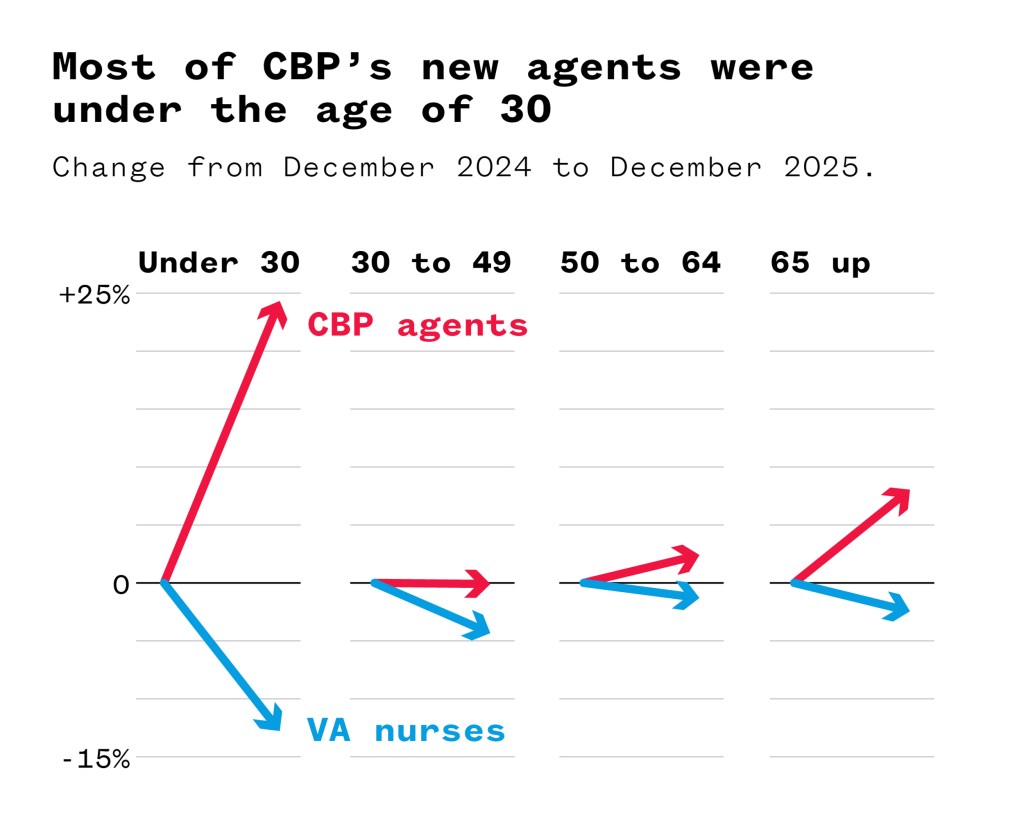
Reductions among younger employees were common across the government. The largest reduction of employment between December 2024 and December 2025 was among probationary permanent employees, a group that skewed younger than other employee groups in December 2024 — and more than 98,000 of whom lost their jobs on net. This was facilitated by a 2025 change to past practice that saw people at the end of their probation period eliminated by default, rather than retained.

The category of employee that saw the biggest increase relative to December 2024? Political appointees (who, incidentally, also skewed younger than other groups).
(There are a lot of different categories of employment within the government; you can learn more about them at the OPM website.)
The broad reductions shown on the chart above were reflected in reductions in nearly every department of nearly every agency. But there were exceptions — like both CBP and Immigration and Customs Enforcement.
In fact, excluding jobs added to departments that recorded no employees in December 2024 (generally meaning they were renamed or new), more employees were added to ICE than to all of the other departments that gained employees combined. When you add in CBP and a few other departments, DHS accounts for about three in five new employees added among those departments. Most of the rest were in the office of Interior Secretary Doug Burgum, who transferred a number of staff from other parts of the agency to his team.

This is the story of Donald Trump’s overhaul of the federal government: slicing away as many employees as possible, particularly in science-related fields, in favor of staffing up immigration enforcement. For all of Trump’s frequent insistences about the importance of veterans, the VA was among the hardest-hit agencies.
The federal government got rid of 4,000 VA nurses and hired almost 1,400 Border Patrol agents and another 7,500 employees of ICE. What happened in Minneapolis last month was a tragedy, and a metaphor.