At the outset, it’s appropriate to recognize that the recent uptick in rhetoric about the importance of America’s “heritage” is nothing more than repainted racism. It is no more complicated than Southern insistences that an embrace of the Confederacy is similarly about heritage, when the defining characteristic of the Confederacy was its unrelenting commitment to enslaving Black people.
When we see a social media account for President Donald Trump’s White House share a message about being “unapologetic in our heritage,” we correctly understand that as an extension of “making America great again” — unwinding America’s evolving diversity in favor of a society that continues to hand advantages to whites and men while pretending they are simply the natural state of things.
When we see Trump ally Elon Musk and others insist that this heritage is inextricably white — a culture of “English-Scotts-Irish origin,” in Musk’s verbiage — the point is not hard to perceive.
Arguing that America was built on white culture gets at an accurate insight by an indirect path: “whiteness” and “Americanness” are often treated as equivalent.
This language, cribbed in spirit (and, occasionally, actual wording) from white nationalists, gets America’s story willfully wrong. Being “American” has often been conflated with being “white” by those in power, largely for self-serving reasons. But the ethnicities placed under the “white” umbrella have evolved. An America in which Europeans were collectively white and immigration from other places was limited is not the historical norm for the U.S. It was, instead, a mid-20th century aberration.
“The baby boom grew up in the whitest, most native-origin population in U.S. history,” demographer Douglas Massey explained when we spoke several years ago. “In 1970, the percentage foreign-born fell to its lowest point ever in American history, 4.7%. The average immigrant in 1970 was somebody’s grandparent.”
This was a function of restrictions on immigration instituted in the Johnson-Reed Act of 1924. It reflected concerns about increasing immigration from Asia and Eastern and Southern Europe — areas full of people not recognized as white in the way that Western Europeans were.
“There were very salient lines between Italians, Poles, Russian Jews, and Anglo-Saxon Americans” in the 1920s, Massey explained. The Johnson-Reed Act used those lines to build walls that lasted until the late 1960s.

Until the 1980s — meaning, until Johnson-Reed was rescinded — immigrants to the U.S. primarily came from Europe. In recent decades, they have been more likely to come from the Americas and Asia.
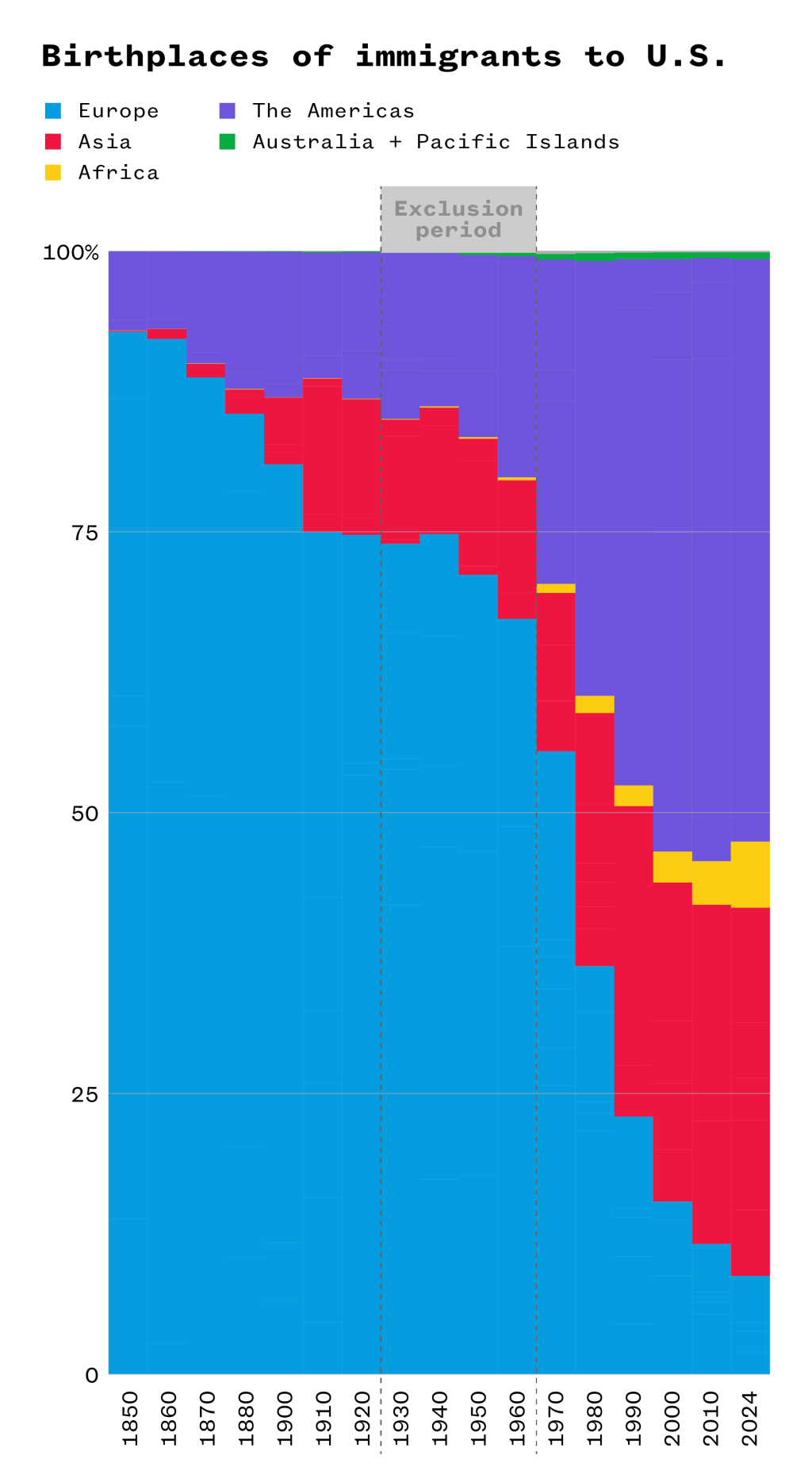
But, again, that obscures the tension between groups from Europe. The surge in immigrants from Ireland in the mid-19th century led to their being targeted with discriminatory laws and practices, undercutting Musk’s point pretty effectively. An increase in arrivals from Italy, Greece and Hungary contributed to Johnson-Reed. Massey noted that Irish and Italians were equated with non-white people, targets of racist organizations such as the resurgent Ku Klux Klan, in part for their religion.
“The Greeks control the restaurant and confectionery business, the Italians the fruit and produce business,” a flyer for a 1925 Klan rally in Washington, D.C., warned. “The Irish Catholics control us politically and are trying to control us religiously.” (Two years later, another Klan rally in New York City became a riot at which Donald Trump’s father was arrested.)

This history is mostly forgotten. People of Irish, Italian and Greek heritage are folded into the broader category of “white” in a way that would have seemed unusual a century ago. This is in large part because, in the intervening decades, Americans married Americans and had American kids, blending Irish and Scandinavian or Italian and Black or French and Greek in ways that made it hard to draw sharp lines even if one wanted to.
Now, Hispanics are a central target of anti-immigrant rhetoric, for the same reasons that the Irish and Italians were: They don’t speak English! They’re taking our jobs! They’re changing what it means to be American! (When an Italian anarchist was accused of setting off a bomb on Wall Street in 1920, The Washington Post’s editorial board warned about “the extent to which the alien scum from the cesspools and sewers of the Old World has polluted the clear spring of American democracy.”)
But “Hispanic” is also malleable, and racial boundaries between white and Hispanic are less clear than we pretend. People of Mexican and Central American heritage have been intertwined with white Americans in parts of the U.S. (the Southwest, Texas) for centuries. In fact, despite hand-wringing about the U.S. becoming “minority majority” in a few decades, Americans are already much more ethnically and racially blended than we often recognize. Changes in how the Census Bureau records data on race and heritage helped trigger a huge spike in the number of Americans who already identify as multiracial. Later generations of Hispanic Americans, meanwhile, often identify not as Hispanic but as simply “American.”
Arguing that America was built on white culture gets at an accurate insight by an indirect path: “whiteness” and “Americanness” are often treated as equivalent. Italians were “alien scum” until, over time, they just became white people. Real Americans that contributed to America, despite the hand-wringing about the influx of immigrants from Italy a century ago.
The ability of Americans to claim the mantle of “white” does also depend on skin color. This was part of the concern about Eastern and Southern Europeans a century ago; they didn’t fit the phenotype. But this is also a useful point to note that the culture of the U.S. is heavily dependent on people from Africa who were kidnapped and forced into servitude. In 1850, while 11% of U.S. residents were immigrants, 15% were Black, according to the Census Bureau — eight in nine of them enslaved.
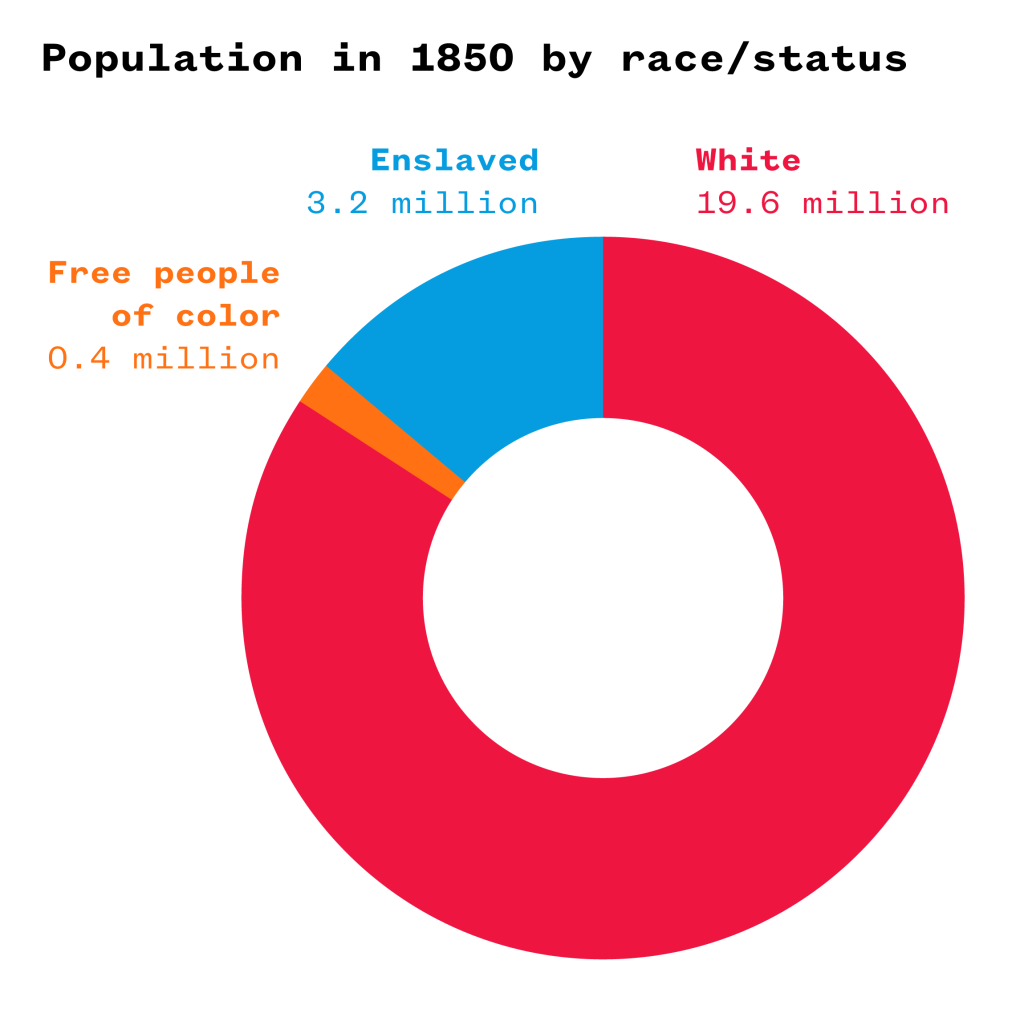
To suggest that American culture wasn’t shaped both by enslaved people and enslavement is to reject an enormous portion of American history — again, often willfully.
Historian David Roediger has noted that the racial groupings we use today will evolve over the next century just as they did over the last one.
“The answer to whether there might be 77 million, or fewer, or three times that many, Latinos in 2100,” he wrote, “will be decided historically and politically, not just demographically.”
Again: Descriptions of U.S. heritage and culture in terms of ethnic and racial groups beyond the familiar “melting pot” metaphor are inherently political. Here, now, they are explicitly political, arguments about an America that never was — in service of eliminating currently disfavored immigrant groups from the America that is.