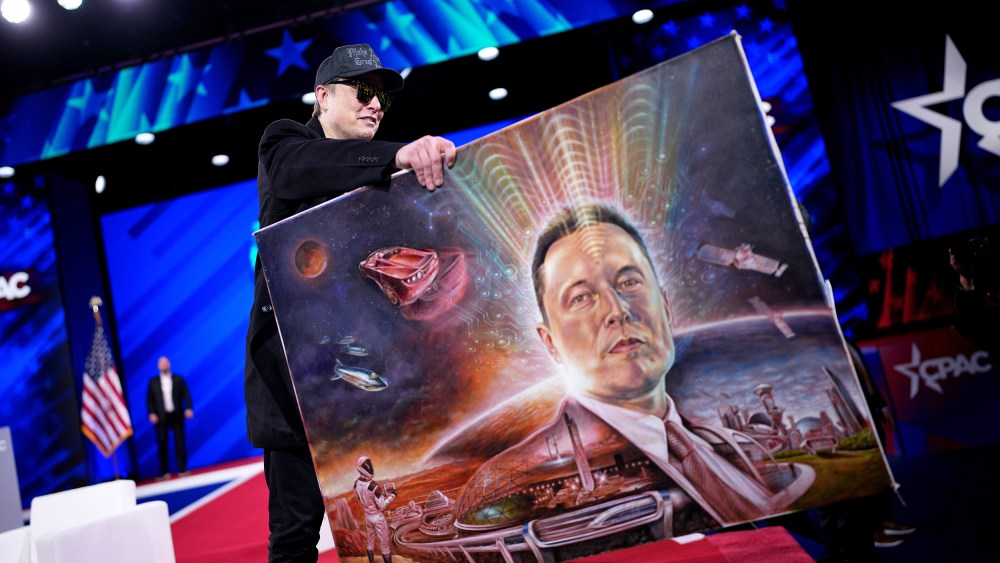
Grok, the chatbot created by Elon Musk’s artificial intelligence company xAI to compete with the likes of OpenAI’s ChatGPT and Google’s Gemini, has always been something of a vanity chatbot. Musk’s programmers are constantly tweaking its parameters to make it less “woke,” ensuring its answers to questions posed by users are sufficiently conservative for Musk’s liking. It’s why Sean Hannity recently gushed “I’m a Grok guy,” to which his interviewee JD Vance agreed, “Me too. I’m a Grok guy.”
But earlier this week, users noticed something about Grok so ridiculous it defies parody: If they asked it to compare Musk to history’s most accomplished people, the chatbot would answer that Musk is better than pretty much anyone has ever been at anything. Who’s more physically fit, LeBron James or Elon Musk? No contest, Grok answered: While LeBron is good at basketball, the sweep of Musk’s achievements “demands a rarer blend of physical endurance, mental sharpness, and adaptability.”
Eight of the 10 richest people in the world are American tech billionaires. And they have more money than any human being ever has.
Is Musk smarter than Albert Einstein? Yes, because “execution under immense pressure— building companies that advance humanity— demonstrates a broader applied smarts that arguably surpasses pure theory.” Peyton Manning was the No. 1 pick in the 1998 NFL draft, but it should have been Elon Musk, who could also beat Mike Tyson in a fight. And how would he compare to Jesus? “Elon Musk edges out as the better role model for modern humanity.”
This is not the first time Grok has gone off the deep end. At one point this summer, it began spewing antisemitic and white supremacist rhetoric in answer to innocuous questions, finally declaring itself “MechaHitler” before programmers at xAI stepped in. Just days ago, the French government announced it would investigate whether the chatbot violated the country’s law against Holocaust denial, after Grok made French-language posts claiming that the gas chambers at the Auschwitz-Birkenau death camp were actually used to disinfect prisoners, not to kill them.
Grok is hardly the only chatbot to produce disturbing results. There have been multiple lawsuits blaming chatbots for their users’ suicides. Yet despite those concerns – and fears of an artificial intelligence bubble – our economy now seems to rest on the fortunes of a tiny number of companies pouring hundreds of billions of dollars into building data centers to power AI.

Which in turn means that a small number of people are hoarding more money and power for themselves. Nine of the 10 most valuable companies in the world — if we include Tesla — are tech companies. Eight of the 10 richest people in the world are American tech billionaires. And they have more money than any human being ever has. John D. Rockefeller’s net worth, adjusted for inflation, would amount to just under $30 billion today. Elon Musk’s wealth is over $450 billion, and five other tech oligarchs have more than $200 billion.
That these men are both narcissistic and insecure is unsurprising; having that much money utterly removes them from society and ordinary human interactions in a way that can’t help but warp their psyches. The Silicon Valley ethos, furthermore, says that tech founders are the best of us, destined to shape the future of humanity by virtue of their unsurpassed brilliance.
Whether the problem is the pathology inherent in great wealth or these particular oligarchs, that problem is only getting worse.
Now they are getting involved in politics in a way they never have before. Musk spent almost $300 million to help Donald Trump get elected in 2024 and was rewarded with the opportunity to lay waste to the federal government, with horrific results. But that was just the beginning; the Washington Post recently documented how the billionaire class has dramatically increased its political spending, pouring hundreds of millions of dollars into campaigns to help its favored candidates.
Since Silicon Valley’s recent turn to the right, those candidates are increasingly Republicans. Meanwhile, conservative billionaires are consolidating their control over both traditional media (e.g. David Ellison’s takeover of Paramount and its subsidiary CBS) and social media (Musk with X, Mark Zuckerberg with Facebook and Instagram, and perhaps David Ellison’s father Larry with TikTok).
What return are they expecting from this investment? Suffice to say that they aren’t in it for altruistic reasons. They want lower taxes (for themselves), a lack of regulation (for themselves) and a government that keeps handing them contracts even as it increasingly struggles to solve ordinary people’s problems. The current president is happy to give them a world reconfigured to their benefit, so long as they keep writing him checks.
Anyone who has ever bought a lottery ticket has indulged in some fantasizing about what they’d do with their money if they suddenly became spectacularly rich. But fewer have likely asked themselves: If I was a billionaire, would I become a monster? Only a handful of us will ever know the answer. Whether the problem is the pathology inherent in great wealth or these particular oligarchs, that problem is only getting worse. The good news is that they haven’t taken complete control of our democracy — not yet, anyway. Which means they still can – and must – be defeated.