
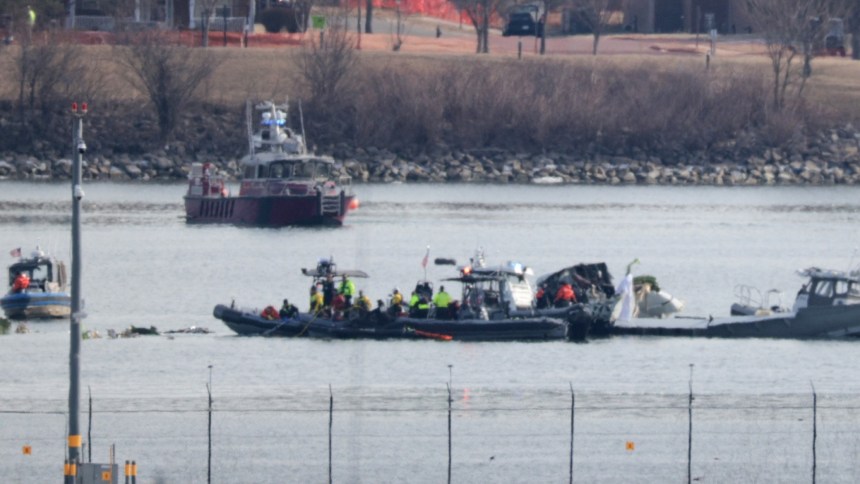
One year after a commercial passenger plane collided with an Army helicopter over the Potomac River, killing 67 people, the outspoken head of the National Transportation Safety Board is blaming the Federal Aviation Administration for a disaster she says should never have happened.
“This was preventable,” NTSB Chairwoman Jennifer Homendy said Tuesday at a hearing to determine the cause of the crash. “This was 100% preventable.”
The independent agency’s yearlong investigation into the crash over the river between the U.S. Capitol and Ronald Reagan Washington National Airport yielded more than 70 findings that took the FAA to task over safety failures.
Homendy personally criticized the agency’s workplace culture, which she said has hindered the board’s efforts to work with FAA leadership to improve air traffic safety.
“We have heard from so many individuals who won’t even put their name on anything, don’t want to be interviewed formally because they are afraid of retaliation,” Homendy said. “That’s terrible because what happens, then, people won’t speak up when there’s a safety issue.”

Since that fatal crash between an American Airlines passenger plane and a Black Hawk helicopter on Jan. 29, 2025 — the deadliest U.S. aviation accident in almost 25 years — air travelers have been wondering: Is it safe to fly?
When asked by MS NOW about the safety of flying in and out of the capital’s notoriously congested airport, Homendy described it as “safe in general,” and pointed to broader issues. “When you have certain conditions, certain systemic vulnerabilities that allow for error, you have to address those conditions,” she said.
The FAA responded to the safety investigators’ findings in a statement, saying, “The FAA values and appreciates the NTSB’s expertise and input. We have worked side-by-side with the NTSB throughout this accident investigation and acted immediately to implement urgent safety recommendations it issued in March 2025. We will carefully consider the additional recommendations the NTSB made today. ”
The midair collision a year ago exposed fundamental flaws in the U.S. air transportation system that have existed for decades, and continue today. Problems persist with a shortage of air traffic controllers, poor communications and routine close calls — in the air and on runways — which the FAA has acknowledged it is working to address.
On March 29, 2025, a Delta plane and an Air Force jet flew close enough to each other that air traffic controllers issued “corrective instructions” to avoid a collision shortly after the passenger plane’s takeoff from Washington’s airport, known as DCA. One month later, at the same airport, two American Eagle regional jets clipped wings while taxiing, causing minor damage. In May, a Black Hawk helicopter landing at the Pentagon nearly collided with a Republic Airways Embraer on approach to Reagan National.

But as Homendy said, the issues are systemic and stretch beyond DCA. A Southwest airlines jet nearly hit a Hawker Hunter British fighter plane on its way to Las Vegas from Southern California in July. On Halloween, two passenger planes taking off from Los Angeles International Airport came within five seconds of colliding.
In an interview with MS NOW before the NTSB’s all-day hearing, Homendy, who was appointed to the NTSB by Trump during his first term and elevated to chair by former President Joe Biden, touched on the evidence that has been gathered since the deadly crash. Laying blame squarely on the FAA, she said the “data was there” to avoid such incidents.
“In my view, nobody was listening or didn’t want to, which is devastating to me,” she said.
Noting that NTSB investigators discovered there was only about 75 feet of separation between the helicopter and the passenger plane, Homendy said, “How is that? Nowhere in the airspace would that be acceptable. Nowhere. That’s why we called it an intolerable risk to safety.”
Since last January’s crash, the FAA has required all aircraft in DCA’s vicinity to use a surveillance technology system to broadcast their positions to one another. The agency also announced in March that it will install technology called the Runway Incursion Device at 74 airports to help air traffic controllers keep track of which runways are occupied. There were only four that used this at the time of the announcement.
Nonessential helicopter operations over the Potomac River airspace near DCA have been permanently restricted and ended the use of “visual separation,” meaning planes must now use radar-based data to help avoid collisions.
But to victims’ family members such as Matthew Collins, whose younger brother, Chris, was a passenger on American Airlines flight 5342 last January, the safety recommendations and enhancements come too little, too late.
“DCA is an accident waiting to happen right now.” Collins said. “I don’t know that I’ll fly back into DCA. I might start flying in other places, or taking the train back up here. But I do think this needs to be looked at — not just at DCA but all across the country.”




Become a member to join the discussion