More than a week into President Donald Trump’s war with Iran, gas prices — long his preferred metric for touting the state of the economy — are soaring. Congressional Republicans — much like Trump — are downplaying concerns.
Many GOP lawmakers say the conflict will be short-lived and that the roughly 50-cent-per-gallon increase at the pump will not last long. They also argue voters understand the broader stakes.
“The public understands the necessity of what we’re doing,” Sen. Roger Wicker, R-Miss., the chairman of the Senate Armed Services Committee, told MS NOW on Monday.
“War is never pleasant,” he said.

Sen. Mike Rounds, R-S.D., said economic markets would “respond positively” in the long-term. “Gas prices will go up, and then I think they’ll start to stabilize and come back down again,” he said.
Sen. John Kennedy, R-La., likewise downplayed the increase, saying he doesn’t expect prices “to spike for a long period of time.”
“I don’t think we’re going to be in Iran for a long period of time,” he added.
Across Capitol Hill this week — and at the House GOP retreat at Trump Doral in Florida — Republicans told MS NOW that higher gas prices were a small price to pay for a safer Middle East. And they repeatedly suggested that it was a temporary sacrifice.
“We saved a lot of lives by demolishing the military of Iran,” Sen. Rick Scott, R-Fla., said.
“The prices are going to come back down when Venezuela starts producing more oil,” he added, “and when Iran gets a government that wants to be part of the world economy.”
Sen. Tommy Tuberville, R-Ala., invoked Trump’s predecessor, telling MS NOW that when Joe Biden was president, “I never paid less than $3.50 a gallon.”
“I paid $2.79 this week in Alabama,” he said. “It’s not a problem.”
(The average gas price in Alabama as of Tuesday was $3.13, according to AAA, and prices frequently dipped below $3 a gallon in the state during Biden’s presidency.)
Right outside Trump’s club in Doral, Florida, where House Republicans huddled for their annual issues conference this week, the price of regular gas was $3.39 a gallon. In Miami Beach, a few miles from the club, some prices were over $4 a gallon.
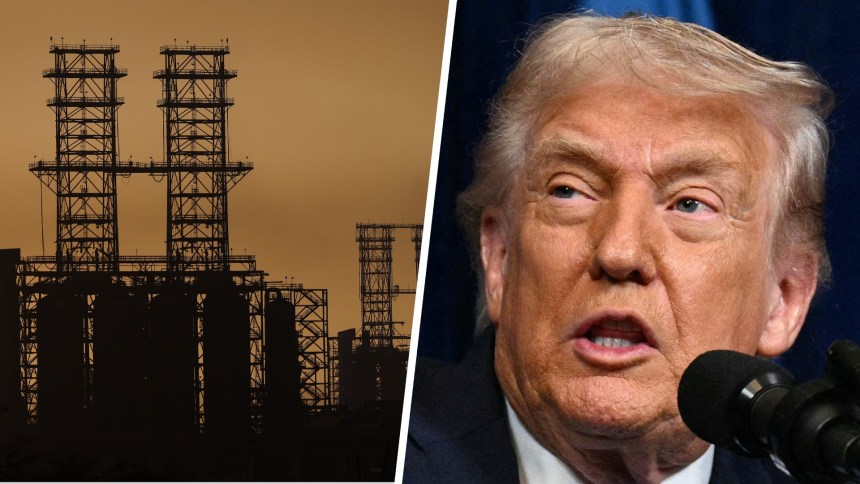
But despite recent major upticks in gas prices since Trump struck Iran, most Republicans weren’t concerned about the political fallout.
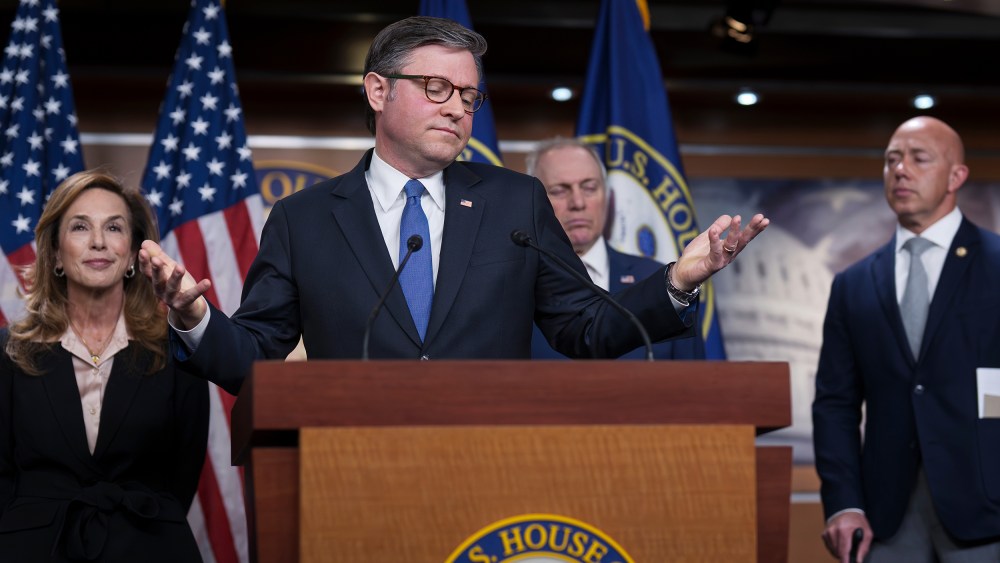
On Tuesday, House Speaker Mike Johnson, R-La., insisted the higher prices at the pump would be a “blip.”
“It will take a couple of weeks, but gas prices will come back down,” Johnson said.
With the midterms just around the corner and control of Washington at stake, the top Republican in the Senate was a bit more candid.
“The price of gas is always kind of a benchmark,” Sen. John Thune, R-S.D., told reporters Monday. “It’s something obviously we’ve got to pay attention to.”
“Hopefully,” he added, “the operations in Iran will be such that there will be — you know, it won’t be an extended situation.”
While most Republicans stuck with the party line that the increases would only be temporary, some GOP lawmakers were sounding the alarm.
Sen. Thom Tillis, who is not seeking reelection in Senate battleground North Carolina, said “gas drives the affordability issue.”
“And so it will be an issue,” he said.
And Sen. Rand Paul, R-Ky., predicted “mass fear and hysteria” on the Republican side if gas prices are still high come the fall.
But the overwhelming majority of Republicans at least publicly echoed the comments of the president — who over the weekend also sought to downplay concerns about gas prices. In a post on social media, he wrote that the higher gas prices are a “small price to pay for U.S.A., and World, Safety and Peace.”
“ONLY FOOLS WOULD THINK DIFFERENTLY!” he wrote.
This messaging from Trump, though, stands in stark contrast with how he has talked about gas prices for years.
Trump, who ran in 2024 on lowering prices, has routinely pointed to the cost of a gallon of gas as a way to gauge the economy. And as he has faced questions about residual inflation throughout the first year of his second term, he and his administration have repeatedly leaned on lower gas prices to argue things are going well.
Around Independence Day last year, for example, in a post on Instagram, the White House credited the “TRUMP EFFECT” for gas prices hitting “a 4-year low.” In November, Trump told reporters, “Every price is down. The biggest price is energy. We’re at almost $2 for gasoline.”
As recently as last month during his State of the Union speech, Trump bragged that while gas prices were a “disaster” under his predecessor Joe Biden, they’re “now below $2.30 a gallon in most states.”
Of course, in the weeks since that primetime address, gas prices have increased dramatically.
The national average for a regular gallon of gas is up nearly 50 cents since the Iran war began just over a week ago, according to data compiled by the AAA autoclub.

Oil costs, meanwhile, have been turbulent, stymied as shipping through the Strait of Hormuz has all but ground to a halt. The price of the international benchmark Brent crude hit nearly $120 a barrel at one point on Monday — the highest since 2022 — before ricocheting down to just below $90 by the end of the day.
Amid the uncertainty, Democrats — who already made addressing affordability and cost of living concerns the central theme of their midterm election message — see a prime avenue to attack Trump and Republicans overall.
On Sunday, Senate Minority Leader Chuck Schumer, D-N.Y., publicly called on the president to release oil from the Strategic Petroleum Reserve to help rein in prices.
In a statement, Schumer said, “American families are suffering from higher prices as the effects of Trump’s reckless war become pain at the gas pump and beyond.”
“They cannot afford to simply wait and hope prices come down,” Schumer added.
Meanwhile, Sens. Mark Kelly, D-Ariz., and Richard Blumenthal, D-Conn., took a different tact this week. They introduced legislation to temporarily suspend the 18.4 cents-per-gallon federal gas tax through Oct. 1.
Rep. Chris Pappas, D-N.H. — who is running for Senate in November — introduced the companion bill in the House.
Jack Fitzpatrick and Mychael Schnell contributed to this report.