It’s a difficult line to walk.
Democrats have deep concerns about what comes next in Iran, how long strikes will last and the ways constitutionally mandated congressional approval was ignored by the Trump administration. Yet on the substance of the action itself — like killing Iran’s supreme leader and disrupting the regime’s ability to solidify a nuclear program — there is support for the result.
It’s a distinction being made by many Democrats, and some Republicans, that all comes down to a simple conjunction: “but.”
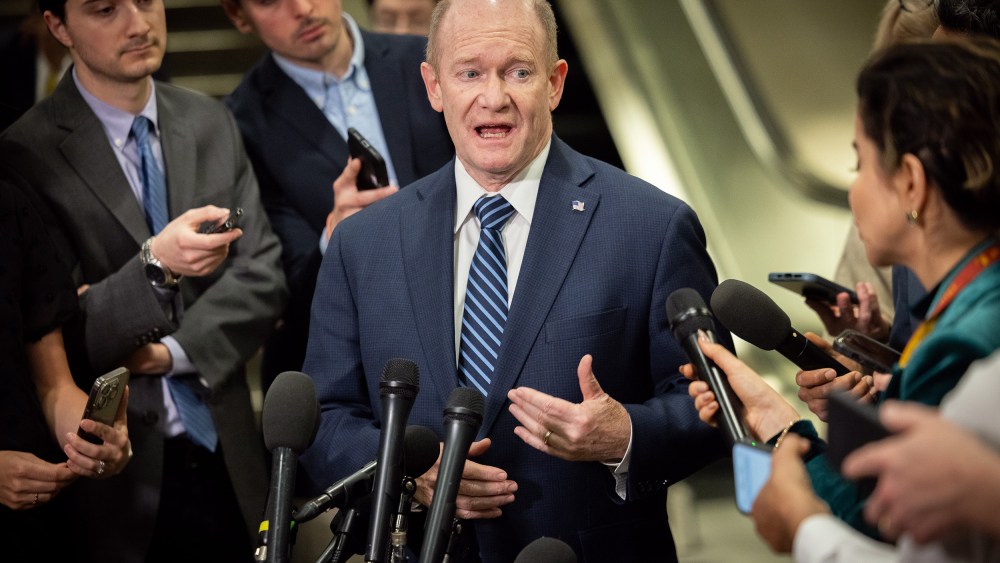
“I’ve long said that the Islamic Revolutionary regime in Iran is a terrorist regime. I do not for a second have any grief over the passing of the ayatollah and real hope at the prospect that there will be some different or new regime,” Sen. Chris Coons, D-Del., told MS NOW on Tuesday.
“But,” he continued, “this is clearly a regional, broad-spectrum war where billions of dollars in munitions are being dropped and where now a dozen other countries have been involved, and where there’s chaos today at American embassies throughout the region. The lack of planning, the lack of consultation, the lack of making a clear case to the American people — that’s what I object to.”
Coons’ position is emblematic of most of his Democratic colleagues, and a handful of wary Republicans: They agree that Iran is a bad actor and that there’s no reason to lament the death of its leader, but diverge on why strikes needed to happen when they did — and especially disagree with the way the administration skirted congressional approval.
“The Constitution says before we go to war, as a democracy, the president should consult with Congress, get our approval and inform the American people,” Coons said. “He did none of that. In his nearly two-hour State of the Union address, he dedicated just three minutes to Iran — right before launching a war which they were already rehearsing,”
His colleague, Sen. Cory Booker, D-N.J., echoed the sentiment.
“Iran is the No. 1 sponsor of terrorism. They are a dangerous regime, and they are a regime that is doing dangerous, awful things,” Booker told MS NOW. “But this is a president that has now violated international order — that has now violated our Constitution.”
Republican Sen. Todd Young of Indiana, who voiced concerns about the administration’s Iran actions behind closed doors during a Republican lunch this week, also used the same structure while explaining his vote against the war powers resolution Wednesday.
“The United States and our allies are now in conflict with a brutal, hostile, and dangerous regime,” Young said. “I believe that danger will only grow if we limit the President’s military options at this critical moment. At the same time,” — another way of saying “but” — “the American people have questions pertaining to the nature of threats and the risks to our troops and homeland. Congress must take a more active role in ensuring answers to those questions are clear and timely.
Sen. Rand Paul, R-Ky., the lone Senate Republican to vote with almost all Democrats on the war powers resolution he co-sponsored, was more clear about Congress’ constitutional role.
He bemoaned a Congress “without ambition” and said “this is a Congress without, really, a belief structure in defending legislative prerogative. They just are a rubber stamp for whatever a president tells them to do.”
Paul’s critique highlights a broader pattern that has defined the second Trump administration: Republican congressional leaders have repeatedly ceded constitutional authority to the White House, even as public opinion suggests Americans want Congress to play a larger role.
A CBS News poll this week found that 69 percent of Americans believe Trump needs congressional approval to continue military action against Iran — a view that transcends party lines but has not translated into legislative action.
On Wednesday, the Senate voted down a resolution that would have required the Trump administration seek congressional approval for future Iran-related military actions. The House did the same the following day. Almost all Republicans, and a small number of Democrats, are keen to give Trump and Israel a free hand to continue operations throughout the region.
The handful of Democrats who broke ranks did so with their own calibrated positioning. A bipartisan House group has proposed giving the administration 30 days before requiring an end to the military action. The deal fell by the wayside as four Democrats voted with most Republicans Thursday not to assert congressional control over war powers.
Even as most Republicans offer full-throated support, some are leaving the door open to Congress rediscovering their constitutional prerogative, especially if the conflict escalates to include American troops on the ground.
“The statute gives the administration 60 days to conduct activity without having to come back to the Congress for authorization, unless they’re ground troops,” Sen. Josh Hawley, R-Mo., told reporters this week. “My view has always been that ground troops will require congressional authorization.”
Whether that line holds remains to be seen, for a party that’s been malleable to Trump’s arm-twisting.
For now, Republicans have given the administration a green light to proceed. But — there’s that word again — Democrats, even in defeat, have staked their claim: The Constitution required a different path to get here.