
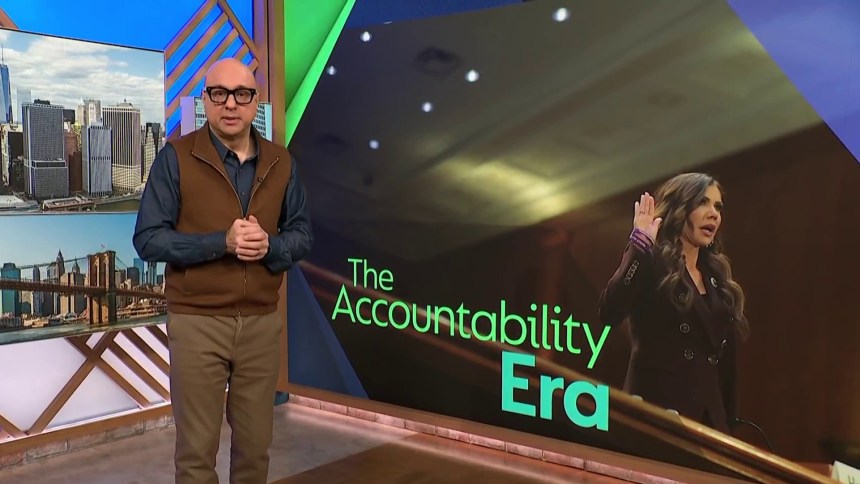
This is an adapted excerpt from the March 7 episode of “Velshi.”
America is at an inflection point. We are witnessing something that we have not seen yet in Donald Trump’s dangerous second term: accountability.
Accountability is a critical principle of a functioning democracy, and, arguably, the entire ethos of this administration has been to avoid it at all costs — to openly flout the law, the Constitution, the balance of power, ethics, morals and basic human empathy with zero consequences.
Now, there have been some consequences: demonstrations and town halls led to massive Democratic victories in New York City, New Jersey and Virginia in November, and a monumental anti-election rigging ballot initiative in California. Protests in Minneapolis and around the world led to changes in the government’s approach to its immigration crackdown.
This isn’t just the downfall of one corrupt and dishonest Trump lackey; it’s proof that the system is not broken — at least not yet.
That was citizen-driven accountability. But recently, we saw a mirror of that from our elected officials when Trump announced the long-overdue firing of Kristi Noem as Homeland Security secretary.
This isn’t just the downfall of one corrupt and dishonest Trump lackey; it’s proof that the system is not broken — at least not yet.
It is proof that even while the president himself was granted an unimaginable protection against prosecution by the Supreme Court, much of his anti-democratic administration is not immune to accountability.
It’s proof that pressure works.
For months, Noem had become a growing liability to the Trump administration. She was dogged by criticism over spending at the department, including a $220 million ad campaign starring herself that was awarded as a no-bid contract to a company that didn’t exist until eight days before they got the contract, and has extensive ties to her allies.
She also faced mounting public outrage over the brutal and deadly immigration crackdown she was overseeing. That pressure intensified earlier this year after federal immigration officers shot and killed two legal observers, both of whom were American citizens, in Minneapolis operations just 17 days apart.
Within hours of each shooting, Noem publicly portrayed the victims as violent agitators, at one point calling one of them a “domestic terrorist” and suggesting that agents had faced either a weapon or a vehicle being used as one.
In both cases, video from the scene soon sharply contradicted those accounts.
When Noem appeared before Congress last week, those controversies spilled out into the open. Lawmakers from both parties delivered sharp criticism of her leadership.
Democrats pressed her on the administration’s characterization of the two Minneapolis victims, questioning why they were labeled violent agitators before any investigation even started, and why she never apologized for implying that they were involved in any criminal behavior, let alone domestic terrorism.
Some Republicans didn’t hold back, either. Sen. Thom Tillis of North Carolina, who lately seems to have discovered a spine, condemned what he called a pattern of poor judgment and leadership.
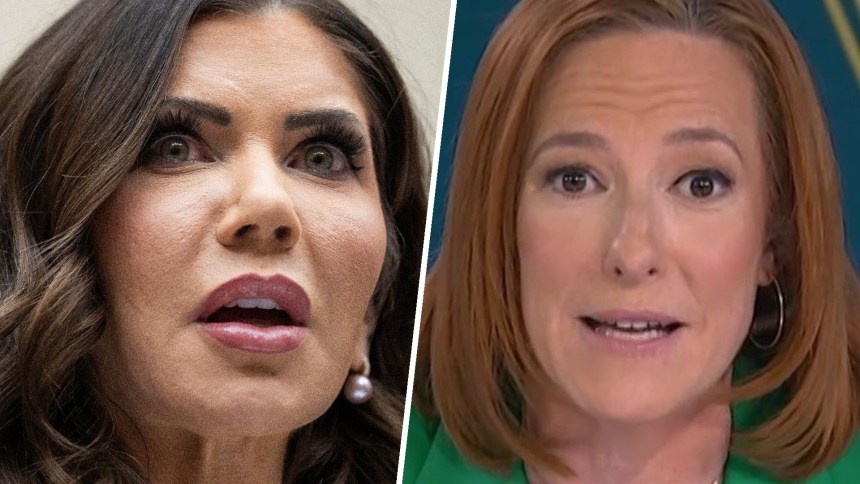
He even pointed to the widely criticized story from Noem’s memoir, in which she described killing an untrained puppy, something she presented as an example of tough decision-making. Tillis argued that the episode reflected the same kind of rash judgment now shaping national policy.
Just one day after her final round of testimony, she was out.
Now, Trump did try to soften the blow, announcing her firing on social media while inventing a new title for her: special envoy for the “Shield of the Americas.”
It’s a nice, powerful-sounding title. But whatever the spin, the reality is clear: Noem didn’t leave because the nation suddenly found itself in urgent need of a special envoy. She left because the political pressure became too great to ignore. And while her ouster may have seemed sudden, it wasn’t — it was the culmination of months of mounting scrutiny, protest and public outrage.
In other words, Americans are doing what generations before them have always done when leaders betray the public trust: supplying the accountability themselves.
You can see it in the streets. According to data from the Crowd Counting Consortium, protests against the Trump administration are now roughly four times larger than they were at the same point in his first presidency.
More than 10 million Americans have taken part in demonstrations since Trump’s inauguration. The “No Kings” protests alone drew millions of people across the country, and the next round is coming up later this month, on March 28.
We have already seen it in Minneapolis, where demonstrations erupted after the killings connected to the immigration crackdown.
We are seeing it every day in communities across America, where residents are organizing to defend their neighbors.
But accountability in a democracy does not stop at protest. It shows up at the ballot box — and last week, voters showed up in full force.
Democratic turnout in the Texas primary shattered records, with more than 2.3 million voters participating, surpassing Republican turnout in a state where that rarely happens.
North Carolina saw the same pattern, with hundreds of thousands more voters casting ballots in the Democratic primary than in the Republican one.
Now, primaries don’t always predict general elections. But they do measure enthusiasm.
In other words, democracy did what democracy is designed to do. It made power answer to the people.
Right now, the energy in American politics is undeniable. People are showing up, and that’s how power has always shifted in this country.
We’re also seeing pressure build inside the Republican Party itself. For years, Trump governed with a veneer of invincibility — the sense that no scandal, no controversy, no public backlash could truly damage him.
But that veneer is beginning to crack. Republican lawmakers are increasingly pushing back on the administration, on everything from Trump’s threats to deploy troops to American cities to investigations targeting his perceived political opponents to economic policies that many in the party fear are hurting them politically.
Other Republicans are quietly distancing themselves ahead of the midterm elections.
Even within Trump’s coalition, the mood is shifting. Support among key groups that helped power his 2024 victory — independents, suburban voters and young men — has weakened.
Perhaps most telling of all, public opinion is turning. A recent Reuters-Ipsos poll found that 53% of Americans disapprove of Trump’s immigration crackdown, and nearly 6 in 10 said enforcement has gone too far.
A new Fox News poll showed nearly 6 in 10 people disapprove of Immigration and Customs Enforcement, the highest level recorded in any poll done by the network since the question was first asked in 2018. And, according to a YouGov poll, half of Americans now support abolishing ICE entirely.
What makes this moment different is that the pressure is coming from every direction at once, and increasingly from fractures inside Trump’s own party.
That’s why Noem lost her job — not because the White House suddenly discovered a commitment to accountability, but because the political system, pushed by public pressure and lawmakers, forced the issue.
In other words, democracy did what democracy is designed to do. It made power answer to the people.
Allison Detzel contributed.





Become a member to join the discussion