On Sept. 11, 2001, Pentagon reporters were assembled in the press office of the chairman of the Joint Chiefs, preparing to report what they were watching on TV as it unfolded in New York — not yet aware of what would soon happen to the building in which they stood.
Recounting the day 20 years later, longtime Pentagon reporter Barbara Starr said the journalists who worked there had all come together to watch one of history’s most pivotal moments. “We’re all looking at the TV, and the second plane hits,” she recalled.
She said she walked down the hall to see a general leave a command center and declare, “It’s terrorism.”
Shortly after, a third plane hit the Pentagon. The building was evacuated and the Department of Defense set up a press area at the gas station overlooking the site of the attack.
When the U.S. entered Operation Epic Fury this past weekend, launching massive air strikes on Iran in the early hours of Saturday morning, the mainstream Pentagon press corps made up of legacy news organizations was not in the building.
“Correspondents Corridor,” the space inside the Pentagon once designated for the press corps covering it, has been virtually empty since last October, when the Department of Defense — now referred to as the Department of War by the Trump administration — issued a new policy governing press credentials, prompting reporters from every major news organization to turn in their badges and leave the building.
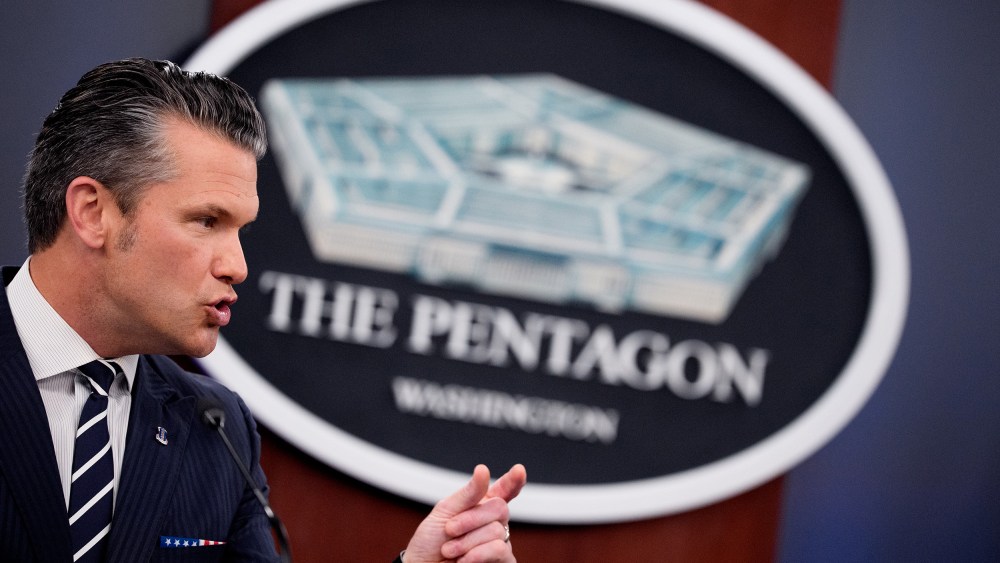
Secretary of Defense Pete Hegseth implemented the new policy aimed at “preventing leaks that damage operational security and national security.” It blocks journalists from reporting any information without approval from department officials, and gives Pentagon officials discretion to immediately suspend or ultimately revoke the press credentials of reporters who violate those restrictions, both on and off Pentagon grounds.
The Pentagon Press Association says the new policy is a direct attack on the First Amendment and the rights of journalists, imposing “unprecedented restrictions” and giving DOD officials “unbridled discretion to expel any reporter from the Pentagon who fails to abide by those restrictions.”
On Friday, a federal judge will consider whether the provisions of the policy targeting the exercise of the First Amendment are unlawful, hearing arguments in a lawsuit brought by The New York Times.
Prior to the new policy, reporters with a Pentagon Facility Alternate Credential (PFAC) — a press credential for journalists who regularly cover the department — had considerable latitude in their coverage. The credential included unescorted access to unsecured areas of the building, eligibility for a physical work space in the Pentagon press area, participation in press briefings and notice of press availability and announcements.
Under the new policy, PFAC holders are required to sign an agreement that they will abide by the new restrictions. Reporters from nearly every major news organization, including MS NOW, have refused to sign the agreement, ultimately forfeiting their PFAC and their access to question department leadership in the course of their journalistic duties.
The lawsuit calls the policy unconstitutional, alleging it suppresses the ability to gather news by not only cutting off access to top officials at press conferences, but also by blocking routine, unplanned interactions between reporters and Pentagon personnel on the grounds.
These types of informal interactions have been crucial for journalists since reporters began covering the Department of Defense from inside the Pentagon when it opened in 1943.
Pentagon reporters were known to stake out Jim Mattis, a defense secretary during Trump’s first term, when he picked up his clothes at the in-house dry cleaners and engaged in off-the-record conversations on the walk back to his office.
“The most effective coverage of the Department leverages the interpersonal relationships of trust these reporters have developed through repeated, face-to-face interactions and years of reputable reporting” writes the Pentagon Press Association in an amicus brief for the lawsuit, adding, “relationships that can be indispensable to timely reporting and preventing the spread of misinformation.”
These types of regular face-to-face interactions have been absent from reporters’ coverage of recent high-stakes stories, including the U.S. military’s strikes on boats in the Caribbean and the department’s inquiry into Senator Mark Kelly, D-Ariz., for his participation in a video urging members of the military to refuse illegal orders.
Even during historically tense times, the relationship between the Pentagon and the press has been largely respectful. During the controversy over the publication of the Pentagon Papers in 1971, the government fought the newspapers in the courtroom, not in the briefing room. There were no threats by the Pentagon leadership at the time to revoke reporters’ credentials, and press briefings continued as usual.
The department recently welcomed what it calls the “next generation of the Pentagon press corps” — those who agreed to the policy. This new press corps largely consists of MAGA and other Trump-friendly individuals and outlets, including Mike Lindell, the executive who promised to “make [the Administration] proud” with his coverage; Laura Loomer, an influential pro-Trump activist; and former Rep. Matt Gaetz, R-Fla., who was briefly Trump’s nominee for attorney general.
This week, the Pentagon held two rare press briefings with Hegseth and Chairman of the Joint Chiefs of Staff Dan Caine to provide updates on the war in Iran. Reporters from legacy media organizations who forfeited PFACs, including MS NOW, were credentialed for this press conference. These credentials did not require affirmation of the new PFAC policy.
But the Pentagon only called on one legacy news outlet: the BBC. When the reporter asked for an update on the reported strike on a girls’ school in southern Iran, Hegseth said the U.S. does not target civilians but was looking into it.
Undeterred, the reporter asked a follow-up question: “Is there any clarity on whose munition this was?” Hegseth, clearly frustrated, responded tersely, “We’re investigating it.”