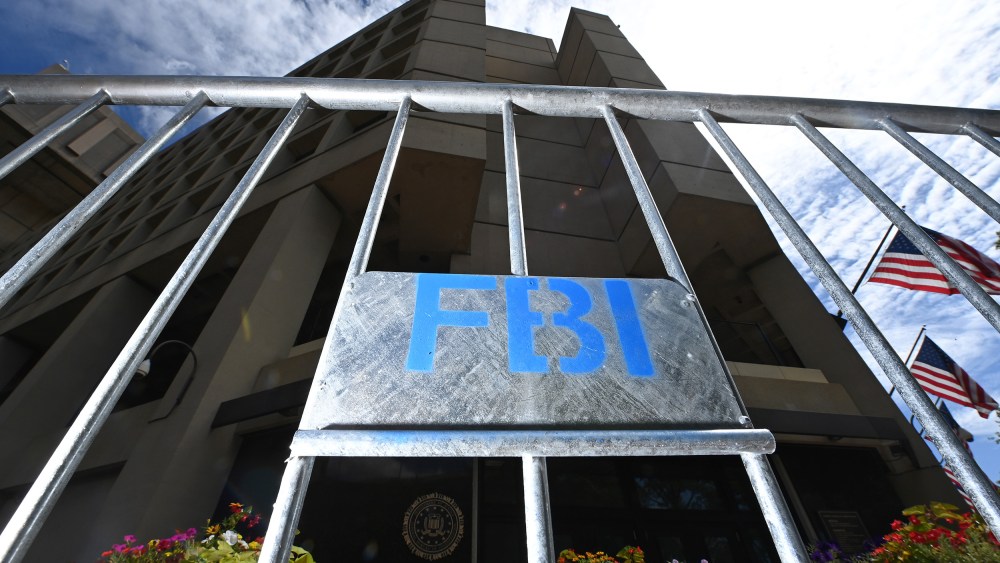
About 300 FBI agents who worked mostly on national security matters have left the bureau since President Donald Trump began his second term, including 45 who were fired, according to an internal count by current and former FBI employees.
Most of those agents hunted terrorists and spies, and at least 50 of them were in leadership roles. Current and former officials say it’s a talent drain without precedent in modern bureau history, and one that leaves the nation vulnerable amid heightened terrorism threats due to the Iran war and a relentless Chinese espionage campaign — which current FBI leadership rarely discusses.
“The Kash Patel-led political retribution purge of the FBI is the equivalent of institutional decapitation,” said former FBI agent and MS NOW national security contributor Christopher O’Leary, who worked in counterterrorism and now speaks to former colleagues across the country.
“After removing decades of leadership experience and expertise in counterterrorism, cyber and counterespionage, the country is now dangerously exposed and vulnerable to sophisticated foreign adversaries,” he said.
O’Leary and others say the vulnerability came into stark focus this week when two young men were charged with terrorism after traveling from Pennsylvania to New York City and lobbing an incendiary device at anti-Muslim protesters outside Gracie Mansion, the home of Mayor Zohran Mamdani. They told police they had pledged allegiance to the Islamic State terrorist group, or ISIS, and apparently had been undetected by the FBI.
And last week, a man wearing a sweatshirt that read “Property of Allah” shot three people and injured more than a dozen others in Austin, Texas. Investigators were looking into whether the shooter was ideologically motivated and possibly triggered by the U.S. and Israeli strikes on Iran.
FBI Director Kash Patel has forced out a number of experienced counterterrorism leaders, including Brian Driscoll, who is now suing the bureau, and James Dennehy, who headed the New York field office. But an even larger number of experienced national security agents have left of their own accord, many because they grew frustrated with what they see as politicization and a shift in priorities to immigration enforcement and street crime, current and former officials say.
“People are racing for the door to retire as soon as they are eligible,” O’Leary said, citing what former colleagues say is poor leadership and a “toxic environment.”
In a statement, FBI spokesperson Ben Williamson did not dispute the loss of 300 national security agents, but he said the FBI’s work in that area had improved.
“The opinions reflected in this article are simply not supported in reality,” he said. “The FBI saw a 35% increase in counterintelligence arrests last year alone, including a 78% and 43% increase in the China and Iran mission centers, respectively. FBI maintains a robust national security team working day and night with our partners to protect the homeland — delivering critical results every single day.”
The FBI declined to explain the basis for those statistics.
“The needless loss of institutional knowledge and expertise has degraded the bureau at a perilous time, when we’re facing threats from Iran and elsewhere.”
Stacey Young, Justice Connection
Current and former Justice Department officials agree that many people within the bureau are still working hard to thwart threats to national security. But they say it’s indisputable that the loss of so many experienced agents has hurt that effort.
“We’ve never seen such a mass exodus of counterterrorism and counterintelligence agents from the FBI — and many of them were forced out,” said Stacey Young, a former Justice Department lawyer who runs Justice Connection, a watchdog group.
“The needless loss of institutional knowledge and expertise has degraded the bureau at a perilous time, when we’re facing threats from Iran and elsewhere. The president’s political retribution campaign has made us all less safe.”
Patel has fired agents in a way that no previous FBI director ever has — often because they worked on what is now seen as a politically unpalatable investigation, especially investigations that resulted in criminal charges against Trump. The FBI Agents Association — as well as legal experts — believe the firings have been illegal because they lacked good cause. They say many of the agents challenging them ultimately will get their jobs back with back pay.
Among those fired was Driscoll, who served as a SWAT team member, head of the Hostage Rescue Team and tactical section chief for the Critical Incident Response Group. For his actions under fire during tactical operations, he was awarded the FBI Medal of Valor and the Shield of Bravery. Trump made him acting FBI director before Patel was confirmed. He was fired after he refused to terminate subordinates for what he saw as spurious political reasons.
Patel also fired a dozen agents and staff on an FBI global espionage unit as he faced White House and public scrutiny for taking an FBI jet to the Olympics in Milan and partying with the U.S. men’s ice hockey team in its locker room. At the time, he also fired the FBI’s top supervisor of all espionage cases across the country, seen as a critical voice of experience on efforts by Iran to infiltrate the United States for its surveillance work.

But it’s not just firings. As MS NOW has reported, many experienced national security agents have been pressured to leave, removed from important jobs and offered unpalatable alternatives.
Mehtab Syed was forced out of her job as the special agent in charge in Salt Lake City just six months after being appointed in February. According to multiple sources, Syed was told she wasn’t a good fit for the office, which covers Utah, Idaho and Montana. She was offered a lower-level job in the FBI’s Huntsville, Alabama, facility, but instead decided to retire. She did not respond to a request for comment.
Syed served in a variety of consequential FBI jobs, including head of cyberterrorism and counterterrorism in the Los Angeles field office, a section chief in the counterintelligence section at FBI headquarters, and assistant legal attache in Pakistan during the height of the U.S. war against al-Qaida in that region. She also worked in counterterrorism in the New York field office and served in Amman, Jordan, during the U.S. fight against ISIS.
“She’s absolutely the best — truly a humble servant leader who treats co-workers like family,” said O’Leary, who worked with Syed. “And she’s a legendary case agent who was involved in some of the most significant national security cases of the last two decades.”
The FBI’s chief of intelligence, Tonya Ugoretz, who has deep experience in terrorism and cyber analysis, was also forced out last year. She was never given a clear reason, people close to her said, but she ran afoul of MAGA influencers on social media over her involvement in recalling a thinly sourced, now debunked intelligence report falsely asserting that China interfered in the 2020 election by flooding the country with fake driver’s licenses.
And then there are the agents and staffers who have simply chosen to move on from the bureau. It’s not uncommon for senior FBI leaders to depart before full retirement age to take more lucrative jobs in the private sector, but the pace of those retirements in the past year is unprecedented, say current and former officials who spoke to MS NOW, and they are happening even as many senior leaders are being fired or forced out for what they believe are political reasons.
Anthony Molloy, who in December left his job as counterterrorism chief in the New York field office to be head of security at Airbnb, had not planned to retire, but he “couldn’t wait to get out,” as one of his former colleagues told MS NOW. Molloy did not respond to a request for comment.
Current and former FBI officials say the ranks of FBI intelligence analysts also have been decimated, as Patel re-evaluates the bureau’s intelligence priorities.
“Some fired. Some forced out, some left due to the hostile work environment, some just don’t want to be a part of this,” said one senior FBI intelligence analyst, who requested anonymity in order to speak freely.
“The FBI has never experienced such a complex threat environment as it faces now,” a second current FBI official said. “Under any previous director, covering major terrorism, cyber and foreign intelligence threats from multiple adversaries and a full-scale war with Iran would be a generational challenge, like 9/11.
“Under Patel, the workforce is paralyzed by the constant threat of being fired on the whim of a social media influencer or a Senate committee chairman. The agents and analysts still there do the work as they always have, but they do it knowing that no one will protect them — not the inspector general, not Congress. No matter how hard they work, they simply can’t be effective under those circumstances.”
Beyond the FBI, a purge at the Justice Department
At the Justice Department, where prosecutors work closely with the FBI on terrorism and spy probes, an elite counterespionage section once had a staff of roughly 50, including about a dozen in a special unit that tracks influence efforts and lobbying on behalf of foreign actors.
“Not having enough experienced prosecutors who know how to do these cases — it makes me uncomfortable for America,”
Former national security official
That unit of the National Security Division is now down to half its size because of firings and resignations, and remaining attorneys have been pleading for prosecutors from other Justice Department sections to apply for its open slots, according to three people familiar with their work.
“Not having enough experienced prosecutors who know how to do these cases — it makes me uncomfortable for America,” said one former national security official.
The role of the counterespionage section is to serve as a linchpin in protecting Americans from Iranian efforts to surveil people on U.S. soil. Those networks can morph and later spawn terror and murder plots, according to former section members and FBI sources.
In the past two decades, the section investigated a rising number of cases of transnational repression involving China and Iran, in which operatives based in the U.S. sought to disrupt and silence dissidents speaking out about their governments’ repressive regimes. In 2024, the counterespionage section aided its counterterrorism colleagues to disrupt and investigate an Iranian murder plot on U.S. soil: Iran targeted an Iranian American journalist living in Brooklyn and hired assassins to try to kill her at her home.
This counterespionage section was also responsible for the 2018 arrest of Ahmadreza Mohammadi-Doostdar, a dual U.S.-Iranian citizen, and Majid Ghorbani, an Iranian citizen living in California. Doostdar pleaded guilty to recruiting Ghorbani to spy on American citizens to target members of an Iranian opposition group known as Mojahedin-e-Khalq, or MEK. Ghorbani, who also pleaded guilty, had expanded his work to surveil Americans at a Jewish community center and a Baha’i temple.
The seasoned counterespionage prosecutor who headed the section left last year, leading the Trump administration to name Christian Nauvel as the new leader. He was a deputy chief of export control and sanctions, focused on tracking foreign ships violating U.S. sanctions, and had extensive experience in money-laundering cases. But he came to run this large unit with no counterespionage experience.
The number of applications for Foreign Intelligence Surveillance Act warrants, to secretly capture the telephone calls and electronic communication of suspected foreign spies, has also plummeted under the Trump administration, with some FBI sources speaking to MS NOW estimating a fall of more than 50% in the last year.
Current agents and prosecutors have told MS NOW that Patel is a key reason for the decrease, as he has refused to sign off on warrant applications. He has repeatedly railed against the tool for its use in special counsel Robert Mueller’s probe of Russian interference in the 2016 election. In that investigation, FISA warrants helped monitor the movements and communications of Trump campaign aides, including Carter Page, when they met with Russian operatives during Trump’s first campaign for president in 2016.
National security experts say the loss of the FISA surveillance tool leaves federal investigators in the dark about a large range of budding foreign plots. They call this development extremely disturbing, because it could harm efforts to identify and disrupt Iran’s pattern of launching sleeper cells in the United States, conducting cyber hacks and even hiring assassins here.
The loss of national security experience is being felt in U.S. attorney’s offices as well, including one of the Justice Department’s preeminent prosecution teams for terror cases.
The U.S. attorney’s office for the Eastern District of Virginia has not yet replaced the chief of its national security prosecution cases, Michael Ben’Ary. FBI agents have complained to prosecutors that they are unable to find prosecutors to engage or consult on some of the cases they consider pressing.
A recent case raised concerns about the capacity of both the FBI and one large U.S. attorney’s office to handle potential threats, according to one person familiar with one case.
A transportation employee who had temporary residency status had been flagged by confidential sources as behaving suspiciously, a potential terrorism threat. But neither the FBI nor the federal prosecutor’s office had resources available to surveil him and determine if he was part of a larger conspiracy, according to the person.
For speed, the government chose to initiate deportation proceedings against the man instead, without learning whether there was a larger network behind him.
America’s national security is at risk, one law enforcement source said, “when offices don’t have the bandwidth to investigate this kind of thing.”