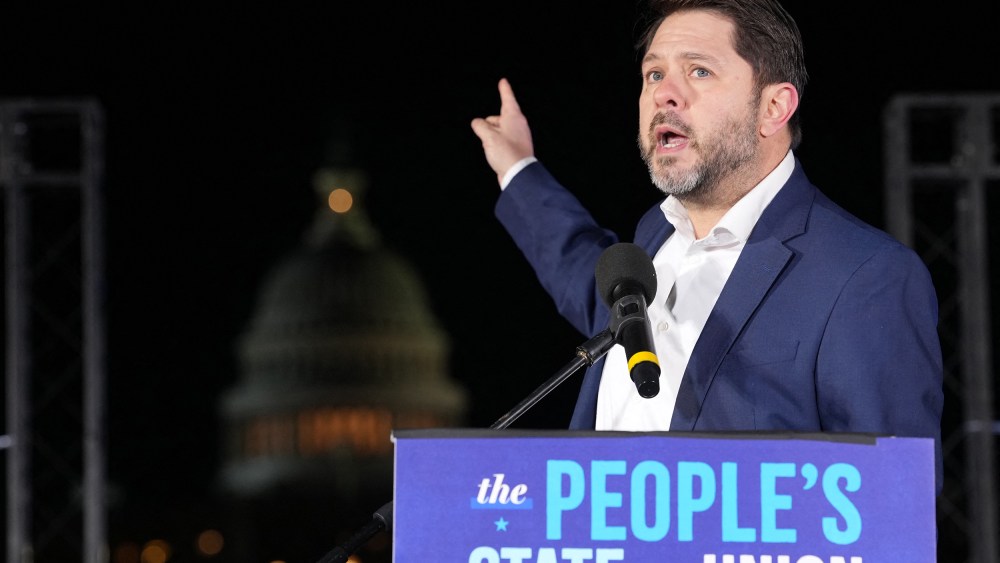
As Democrats escalate their criticism of President Donald Trump’s military strikes on Iran, one message has already crystalized: Americans have seen this movie before.
Leading the charge to deliver that message are Democratic veterans in Congress, who have been sharing their stories from the frontlines of Iraq and Afghanistan and making the case that the president’s actions this week are not only putting service members at risk, but also making Americans as a whole less safe.
It’s a message that took on greater urgency after the announcement that four American service members had died in Kuwait amid Iranian counterattacks.
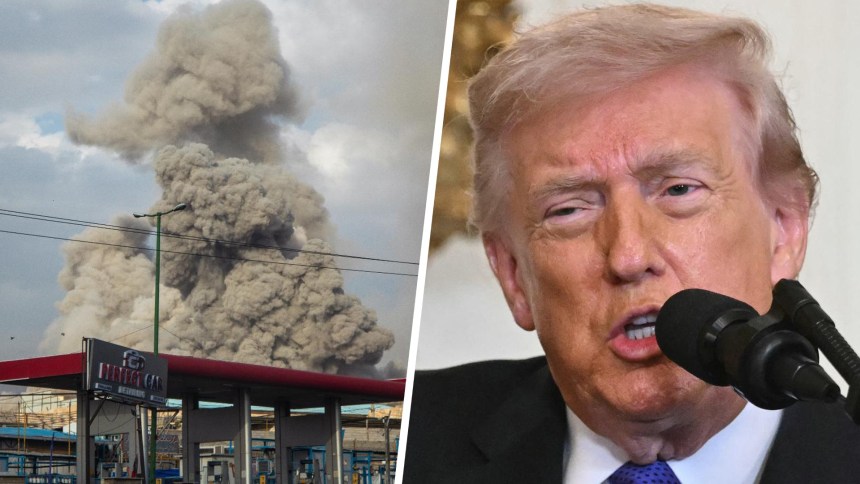
In a social media post this weekend, Rep. Pat Ryan, D-N.Y., who served two combat tours in Iraq, invoked his own experience in the Middle East to argue that the president made a terrible decision.
Noting that he lost friends in Iraq to “Iran-backed terror groups,” Ryan said, “To me, honoring them means preventing another generation of brave Americans from dying in regime-change wars.”
Ryan also called the president a “chicken-hawk” — slang for anyone keen to go to war who didn’t serve themselves.
“Draft-dodging chicken-hawks love to talk tough (from their fancy, gold-plated beach resorts). But they have NO CLUE what war is really about,” Ryan posted on social media the morning that Trump launched the strikes.
Rep. Seth Moulton, D-Mass., a Marine veteran of the Iraq War, left little to the imagination on Saturday, drawing direct comparisons to former President George W. Bush and saying the U.S. attack on Iran “feels a lot like Iraq 2.0.”
Appearing on MS NOW, Moulton argued that Trump was repeating “two foundational mistakes that Bush made going into Iraq. One was that the whole war was based on a lie about nuclear weapons. And number two: there was no plan for the day after.”
(The Bush administration, of course, claimed there were weapons of mass destruction in Iraq. And the Trump administration — after saying last summer that U.S. military strikes “totally obliterated” Iran’s nuclear facilities — warned in the lead-up to this weekend’s attack that Iran was close to posing a nuclear threat.)
In a sign that the Trump administration is perhaps anxious about the Iraq War comparisons, Defense Secretary Pete Hegseth — himself an Iraq and Afghanistan veteran — insisted on Monday that “this is not Iraq, this is not endless.”

At a press briefing, Hegseth said Trump “called the last 20 years of nation-building wars dumb, and he’s right. This is the opposite.”
The death of U.S. service members — and the president’s response to those casualties — is only amping up the frustrations of these Democratic veterans.
After the initial announcement that three military members had died, Trump said the nation grieves for the fallen, before adding, “Sadly, there will likely be more before it ends. That’s the way it is.”
Ryan, in an interview with MS NOW, called the president’s comments “incredibly tone deaf and disrespectful.”
“To hear that dismissive tone and then every parent of every soldier, sailor, airman, Marine deployed right now to see essentially a shrug of Trump’s shoulders of ‘oh, well, yeah, that’s the way it goes’ — it’s infuriating,” Ryan said.
The message these Democratic veterans are offering, though, goes beyond comparisons to the past.
Several are also invoking economic class divides as part of their criticism, saying it’s not the elites but members of the working class who will end up being sent off to war — a not-so-subtle allusion to the “haves and have-nots” affordability criticism of Trump that Democrats have made their central election message heading into the fall midterms.
Rep. Jason Crow, D-Colo., an Army Ranger who was deployed to both Iraq and Afghanistan, wrote online, “Donald Trump’s not sending his family or the kids of his billionaire donors off to fight. He’s sending working class folks off to war.”
And Sen. Ruben Gallego, D-Ariz., a Marine veteran, said that “a draft-dodger who’s never worn a uniform” — meaning Trump — “is now risking the lives of working-class kids.”
Asked about the overall messaging strategy, Ryan told MS NOW that sharing his “experiences” make the message “not political or academic” but “visceral.”
But drawing parallels to and invoking memories of incredibly unpopular past conflicts could also come with a political benefit, potentially helping turn the American public further against Trump.
“The American people are wise, and they know that these regime change wars have not worked in the past, and don’t want more of them,” Ryan told MS NOW. “That’s one of the most widely agreed upon things I hear from my constituents, and we certainly see it in polling.”

A Reuters-Ipsos poll conducted in the first two days of the strikes found that only 27% of U.S. adults approved of the attack, compared with 43% who did not. The rest were unsure.
There are already small fissures in the MAGA base over the president’s choice to launch the strikes. The MAGA movement grew, in part, out of public backlash to the Bush-era wars in Iraq and Afghanistan. And on the campaign trail, Trump repeatedly dismissed foreign entanglements as anathema to the “America First” agenda.
Of course, some top Democrats who are not veterans are also pointing to memories of Iraq and Afghanistan as part of their criticism of the president.
On Tuesday, ahead of the State of the Union address, for instance, House Minority Leader Hakeem Jeffries, D-N.Y., said the “American people understand that under no circumstances should the Trump administration get us into another failed, foreign forever war.”
“We know the outcome, particularly in the Middle East,” he told reporters. “It’s going to cost American lives.”
Other Democrats have opted to focus their criticism of the White House on another angle — leaning into the constitutional question of war powers.
These Democrats say the president should have come to Congress to get sign-off before launching the strikes. In many ways, such a framing allows lawmakers to avoid directly criticizing the idea of eliminating Iranian Supreme Leader Ayatollah Ali Khamenei while still opposing Trump.

But for some members of the party, a “process” argument is simply not good enough.
Rep. Eric Swalwell, D-Calif., for instance, argued on social media that “now is the time for values-based arguments against war with Iran. NOT process (‘Come to Congress’) ones.”
Democrats by no means have a monopoly on veterans on Capitol Hill. The Republican ranks in Congress also include many lawmakers who served in Iraq and Afghanistan. So far, they have not followed the lead of their Democratic colleagues.
Sen. Tom Cotton, R-Ark., the chairman of the Senate Intelligence Committee and a veteran of the Iraq and Afghanistan conflicts, has embraced the president’s actions.
Appearing on CBS News Sunday, Cotton admitted that while there is “no simple answer for what’s going to come next” in the conflict with Iran, he argued that the president was fulfilling a “promise” to help the Iranian people.
That “help,” he said, is “going to continue to be on the scene for probably a few weeks, as we make sure that Iran’s military is no longer capable of threatening our own troops, our Arab friends in the region and Israel, and also repressing its own people.”









Become a member to join the discussion