
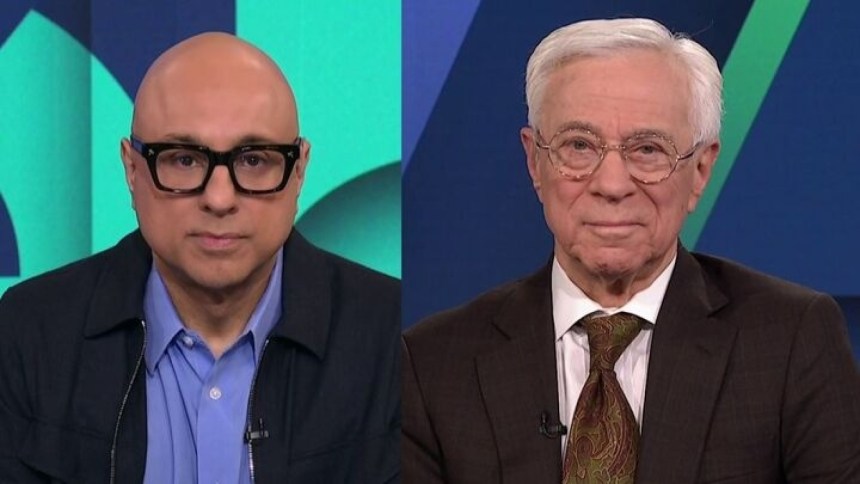
This is an adapted excerpt from the March 8 episode of “Velshi.”
On Saturday, the Pentagon announced another U.S. service member had died of injuries sustained during Iran’s initial counterattack, bringing the American death toll to seven.
Just one day earlier, the bodies of six U.S. Army Reserve soldiers killed last week in an Iranian drone strike in Kuwait arrived at Dover Air Force Base in Delaware. Some of them had served for almost two decades. The youngest was just 20 years old. Each one of them leaves behind grieving families and communities.
And as President Donald Trump signals that he intends to escalate this war of his own choice, it is almost certain that more such arrivals of bodies will occur.
Or, as the president puts it, “Some people will die.”
This is not a war of necessity, it is a war that most Americans do not understand the reasons for.
Under Secretary of Defense Pete Hegseth’s leadership, evangelical Christian nationalism has gained unprecedented visibility inside the U.S. military.
But reluctance to spend blood and treasure on unclear objectives in war can be offset by infusing the conflict with a good reason, a clear purpose, a shared understanding of why the ultimate sacrifice is necessary.
In this case, there is none of that, not even a halfway coherent narrative to justify our war with Iran, no clear objective and no real public support.
So if the American people don’t understand this war and haven’t rallied behind it, then what is driving it?
It wasn’t that long ago that groups in parts of the Middle East invoked extremist interpretations of Islam to justify violence against the West. Regimes like Saudi Arabia encouraged an interpretation of Islam that considers anyone who doesn’t follow its doctrine, including other Muslims, as infidels. The consequences, as we all know, have been devastating.
That ideology helped give rise to movements like al-Qaida and later its offshoot, the Islamic State group, which targeted not only the West but also Middle Eastern regimes. State-sponsored clerics routinely denounced Western civilization and framed global politics as a civilizational struggle.
Americans remember the consequences of this worldview, because the violence it bred eventually landed on our shores.
But that religious extremism did not arise in a vacuum. Crucially, it was sustained by a political bargain. For decades, the Saudi monarchy maintained an implicit agreement with its clerical class: The government will protect your authority and enforce your worldview, so long as you legitimize the government. Religion, in other words, became the ideological engine for maintaining political power.
Something eerily similar is now unfolding right here at home, and it has been building for some time.
More than two centuries after the framers warned about the dangers of merging faith with political power, we are now seeing a version of that same dynamic take hold at the highest levels of American government. It’s not just creeping in; it is actively shaping how this war is being understood and justified — from those advising the president to military commanders briefing troops before their deployment.
Under Secretary of Defense Pete Hegseth’s leadership, evangelical Christian nationalism has gained unprecedented visibility inside the U.S. military.

Hegseth has hosted Christian prayer services inside the Pentagon and attends weekly White House Bible studies. He has openly framed geopolitical conflict through the lens of Christian civilization.
Tattooed across his chest is the Jerusalem Cross, a symbol that was the coat of arms of the Crusader Kingdom of Jerusalem after 1099, and long associated with the idea of Christian warriors reclaiming the Holy Land.
At last month’s National Prayer Breakfast in Washington, Hegseth told the crowd, “America was founded as a Christian nation. It remains a Christian nation in our DNA if we can keep it. And as public officials, we have a sacred duty 250 years on to glorify Him.”
“We talk a lot about peace through strength,” he continued. “At the War Department, we see ourselves as the Strength Department. But we also need to remember that we derive our strength through faith, and through truth, and through the word of God.”
What we are now seeing play out on the global stage are the downstream effects of those beliefs.
The nonprofit Military Religious Freedom Foundation reports that it has received more than 200 complaints from service members across more than 50 military installations, spanning every single branch of the U.S. military, who say their commanders are invoking Christian prophecy to justify the war with Iran. (MS NOW has not independently verified or viewed these complaints.)
But the organization’s founder, Michael Weinstein, told Military.com this week that the reports are “continuing to come in everywhere.”
According to one complaint reviewed by The Guardian, a commander told officers that the war was “all part of God’s divine plan” and that Trump had been “anointed by Jesus to light the signal fire in Iran to cause Armageddon and mark his return to Earth.”
Other complaints received by MRFF describe commanders speaking about a “biblically sanctioned” war tied to the Christian “End Times.”
Think about that for a moment: American soldiers, who come from all different faiths and swear an oath to defend the Constitution, are being told that this war is part of biblical prophecy — that this is literally God’s plan.
The real danger, as we know, is that when a conflict is framed as a religious destiny, restraint and the laws of war disappear. Diplomacy becomes an act of sin. Violence becomes righteous. Soldiers dying becomes martyrdom.
It’s important to remember that the ideology driving this thinking is not fringe. It is part and parcel of the political coalition that brought Trump to power.
Evangelical Christianity was one of the most powerful political forces behind his rise, and the devil’s bargain that religious nationalists struck with Trump looks not unlike the Saudi monarchy’s bargain with extremism.
When a conflict is framed as a religious destiny, restraint and the laws of war disappear. Diplomacy becomes an act of sin. Violence becomes righteous. Soldiers dying becomes martyrdom.
They would overlook Trump’s moral, ethical and legal transgressions, and in return he would hand them the keys to the kingdom: power over American culture, power over education, power over women’s autonomy and, increasingly, power over the machinery of the state itself.
This is already happening here at home, and now we’re seeing how that alliance is helping to shape American foreign policy.
Mike Huckabee, Trump’s ambassador to Israel and a former Baptist minister, is a self-proclaimed Christian Zionist. This is a movement that views Israel not simply as a modern state but as the fulfillment of biblical prophecy and a necessary step toward the second coming of Christ.
Huckabee himself has repeatedly framed Middle East politics in explicitly theological terms. In a recent interview, responding to a question about Genesis 15:18’s description of Israel, which states, “On that day the Lord made a covenant with Abraham, saying, ‘To your descendants I have given this land, from the river of Egypt as far as the great river,’” Huckabee suggested it would be “fine” if Israel controlled the entire territory stretching from the Nile in Egypt to the Euphrates in Iraq — essentially much of the modern Middle East.
Republican Sen. Lindsey Graham of South Carolina has described the current conflict as “a religious war” that will determine the course of the Middle East for 1,000 years.
When religious ideology, state power and military force merge, history tells us exactly what happens. It leads to what James Madison called “superstition, bigotry, and persecution.”
The U.S. military was never meant to fight for a religious prophecy. In fact, the founding fathers were so concerned about the line between church and state — which includes the military — that they included it in the Bill of Rights.
But today, under Trump, Hegseth and the Christian nationalist movement that surrounds them, that line is being erased in real time.
The price of that erasure will be paid for with the lives of innocent civilians abroad. It may be paid for with the lives of innocent civilians here at home. And it will surely be paid for by American soldiers, sailors and airmen and women, many of whom are being told they are carrying out God’s command.
Allison Detzel contributed.






Become a member to join the discussion