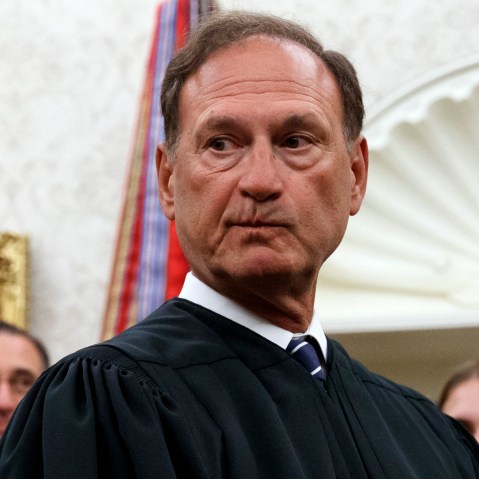
On July 1, the Supreme Court announced its decision in Americans for Prosperity v. Bonta, in which a 6-3 majority of justices struck down a California rule requiring donations over $5,000 to be disclosed by charities to the state attorney general. “Freedom of association” the court ruled, allowed charities to keep these donations secret — at least from the state attorney general.
The Supreme Court’s decision in Bonta, if interpreted broadly, could allow enormous amounts of influence peddling by foreign nationals that goes undetected.
This decision, if expanded to protect the secrecy of even larger donations to U.S. charities, could be a serious threat to our nation’s independence from special interests both foreign and domestic.
Most of us know about the high-profile investigation and civil suit brought by New York’s attorney general against the National Rifle Association. Much of that suit involved abuses other than secret foreign donations, including the NRA’s chief executive being paid millions in compensation, charitable funds being used for personal purposes by senior leadership, and “appearing to dole out lucrative no-show contracts to former employees in order to buy their silence and continued loyalty.”
An issue tangential to the New York attorney general’s suit against the NRA, but critical to our national security, is the fact that the gun rights group also accepted secret contributions from Russia, enough so that it could be described as a Russian asset.

The NRA is not alone. For decades, leading American universities have taken large contributions from foreign interests, including Harvard, which before 9/11 took large donations from the Bin Laden family. The University of Pennsylvania was recently exposed for taking substantial secret donations from China and Saudi Arabia.
Many Washington, D.C., area think tanks accept large donations from foreign corporations, some of which may indirectly come from foreign governments. Some of these charitable donations by foreign nationals are disclosed by the recipient organizations. Many, however, are secret.
Domestic interests also contribute millions to nonprofits expecting influence in return. Harvard and the Massachusetts Institute of Technology had a close relationship with the convicted sex offender and billionaire Jeffrey Epstein even after he had been criminally charged. Elaborate efforts were made to conceal the source of donations from Epstein. Universities also accept enormous amounts from corporations, some of it disclosed and some not.
The NRA has established a virtual “protection racket” over the Republican Party, tolerating no dissent on gun laws.
These and many charitable institutions in turn have a substantial influence on the American political system. The NRA has established a virtual “protection racket” over the Republican Party, tolerating no dissent on gun laws.
Big universities and possibly their foreign donors also have influence in Washington. For example, President Joe Biden recently nominated Amy Gutmann to be ambassador to Germany; Gutmann is the president of the University of Pennsylvania, for which she is paid almost $4 million a year. She also appointed Biden as a “professor” at Penn from 2017-19 for compensation of $911,000 even though he taught no classes. Part of the problem is that we don’t know where all of the University of Pennsylvania’s money comes from.
The Supreme Court’s decision in Bonta, if interpreted broadly, could allow enormous amounts of influence peddling by foreign nationals that goes undetected. A broad application of the Bonta decision also magnifies the disastrous decision in the January case Citizens United v. FEC by adding a constitutionally protected layer of secrecy to at least some of the flow of money into organizations that influence American public policy.
The Bonta decision, however, is not an absolute bar to mandated disclosure. The court imposed an “exacting scrutiny” test to charitable contribution disclosure laws such as that of California, saying that “while exacting scrutiny does not require that disclosure regimes be the least restrictive means of achieving their ends, it does require that they be narrowly tailored to the government’s asserted interest.” The court went on to say that “a substantial relation to an important interest is not enough to save a disclosure regime that is insufficiently tailored.”
The holding thus provides an opening for Congress at least to try to devise a disclosure regime narrowly tailored to confront the greatest dangers of secret money entering American nonprofits.
One approach would be to amend the Internal Revenue Code to condition an organization’s tax- exempt status on it disclosing at least some of its donations not only to the IRS, which already requires disclosure on Schedule B of Form 990, but also to disclose to federal agencies safeguarding our national security, and in the case of the largest charitable donations, public disclosure.
Congress could mandate that the IRS release internally to federal national security agencies lists of donations over $5,000 on a charity’s Schedule B. Congress could also provide that donations over $50,000 from foreign sources, and donations over $100,000 from domestic sources, must be publicly disclosed. The Supreme Court hopefully would distinguish such a narrowly tailored disclosure rule from the California rule in Bonta, which drew the line at $5,000, where the court believed the California attorney general had not demonstrated a true need for the information. Whether the court would recognize this distinction is uncertain. Congress, however, should at least try.
Secret money in American nonprofit organizations is a threat to our national security and to the integrity of our government. Whether it be Russia buying influence through the NRA or the Bin Laden family or Epstein buying influence at Harvard, undetected for years, this secrecy is wrong.
If we value the integrity of our charitable institutions, and our government, we will insist that the veil of secrecy be lifted. And we will recognize the wisdom of the late Justice Louis Brandeis’ famous words: “sunlight is the best disinfectant.”