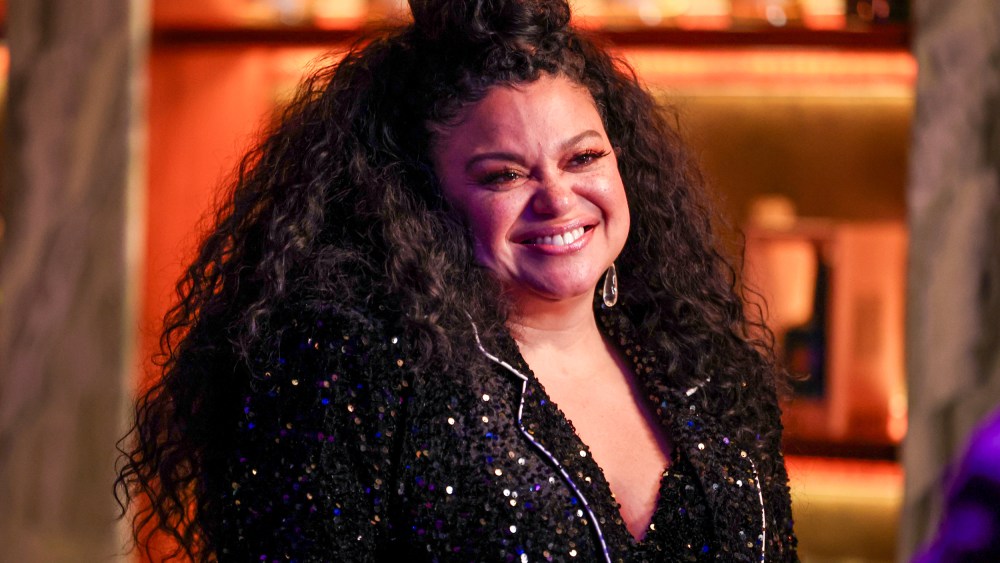
In “Michelle Buteau: A Buteau-ful Mind at Radio City Music Hall,” which debuted New Year’s Eve on Netflix, Buteau, the first female comedian to headline a special at the famed New York venue, meticulously takes aim at a number of cultural and political issues. From describing a random encounter with a racist white woman at a reptile sanctuary to explaining her realization that dogs have more reproductive rights than she does, Buteau’s set embodies what makes her approach to comedy so refreshing. She’s insightful and hilarious. She makes her audiences laugh and interrogate the world and themselves — and she achieves this perfect blend without ever punching down.
She makes her audiences laugh and interrogate the world and themselves — and she achieves this perfect blend without ever punching down.
That’s a lesson other comedians should take from “A Buteau-ful Mind.” Exceptional comedy can be welcoming and bright rather than exclusionary and hate-filled. Instead of targeting vulnerable populations and then saying “it’s just comedy” to shield oneself from criticism, Buteau, leaning into the art form’s radical roots, calls out social ills and those perpetuating them. And she calls out comedian Dave Chappelle by name for his tireless crusade against trans people.
After telling a raunchy joke about her lesbian friend, whom she calls the “oracle,” Buteau paused to reflect on what she’d just done. “For the most part, we laughed,” she tells the audience. “What I’m saying is it can be done. It can be done. We can tell jokes and stories and not disparage a whole community. We can do that; we can make it funny. You just have to work at it, right? So, if you guys ever run into Dave Chappelle, can you let him know that s—?”
Chappelle’s last two Netflix specials, “The Closer” (2021) and “The Dreamer” (2023), are, in a word, transphobic. He spends significant time in each routine railing against trans people for existing and comparing the plights of Black people and LGBTQ people — as if Black LGBTQ people don’t exist. Chappelle declares himself a member of “Team TERF,” a phrase used to describe virulent anti-trans activists, including J.K. Rowling, who are committed to eradicating the “concept” of transness.

Though his remarks are incendiary, Chappelle has claimed he “has never had a problem with transgender people.” He’s also said the trans people he knows have “been nothing but loving and supportive” about his anti-trans jokes. We have no way of verifying that and no way of knowing how many trans people he even knows. We do know, though, that the anger at Chappelle that trans people have publicly expressed is real and that it’s had some effects.
Netflix employees staged a walkout after “The Closer” was released and publicly excoriated Chappelle and Netflix executives for green-lighting the special without including a disclaimer at the beginning. (Full transparency, I was an employee at Netflix then and I participated in the walkout.) First Avenue, the famous venue in Minneapolis, also canceled one of his shows after trans people protested.
According to the Human Rights Campaign, at least 30 trans and gender-nonconforming people were killed in the United States in 2024.
Even after the controversy over “The Closer,” Netflix executives affirmed their support for Chappelle. “While some employees disagree, we have a strong belief that content on screen doesn’t directly translate to real-world harm,” co-CEO Ted Sarandos said in an email obtained by Variety. But many signs point to that being untrue as transphobia continues to cost trans people their lives.
According to the Human Rights Campaign, at least 30 trans and gender-nonconforming people were killed in the United States in 2024 alone. Comedy targeting trans people is especially problematic in this context. Still, other high-profile comedians have mostly rallied around Chappelle and defended his habit of scapegoating people who are already disproportionately more likely to die from suicide.
Given these stakes — and the fact that Buteau and Chappelle both have overall deals with Netflix — Buteau’s decision to unapologetically call out Chappelle is even more heartening. After calling Chappelle the GOAT, but defining it as “going off about trans people,” Buteau made the stakes abundantly clear: “Dave, it’s not funny. It’s dangerous,” she said. “I can’t believe somebody would make millions and millions of dollars for making people feel unsafe.”

Outside of Wanda Sykes and Jerrod Carmichael, who are both Black, queer comedians, many of Chappelle’s contemporaries have argued that he has an unfettered right to free speech and shared stages with him. In 2022, John Mulaney had Chappelle open for him during a show in Ohio, and as to be expected, Chappelle told both homophobic and transphobic jokes. After Chappelle’s set, Mulaney came onstage and embraced him. In defense of Chappelle, Kevin Hart, who lost his gig to host the 2019 Academy Awards after homophobic tweets resurfaced, told The Independent that “you have the option of just not watching someone you don’t find funny or entertaining.”
There’s been one noticeable exception to the chorus of praise: While Katt Williams doesn’t appear to have publicly criticized Chappelle by name, when he appeared on “Club Shay Shay” last year, he did note that comedians must evolve with the times. “There are words we can use for a while until someone says, ‘That ain’t a good word. … That don’t make people feel good.’ And we stop saying the word,” he said. “There are things you can say to get your point that don’t have to hurt people.” It should be that simple, but instead, Chappelle has resisted the cultural push by trans people to be respected rather than treated as punchlines.
I can’t believe somebody would make millions and millions of dollars for making people feel unsafe.
Buteau’s work is a reminder that comedy can be a home for misfits who use humor to survive their circumstances and interrogate the systems that have made their lives more difficult. Whether she’s telling jokes onstage, leading the Netflix series “Survival of the Thickest,” or playing an overworked and disconnected wife and mother in “Babes” and BET+’s “The Single Wives Club,” Buteau uses entertainment to bring us closer together. That gives her the cachet to call out other comedians who use their art to deride already ostracized people.
“You’re hurting people and you’re making it dangerous,” Buteau told USA Today. “And it’s not just Chappelle — it’s part of the culture that I don’t understand. When people say, ‘We can’t do what we used to do.’ Yeah! Slavery used to be legal, you guys. Sometimes we’ve got to move forward, and I’m sorry if it’s different, but wrap your little mind around it.”
When Buteau said during the special that she’s manifesting making millions while “making people feel safe, seen, secure, heard and entertained,” she’s making a point that she shouldn’t have to make, that comedy can be edgy without being cruel.
There’s been one noticeable exception to the chorus of praise: While Katt Williams doesn’t appear to have publicly criticized Chappelle by name, when he appeared on “Club Shay Shay” last year, he did note that comedians must evolve with the times. “There are words we can use for a while until someone says, ‘That ain’t a good word. … That don’t make people feel good.’ And we stop saying the word,” he said. “There are things you can say to get your point that don’t have to hurt people.” It should be that simple, but instead, Chappelle has resisted the cultural push by trans people to be respected rather than treated as punchlines.