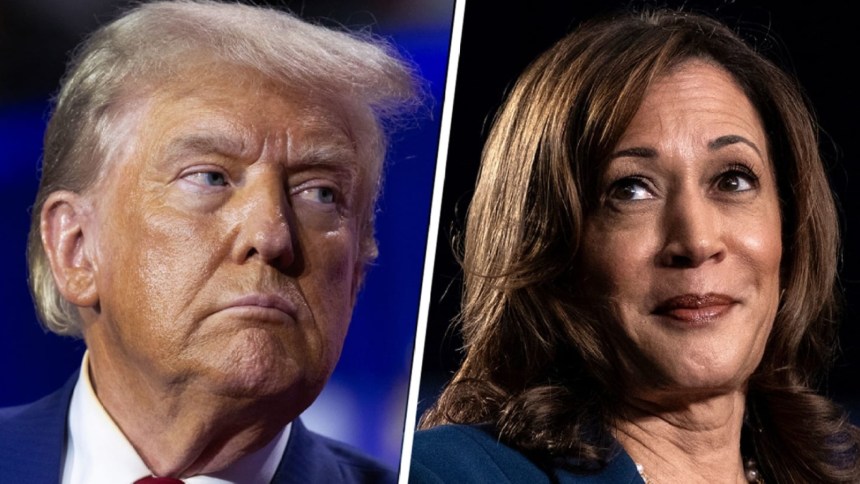
No force is as animating in this election as gender. One candidate stands to be the first female president of the United States, while the other runs a campaign of aggrieved masculinity. Abortion remains a top campaign issue after Donald Trump appointed Supreme Court justices who overturned Roe v. Wade and set reproductive rights back by, in some states, as many as 150 years. And finally, there are the voters among whom a vast gender gap has cleaved open.
Recent NBC News polling shows women breaking for Vice President Kamala Harris by 14 points. Men, on the other hand, support the former president by a 16-point margin. The gender gap is so pronounced that Trump, who dropped out of the third presidential debate after losing the second one to Harris, participated in a Fox News town hall that aired Wednesday to talk specifically to female voters. The audience, which was women only, watched as Trump called Sen. Katie Britt “fantastically attractive” and bizarrely anointed himself the “father of IVF.”
“Female voters” are a notably heterogenous pool and considering them as a single entity is unhelpful bordering on political malpractice.
Much has been written about the overt gender politics of this election. Harris seems to be playing down her gender, presumably in an effort to appeal to a broad swath of voters, but the historic nature of her candidacy makes the issue hard to hide. Trump, on the other hand, chose a running mate who has repeatedly maligned “childless cat ladies.” Hulk Hogan ripped off a U.S. flag tank top at the Republican National Convention. Even some Trump supporters say they worry that the campaign’s testosterone-fueled, boorish rhetoric may be turning off female voters.
But “female voters” are a notably heterogenous pool and considering them as a single entity is unhelpful bordering on political malpractice. Take, for example, the discourse around white women, which came to the fore after Trump won this demographic in 2016. It is true that more white women voted for Trump than for then-Democratic candidate Hillary Clinton, and they may very well do so again. But white women are the country’s largest voting bloc when you break the electorate out by race and gender, and this enormous group was almost evenly divided in 2016 and 2020.
According to Pew data, white voters made up nearly 70% of the electorate in 2016 (Black and Hispanic voters each made up 11%). Women outvoted men that same year, with 67% of white women saying they voted in 2016. By comparison, 63% of white men and 64% of Black women voted, along with just 54% of Black men, 50% of Hispanic women, 45% of Hispanic men, fewer than half of Asian men and women.

Democrats absolutely must turn out voters of color in order to win, and Black voters in particular have been essential to Democratic victories. But Democrats could potentially secure every nonwhite vote in the U.S. and still lose. They have to figure out which white voters — specifically white women — are winnable. And that means resisting the urge to dumb things down. Observations about huge demographic groups — things such as “white women voted for Trump” or “women are backing Harris” — don’t tell us nearly enough.
Understanding the why behind the Trump-supporting segments of these huge populations is key. Trump’s base includes several subgroups of white women: those without college degrees, those who are evangelical Christians and those who live in the South. According to a recent NPR/PBS News/Marist Poll, close to 60% of college-educated white women say they plan to vote for Harris, while 55% of white women without college degrees, and a whopping 70% of white men without degrees, are backing Trump. So one crucial question becomes: How can Trump’s boorish behavior be so appalling to so many women and seemingly so acceptable to others?
The answer lies in various stubborn American subcultural norms. Male violence is a problem everywhere, for example, but researchers have pointed to the ways in which white Southern honor culture is different from, say, the dominant culture of the Northeast. Southern white women in particular have long been portrayed as objects that both demand and require protection; similar narratives of female weakness and the necessity of male protection and authority suffuse white evangelical religious beliefs. And the benefits of male protection and respect are higher because the penalties are more extreme. A woman who is seen as sexually audacious (or simply a feminist) will almost certainly have a harder go of it in a white Southern Baptist community than among, say, white college-educated Brooklynites.
One crucial question becomes: How can Trump’s boorish behavior be so appalling to so many women and seemingly so acceptable to others?
There’s also some evidence that men overcompensate and become more aggressive when their status is threatened. One 2013 study found that “men given feedback suggesting they were feminine expressed more support for war, homophobic attitudes, and interest in purchasing an SUV.” Members of the Trump campaign team have taken to accusing insufficiently MAGA men of being “cucks” — slang for men emasculated by cheating wives.
White evangelical churches may not as readily embrace the naughty words, but they have long evinced a toned-down version of the same misogyny, adopting edicts of male leadership and female submission. Women are not allowed to take senior pastor and other top leadership roles in many (and possibly most) evangelical churches; the Southern Baptist Convention, America’s largest evangelical denomination, has purged churches that ordain women as pastors.
James Dobson, founder of Focus on the Family and one of the country’s most influential evangelicals, is clear on “the role of the female as help-meet, bread-baker, wound-patcher, love giver, home builder, and child-bearer” and the female obligation of submission to masculine leadership (he does, generously, encourage husbands to give their wives “one day of recreation each week”). It’s unsurprising that women steeped in a culture that not only demands, but also sanctifies female submission and male dominance might not embrace a female leader. Outside of the church, women who are more accustomed to conservative cultural norms of male grievance, aggression and violence may simply have a greater tolerance for Trump’s actions and rhetoric.
This is not to say that college-educated women living in large northern cities are surrounded by wonderfully feminist men; bad male behavior, that includes violence and simple entitlement, is everywhere. But there really are significant cultural differences between white Americans according to region, religion, education and urbanity, and these differences make for very different political preferences and voting patterns.
The overarching gender gap narrative is true. Trump really is cleaning up with male voters, and white ones in particular. He really is making inroads with Black men: While 80% of Black men voted for Joe Biden in 2020, 70% now say they support Harris, according to a recent New York Times/Siena poll, while 1 in 5 are backing Trump. But this needs more context. The “Black men for Trump” story is interesting primarily because it’s a shift, not because anything close to a majority of Black men support Trump. The fact that Harris enjoys the support of 70% of Black men means that demographic backs her more strongly than any other race/gender group except Black women.
The numbers for Hispanic voters are far starker, according to that same Times/Siena poll: Trump is winning Hispanic men by 5 points, while 59% of Hispanic women currently support Harris. And Harris really is doing quite well with women. According to some polls, she is even enjoying a small lead among white women.
White women remain the least likely to support Democrats. That fact can lend itself to easy narratives.
Among female voters, white women remain the least likely to support Democrats. That fact can lend itself to easy narratives and self-righteousness, becoming a justification for finger-wagging: After Trump narrowly won the white female vote in 2016, a few demonstrators at the anti-Trump Women’s March held signs admonishing white women, even though the pussy-hat-wearing marchers were not the white ladies who voted him into office. In response, many white liberal women pledged to “do better” and call in their peers, despite the fact that liberal white college-educated women living in big cities likely have few, if any, Trump-voting pals. An important moment of reckoning — a realization that a lot of women do not vote in what feminists would say are their interests — became, unfortunately, a vast oversimplification.
Ultimately, elections capture a population at a particular moment in time. The work of social movements is to shift the views of that population over time, not just to win elections, but also to change societies. To understand the race and gender gaps in this election, we must also understand how the power of male grievance plays in different cultural contexts. In a country as vast and diverse as the U.S., culture shifts not just along racial lines, but also according to where one lives, how (and if) one worships, what opportunities one does or does not have access to, and — for women — how the men around them feel about their status as men, and how those men behave as a result.