
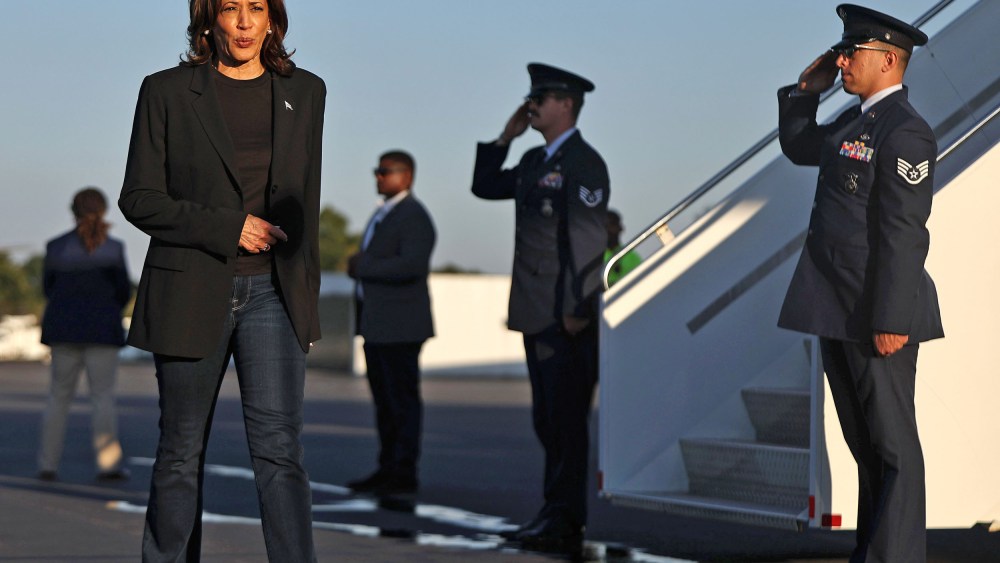
When Israel killed Hezbollah leader Hassan Nasrallah with a U.S.-made bomb, Vice President Kamala Harris hailed the act as “a measure of justice.” Now Harris’ team struggles to defend Israel’s devastating air strikes on Lebanon, which have displaced hundreds of thousands. Former President Donald Trump has called the war “unacceptable.” Meanwhile, Harris labels those who, like Trump, want Ukraine to be willing to make concessions as part of a diplomatic settlement as proponents of “surrender.”
If Harris aims to be the only presidential candidate defending Israel and Ukraine, she should stop. It allows Trump to position himself as the peace candidate — something many Americans, especially swing voters, crave. A survey conducted by my colleagues at the Institute for Global Affairs provides some examples.
Harris would be wise to prioritize ending the conflicts. She should say she wants the wars to end.
Fully two-thirds of Americans want the U.S. to push for a negotiated settlement to end Ukraine’s war, and in six battleground states, independent voters were the most inclined to do so. And a plurality of independents in these battleground states believe any military aid to Israel must be conditioned on first reaching a cease-fire. (The margin of error for both national and battleground state samples in the survey was 3.9%.)
Instead of continuing the current open-ended “as long as it takes” approaches, which have failed to distinguish between American interests and those of Ukraine and Israel, Harris would be wise to prioritize ending the conflicts. She should say she wants the wars to end.
Nationally, when asked what goals the U.S. should pursue, independents joined Republicans in being 20% more likely than Democrats to prioritize de-escalation over other goals like restoring Ukraine’s borders or deterring autocrats. Even among Democrats, the avoidance of escalation outweighs the pursuit of total victory or deterrence.

In the presidential debate, Harris conjured an image of Vladimir Putin “sitting in Kyiv with his eyes on the rest of Europe — starting with Poland.” This scenario, however, seems far-fetched to both low-information undecided voters and high-information national security experts alike.
Her swift pivot to addressing “the 800,000 Polish Americans right here in Pennsylvania” revealed more about political math than geopolitical reality. I’m not above data-based politics; this whole piece is based on poll numbers. But there’s a difference between understanding voter sentiment and treating American voters of Polish descent like they’re living in Warsaw rather than West Chester.
Our poll found that independents join Republicans in their skepticism of America’s support for Ukraine’s maximalist war goals — but they join Democrats in their skepticism of unconditional support for Israel’s war effort. Most want to either end American support outright or tie military aid to a cease-fire.
Unfortunately for Harris, while she and Trump are seen nationally as equally likely to end these wars, our battleground state polling tells a different story. In these states, Trump leads Harris 58% to 42% on the issue, with a 3.9% margin of error.
2024 is proving different. Foreign policy has muscled its way into the forefront of voter concerns.
This gap extends to broader foreign policy perceptions, too. More voters nationally — but fewer in these swing states — see Harris as someone who advances America’s interests abroad or pursues a foreign policy “which benefits people like you.”
Some might say, “So what? Elections hinge on issues that hit closer to home — jobs, inflation, cultural flashpoints.” That’s usually true. Five years ago, James Lindsay of the Council on Foreign Relations told me, “Most Americans don’t spend a lot of their time thinking about the ways foreign policy affects them, even though it affects them in profound ways.”
But 2024 is proving different. Foreign policy has muscled its way into the forefront of voter concerns. A recent Pew survey ranks it fourth among issues driving voters’ decisions, and Trump has the edge over Harris.
Even if U.S. presidential campaigns aren’t always interested in geopolitics, geopolitics is interested in presidential campaigns. Israeli Prime Minister Benjamin Netanyahu, a shrewd observer of American politics, has most likely made the calculation that President Joe Biden has little willingness to publicly rebuke Israel’s dangerous escalation mere weeks before a presidential election.

Harris now has a decision to make. She could continue to let Netanyahu dictate the direction of this war, or she could use the leverage with Israel the U.S. has long neglected. She would do well to heed the counsel of her advisers, such as Rebecca Lissner and Philip Gordon, who offer a sober and strategic alternative to the threat-inflation and simplistic good guys-vs.-bad guys narratives that are all too common in Washington. Harris’ selection of Tim Walz as her running mate hints at a willingness to buck foreign policy orthodoxies. This is a start, but she needs to go further.
Harris has an opportunity to articulate a new vision of foreign policy that’s both principled and pragmatic. One that recognizes the limits of American power without abandoning its ideals and sees the risks as well as the rewards of its security partnerships and alliances. Historically, successful presidential candidates often run against wars. George W. Bush campaigned against nation-building before embracing it. Barack Obama’s opposition to the Iraq War was instrumental to his rise. Trump’s “America First” rhetoric resonated deeply in 2016.
For Harris, calling for the end to the wars in Gaza and Ukraine wouldn’t be just smart policy — it would be smart politics.






Become a member to join the discussion