
Beyoncé Knowles-Carter is, undoubtedly, the brightest star in our musical galaxy, and she once again proved it with the release of her concert film “Renaissance.” The 3-hour film combines spellbinding footage from stops on her record-breaking “Renaissance” tour with intimate, behind-the-scenes snippets that contextualize how the tour came to be, the nonstop work needed to make her excellence look effortless, and the hope and joy Beyoncé aims to imprint on every concert attendee. The film offers a rare peek into the superstar’s ultraprivate world, where she is the maestro — responsible for every element of a stadium tour — and a student learning alongside the people she’s brought along the “Renaissance” journey.
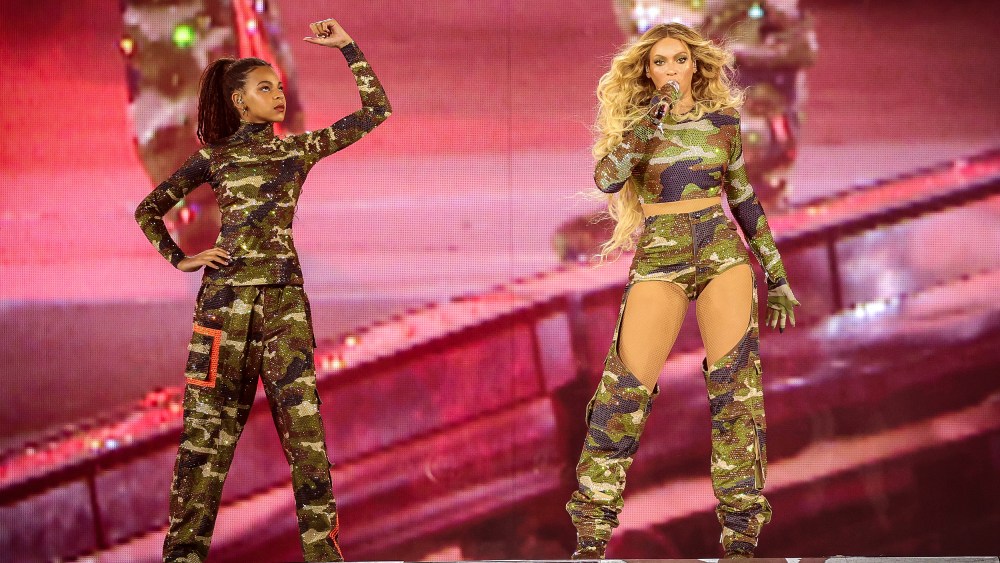
The film also chronicles the ascension of another star in Beyoncé’s orbit: Blue Ivy Carter, the 11-year-old daughter she shares with rap titan Shawn “Jay-Z” Carter.
The film also chronicles the ascension of another star in Beyoncé’s orbit: Blue Ivy Carter, the 11-year-old daughter she shares with rap titan Shawn “Jay-Z” Carter. We’ve been witnesses to Blue Ivy’s journey, from the moment Beyoncé announced her pregnancy on a stage at MTV’s VMA Awards, but this film spotlights her stepping into her own, defining herself for herself and learning herself along the way. At first, her megastar parents were hesitant about allowing their daughter to perform. “I did not think it was an appropriate place for an 11-year-old on the stadium stage,” Beyoncé says in the film. “All of the things I’ve had to go through, the obstacles I’ve had to overcome, prepared me. She hasn’t had that struggle.”
However, Beyoncé eventually relented, cutting a deal with Blue Ivy that if she rehearsed diligently with the tour’s other dancers, then she’d allow her to perform — once. When Blue Ivy rose from the stage’s lift in Paris on May 26 to dance alongside her mother to a medley of “My Power,” Kendrick Lamar’s “Alright” and “Black Parade,” it stunned the world. The child the Beyhive has jokingly called “the next Supreme” and “Beyoncé’s manager” was taking her rightful place on the world stage, declaring herself as the next heir to the Knowles-Carter musical kingdom.
However, the reception to Blue Ivy’s first stage appearance wasn’t completely positive. It’s hard being the child of two of the world’s most famous artists, and people put a lot of pressure on the 11-year-old to perform as flawlessly as her mother does.
Some of the criticism was cruel, which is likely not new for a child who’s been facing scrutiny since birth, but we see in the film that rather than shy away from the pressure, Blue Ivy let the criticisms of her performance fuel her instead. She rehearsed even harder and persuaded her parents to allow her to continue to perform. “When Blue Ivy started practicing and practicing and basically saying, ‘I’ll show you,’ that’s a Knowles right there,” Mathew Knowles, Beyoncé’s father and one of the architects of her career, says in the film. “That’s a Knowles right there.”

Beyoncé agreed, noting in the film that “Blue comes up fighting against the negativity that was put on her just because she was our kid. She was ready to take back her power.”
And, indeed, she did.
When Blue Ivy stepped on the stage at the show I attended in Las Vegas, the crowd screamed its support to her, and she soaked it up. She radiated confidence as she led the dancers down the ramp at the center of the stage, hit every dance move with ease and showcased her playful personality through her facial expressions. When we collectively shouted “Blue, Blue, Blue” at the end of her section of the show, she removed one of the earbuds performers wear to hear the music and seemed genuinely shocked at the amount of love she received.
Her mother is already a legend, an icon in a class singularly her own, and yet she’s unintimidated performing before 50,000; 60,000 and sometimes 70,000 people. That confidence is the dream for Black girls, who deserve to be loved, to be protected, to be encouraged to embrace their talents, and to be given every tool available to pursue their dreams.
“I feel like now, my mindset has changed,” Blue Ivy says in the film. “Now, I have to actually wake up in the morning and go to rehearsal. I have to actually work hard.” What she will likely realize, as she ages though, is that no amount of fame and wealth can protect her from a world that insists on tearing Black girls and Black women down. Even her mother, the most-awarded artist in Grammys history, faces that pressure simply because of who she is. As Beyoncé recounts in the film, she’s encountered obstacle after obstacle in her career of two decades, and even now, when she’s ascended to the top of the music industry, she’s still fighting for the modicum of respect she’s earned.
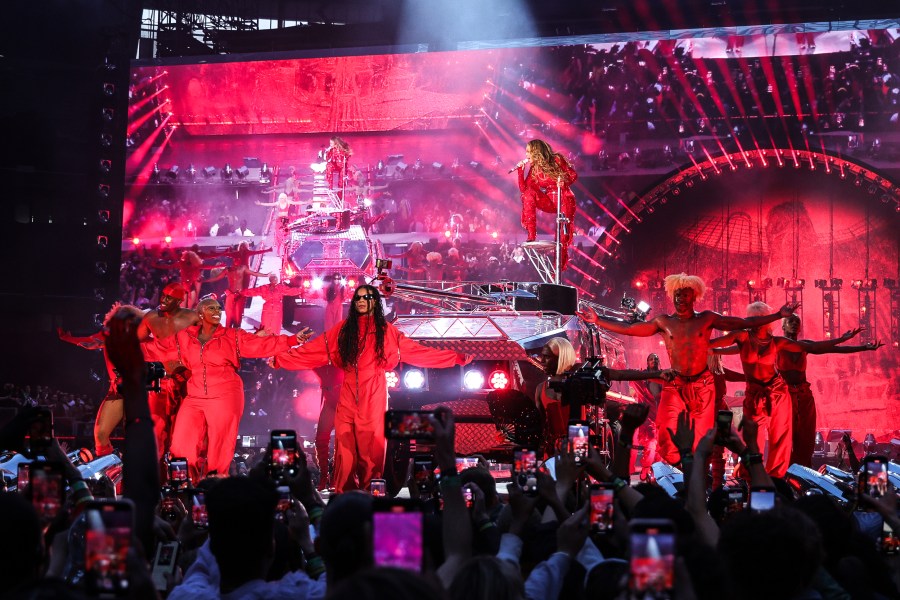
“Communicating as a Black woman,” she says, “everything is a fight.” Throughout the film, we watch people she’s hired to handle different parts of the show doubt her knowledge or declare that something that she already knows is possible isn’t. She gazes at them with a look that reads, “Do you know who you’re talking to?” and even that isn’t enough to make them back down. She’s still doubted, still treated as if her career is a matter of luck and not competence. “Eventually, they realize this bitch will not give up,” she declares. Who would want to subject their child to that extreme of being doubted at every turn?
Beyoncé and Jay-Z said they didn’t want to, but instead they trusted their Black child to chart her own future. It does the heart good to watch a Black family, especially one with as much fame and wealth as the Knowles-Carter family, insulate their Black girl child until she was ready to step into her power, and then, once she declared that she was, surround her with the right people, imbue her with confidence and set her up to succeed. If life is but a dream, then that is the dream for every Black girl who has a vision for herself. Blue Ivy is charting the course for the next generation, just as her mother once did for those of us who’ve watched her career. Destiny fulfilled.






Become a member to join the discussion