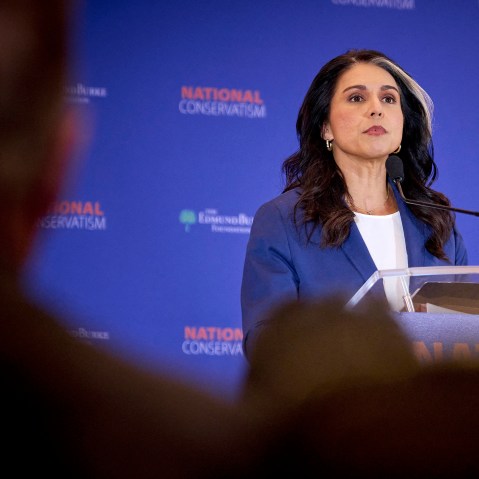
Senators on Monday confirmed one of their own, Marco Rubio of Florida, to be the next secretary of state and President Donald Trump’s first Cabinet member. Based on her performance in her own hearing on Tuesday, Rep. Elise Stefanik, R-N.Y., may soon follow suit as the U.S. ambassador to the United Nations. When answering questions from the Senate Foreign Relations Committee, there were only glimpses of the MAGA warrior she has molded herself into over the years.
Stefanik will have to contend with the rampage that Trump has already begun against anything resembling international constraints on U.S. interests.
Instead, Stefanik was informed about the workings of the United Nations and sounded overall like she’d represent some other administration than the one currently taking shape. Her appearance was at times a throwback to the performance that one of her predecessors, Nikki Haley, gave during her own confirmation hearing eight years ago. But unlike some of her fellow nominees, the gantlet of Senate confirmation will likely be the easy part for Stefanik. The job itself will be much harder.
At the U.N., Stefanik will have to contend with the rampage that Trump has already begun against anything resembling international constraints on U.S. interests. Among the many executive actions from his first day, Trump signed a pair of orders that fundamentally weaken American foreign leadership and will make it more likely that even allies think twice before signing on to any agreements with the United States.
The first executive order instructs the U.N. ambassador to immediately begin the process of withdrawing from the Paris Agreement on climate change — again. Trump pulled out of the treaty in his first administration as well, before Joe Biden reversed his decision upon taking office in 2021. This new executive order also orders America to pull out of any agreements made under the United Nations Framework Convention on Climate Change and cuts U.S. funding to the Intergovernmental Panel on Climate Change and various climate financing schemes.

(Since there’s no acting official tapped to head the U.S. mission to the U.N. right now, submitting the necessary paperwork to the relevant bodies will fall on Stefanik once she is confirmed.)
Trump also issued an order to facilitate America’s withdrawal from the World Health Organization. Trump likewise began this process previously, submitting his intention to leave the global health body in July 2020 during the height of the Covid-19 pandemic. Under domestic law, the process to leave the WHO requires a one-year notice from the U.S. and that “the financial obligations of the United States to the organization shall be met in full for the organization’s current fiscal year.”
There’s ambiguity in the order, though, about whether the Trump administration intends to comply with that law. It’s not clear if the White House thinks the original one-year timer kept going despite Biden’s order revoking the withdrawal. It also isn’t clear whether Trump’s director of the Office of Management and Budget will immediately withhold the funding that’s due to the WHO despite what the law says.
The phrase “strategic ambiguity” is often used to describe American policy toward China and Taiwan, where the U.S. never makes entirely clear how far it will go toward defending the island from the mainland. But that’s a very specific case of balancing competing interests. What we’re seeing from Trump is a much more random ambiguity that is bad for international relations. Withholding clarity gives other actors the chance to fill in the blanks in ways that may lead to misunderstandings that can be downright dangerous.
In the absence of long-term guarantees, it is hard to see how states will want to come to the negotiating table with America
The back-and-forth over the Paris Agreement and the WHO and whichever other international bodies come under fire next is detrimental to the U.S. in both the short and long run. In the short term, it is entirely self-defeating to remove America’s diplomats and resources from a pool of resources that are meant to combat truly global threats. Pandemics and climate change don’t care about lines drawn on a map, as we’ve seen over the last five years.
In the long term, treaties and other vehicles of international law are meant to be the antithesis of ambiguity. Each word is carefully chosen in high-stakes diplomatic meetings and enforced based on the idea that, absent a specified deadline, they go on in perpetuity. The liberal rules-based order that the United States has overseen since the end of World War II has depended on the idea that these agreements are negotiated in good faith with nations that intend to abide by those words.
In the past, with rare exceptions, treaties and other international agreements have mostly held firm under successive administrations. That’s not been the case over the last decade, as changes in U.S. administrations have prompted a global whiplash and uncertainty over just how long any agreement might last. In the absence of long-term guarantees, it is hard to see how states will want to come to the negotiating table with America, absent the exact sort of bullying threats that Trump specializes in issuing but often fails on following through on.
This is the task Stefanik will be charged with undertaking at the United Nations should the Senate confirm her. Her predecessors in the last Trump administration had to convince their fellow diplomats that they could speak on the president’s behalf. This time around, Stefanik will have to convince allies that any new agreement with the U.S. is worth the paper that it’s printed on.