During Donald Trump’s first term, the president and his White House team showed at least some apprehension about having accused racists and white nationalists in key positions of influence. In the Republican’s second term, however, the standards are … different.
For example, Team Trump tapped Paul Ingrassia, a right-wing lawyer and former podcast host, to lead the Office of Special Counsel, despite his history of radicalism, including a group text in which he acknowledged having a “Nazi streak.” Similarly, the president and his team tapped Darren Beattie for multiple positions in the administration, despite a lengthy record of inflammatory and racist remarks.
And then there’s Jeremy Carl, Trump’s nominee for assistant secretary of state for international organizations, who has a similarly offensive background, and whose nomination just collapsed. Reuters reported:
President Donald Trump’s nominee for a senior State Department position withdrew from consideration on Tuesday after his controversial comments about Jewish people and diminishing white power stirred rare Republican opposition to the president’s choice.
In a statement on X, Jeremy Carl, Trump’s nominee for assistant secretary of state for international organizations, thanked Trump and Secretary of State Marco Rubio for their support, but said their backing was not sufficient.
The demise of Carl’s nomination was all but inevitable after senators learned about his highly provocative record, which included publishing online commentary suggesting the Capitol rioters of Jan. 6, 2021, were treated worse than Black people in the South during the Jim Crow era. He’s similarly championed the “great replacement” conspiracy theory and condemned white people who celebrate Juneteenth.
“We are essentially moving,” Carl told Tucker Carlson in April 2024, “to what is effectively a post-white America.”
In case that wasn’t quite enough, Carl has also criticized Jewish people for wanting to “relitigate” the Holocaust, while claiming that Jews are “overrepresented” in the ranks of American billionaires.
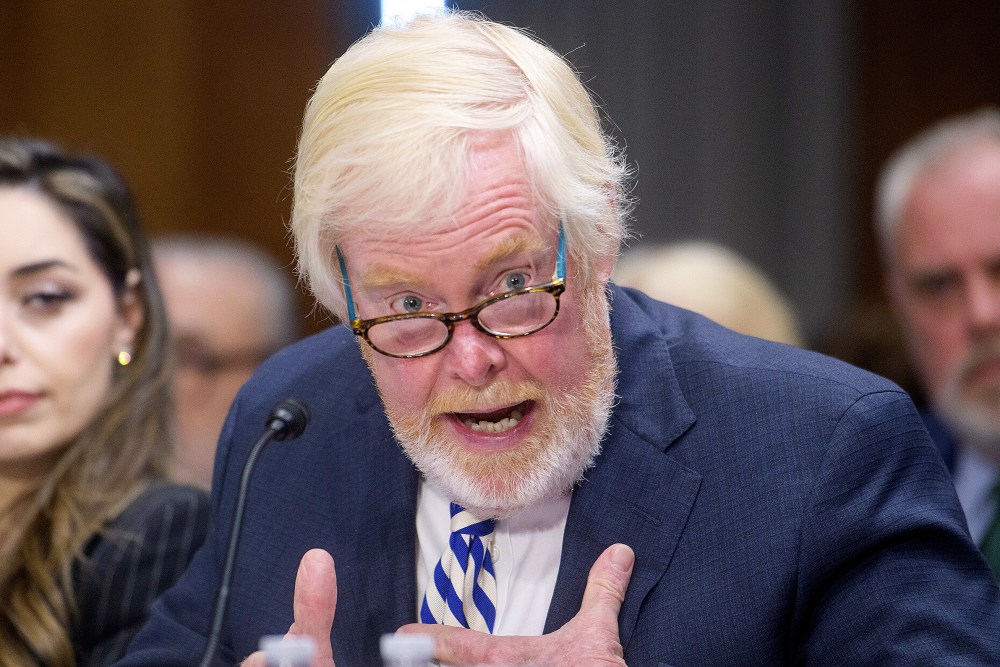
In a normal and healthy political environment, these revelations would have led the White House to pull the nomination. But Carl held onto Trump’s backing and subjected himself to a Senate Foreign Relations Committee grilling last month, where Democratic Sen. Chris Murphy of Connecticut asked him about his stated concerns regarding “the erasure of white culture.” To put it mildly, Carl struggled to defend his right-wing worldview.
In a separate exchange with Democratic Sen. Cory Booker of New Jersey, Carl also said, “One of my weaknesses … is sometimes I take an idea too far. I made some comments … about minimizing the effects of the Holocaust that were absolutely wrong.”
After the hearing, one Senate Republican, Utah’s John Curtis, announced his opposition to the nominee, which was consequential: While the Utahn was just one member, the GOP only has a one-vote advantage on the Foreign Relations Committee, and without Curtis’ backing, Carl didn’t have the votes to advance to the Senate floor. Seeing the writing on the wall, the nominee had little choice but to drop out.
But as the dust settles on this avoidable fiasco, three broader questions hang overhead: Why in the world did the president nominate this guy in the first place; who did the vetting on Carl; and why did Trump continue to support Carl’s doomed nomination in light of everything we’ve learned about his indefensible worldview?
This post updates our related previous coverage.